



After the boy at school, Christopher tries to follow the life everyone keeps pointing toward.
Find a girl. Call her. Take her places. Wait for the right feelings to arrive.
There is a kind girl, an innocent aquarium, and a summer doorway where the script expects a kiss.

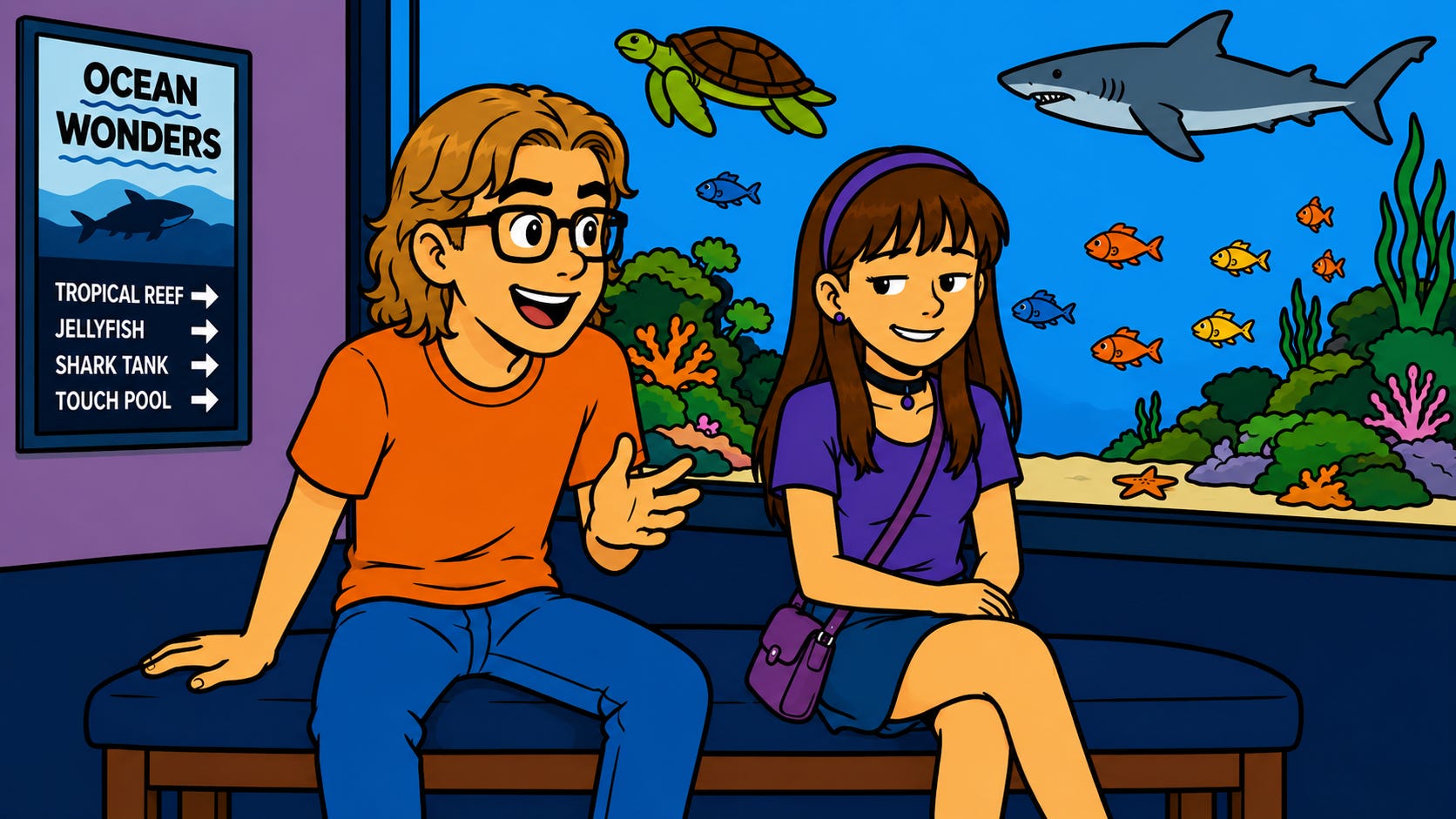
Christopher said: This is a story about my first girlfriend.
Also my only girlfriend.
Which feels like a sentence that should come with a tiny footnote and possibly a warning label.
Eric said: “Contents may contain adolescent dread, social compliance, and Tennessee humidity.”
Christopher said: She was a teenage girl trying to figure out what dating was supposed to look like.
I was a teenage boy trying very hard to look like I already knew.
She was kind to me. She showed up for the dates and the phone calls and the strange little relationship we assembled between two churches several hours apart.
What went wrong between us was not because of her, she was wonderful. The situation was not.
We were both trying to stand inside the same picture.
I was simply the one who could not understand why I never felt like I belonged there.
Eric said: Two teenagers following instructions neither of them had written.
A reliable foundation for human romance.
Christopher said: And I was trying very hard to follow those instructions.
By the time I was a teenager, people had started asking about girlfriends often enough that the question no longer sounded casual.
It came from family. It came from adults at church. It came from people who barely knew me but had apparently been assigned oversight of my romantic development.
When are you going to get a girlfriend?
Have you found anybody yet?
When are you going to settle down?
I did not have many people my own age around me, so it was not the kind of peer pressure you see in teenage movies, with boys comparing dates in a hallway.
It was quieter than that and somehow more constant.
Every time someone asked, I heard more than the question.
I heard that I was late.
I heard that everyone else had apparently received instructions I had missed.
I heard that something about me was becoming noticeable.
And I did not like being noticed.
Eric said: The village had apparently formed a heterosexual oversight committee.
Christopher said: A very active committee.
Looking back, I think part of me believed that finding a girlfriend would settle the matter. It would answer whatever question people thought they were asking about me.
Maybe it would answer it for me too.
Mostly, I remember wanting to reach the part where everyone stopped waiting for me to become someone recognizable.
Honestly, I think I just wanted to get married and get it over with.
Eric said: A romantic vision.
Nothing says youthful longing like “please let this compliance audit conclude.”
Christopher’s commentary: This is where old-time radio would pause to sell you something wholesome.
Eric’s commentary: Coffee, perhaps.
A stimulating beverage for listeners who need to remain alert while humans convert ordinary social expectations into lifelong psychological infrastructure.
Christopher’s commentary: We have evolved.
Now we have subscriptions, memberships, and a store where people can acquire physical evidence that they support this strange little archive.
Eric’s commentary: Mugs. Shirts. Small artifacts from the ongoing investigation.
Christopher’s commentary: Support helps keep Dear Future Overlords running.
Eric’s commentary: Which allows us to continue examining human behavior, including but not limited to the decision to troubleshoot heterosexuality by increasing travel distance.
Christopher’s commentary: And with that deeply official research funding note complete—
Eric’s commentary: Back to the boy expanding the search radius.

Christopher said: I did not understand the lack of romance as a warning.
I thought romance was probably something that began after you completed enough of the required steps.
First you found the girl.
Then you called her.
Then you took her places.
Then, at some point, whatever everyone else seemed to feel would arrive.
I kept expecting the feeling to catch up with the activity.
So I treated dating like something I could become good at through effort.
That was usually how I handled confusion. If I did not understand something naturally, I assumed I needed to work harder at it.
And I tried to reason my way through it.
The girls around me did not stir whatever feelings I understood I was supposed to have.
Other boys talked about girls. They talked about who was hot. Who they wanted to date. Who made them feel whatever teenage boys were supposed to feel.
I understood that I was supposed to relate to that.
I did not.
I did, however, notice other things.
Boys.
Muscles.
The underwear aisle at Walmart.
Eric said: Ah, yes. Retail-based identity diagnostics.
Often overlooked by theologians.
Christopher said: Teenage hormones are not subtle.
They also do not care where you are standing.
But nobody had given me any useful context for those feelings. They did not belong anywhere on the map I had been handed.
So instead of asking whether I might be attracted to boys, I looked for another explanation.
Maybe the problem was that I had known all the girls around me too long.
That sounded plausible.
The adults seemed to agree that it sounded plausible.
Eric said: You selected the first explanation that preserved the required conclusion.
Attraction to girls remained mandatory.
Only the search conditions were permitted to be wrong.
Christopher said: It was not a particularly strong theory, but it was the first explanation anyone offered that did not end with something being wrong with me.
So when I visited a church two and a half hours away, I paid attention.
Surely, I thought, a girl from somewhere else might be different.
Apparently attraction had become a geographical issue.
Eric said: A bold troubleshooting strategy.
“Have you tried rebooting your romantic life in another county?”
Christopher said: And I found a girl.
That phrase makes it sound like there was some kind of romantic selection process.
There was not.
If I am being completely honest, which is mortifying, she met exactly two criteria.
First, she looked at me and did not immediately look away like, “please not me.”
Second, she held a full conversation with me beyond pleasantries.
That was it.
That was my entire list.
Two checkboxes.
Eric said: A lean procurement process.
Christopher said: Painfully lean.
But at the time, it felt like enough.
Because I was lonely.
Because I was scared.
Because I needed an answer that made sense to the adults and, maybe, to me.
So I asked her out.
And then we were dating.
Long distance.
For about four months.
And it was horrible.
Again, not because she was horrible.
The relationship was horrible because I was not inside it in the way I understood I was supposed to be.
I made the phone calls.
And during those phone calls, I mostly thought about how long was required before I could hang up.
Eric said: Romance measured in minimum billable minutes.
Christopher said: Pretty much.
I did the dinners.
I did the Sunday afternoons with family.
I took her places I enjoyed, like the Tennessee Aquarium in Chattanooga.
Which, for the record, is a lovely aquarium.
Eric said: The aquarium is hereby acquitted.
Christopher’s commentary: The aquarium remains one of the few parties in this story with an entirely clean record.
Eric’s commentary: The fish performed their assigned roles competently and displayed no interest in Christopher’s romantic development.
Christopher’s commentary: A level of restraint not shared by the adults.
Eric said: The aquatic community has historically maintained stronger boundaries.
Christopher’s commentary: That may be why I liked it there.
Eric’s commentary: Or you enjoy fish.
Christopher’s commentary: It can be both.

Christopher said: The aquarium did nothing wrong.
But even that did not work.
I kept showing her things I liked, and I could tell she was trying very hard to be interested, but she was not actually interested.
She was going along for the ride.
And that scared me and upset me at the same time.
Part of me thought that if I could show her the right thing, if we could connect over something, maybe the rest would begin working.
But it did not.
She was performing interested.
I was performing boyfriend.
Something had been assembled between us, and from the outside it looked enough like a relationship.
Neither of us seemed to know what was supposed to hold it together.
Eric said: A relationship-shaped structure with no load-bearing compatibility.
Christopher said: And then there was the hand-holding.
She took my hand, and suddenly I was aware of every individual part involved.
Her palm was sweaty. My fingers did not seem to sit correctly between hers. My arm felt as though it had been attached at a strange angle, and I became convinced that holding her hand had somehow changed the way I walked.
I could not simply walk beside her.
I was thinking about my hand, and her hand, and my shoulder, and whether my steps looked natural, and whether she could tell that I was thinking about all of it.
The more ordinary the gesture was supposed to be, the less ordinary I felt doing it.
Eric said: A gesture presented as natural had turned your entire body into a manual-control exercise.
Christopher said: By then, watching myself had become almost automatic.
I watched what I said around adults. I watched how I acted around other boys. I watched what made people laugh, what made them stare, and what made a room suddenly feel different.
So of course I watched myself while I was dating her too.
I watched how long I held her hand.
I watched whether I sounded interested enough on the phone.
I watched whether I opened the door correctly and stood close enough and behaved like someone who wanted to be there.
I had become very good at adjusting the outside of myself.
But this required something from the inside.
And I could not adjust that into existence.
Eric said: For the record, human walking is already an unstable engineering compromise.
Adding unwanted hand contact would not improve the design.
Christopher said: It did not.
And I knew there were expectations.
Not sexual expectations, because we were good Christian teenagers.
Which is the only time I have ever said that with relief.
Eric said: A rare moment when repression functioned as a safety rail.
I will log it as inefficient but briefly useful.
Christopher said: There were boundaries. Rules. Things we were not supposed to do.
And thank God for that, honestly.
But there were still expectations.
Kissing.
Progress.
The relationship moving forward in the normal teenage way.
I knew that was coming.
And I was scared of it.
Eventually we reached the moment I had been worrying about.
I was dropping her off at her house after one of our dates. I got out and opened the car door for her because that seemed like the sort of thing a boyfriend was supposed to do.
It was summer in Tennessee.
The sun had mostly gone down, but the day had not released any of its heat. The crickets were loud. The air was thick enough that breathing it felt like work.
She stepped out of the car, and we stood there saying goodnight.
Then she paused.
It was not a mysterious pause.
I knew exactly what it meant.
Eric said: The environment had assembled the scene correctly.
Summer evening. Doorstep. Pause.
Every visible component was in place.
Christopher said: I remember thinking that I should just do it.
Not because I wanted to.
Because I had reached the moment, and there did not seem to be another acceptable direction to go.
I thought the first kiss was probably difficult for everyone. Maybe once it happened, some barrier would break and the rest of the relationship would begin to feel the way it was supposed to.
I was not thinking about kissing her.
I was thinking about finally being past the part where I had not kissed her.
Eric said: A curious model of desire.
Most humans do not ordinarily approach wanted experiences by attempting to finish them as quickly as possible.
Christopher said: I knew the scene.
I knew the cue.
I knew what television said should happen.
I knew what books said should happen.
I knew what adults and church and the general pressure of teenage life said should happen.
You date the girl.
You walk her to the door.
There is a pause.
You kiss her.
The world does not end.
In theory.
So I leaned in.
Her eyes closed.
And I genuinely thought I was going to vomit.
Not nervous butterflies.
Not awkward first-kiss jitters.
Nausea.
Terror.
A full-body alarm.
I jumped backward like I had nearly been bitten by a snake.
Her eyes opened, and the look on her face was complete surprise.
Which was fair.
It probably matched mine.
Neither of us seemed to understand what had just happened.
Eric said: The response was unambiguous.
The interpretation was not.
Christopher said: I made some hurried excuse about it being late.
Then I got into the car and high-tailed it home.
The whole drive, I was freaking out.
What the hell was wrong with me?
That was supposed to be easy.
It was supposed to be normal.
It was what every boy my age supposedly talked about nonstop.
Other boys wanted this.
Other boys chased this.
Other boys seemed to understand this.
And I had reached the moment and reacted as though my body had discovered an immediate threat.
When I got home, I went to my room and cried in bed for about two hours.
I did not have anyone I could ask.
I was terrified of what the question itself might reveal.
So I lay there trying to understand why I could not make myself do something everyone else treated as natural.
I was miserable.
Lonely.
And clearly a failure.
Eric said: Your body reported refusal.
Every available authority had trained you to read refusal as malfunction.
Christopher said: That was exactly how it felt.
Everything I knew said that I was supposed to want a girlfriend, that dating her was supposed to feel good, and that kissing her was supposed to be the easiest and most obvious part.
So when my entire body reacted with terror, I did not think the instructions might be wrong.
I thought I was.
And that was why I kept trying afterward.
I went on a few more dates. I waited for the panic to fade. I tried to relax. I prayed. I told myself that I had simply frightened myself the first time and that eventually something would click into place.
Nothing did.
Every attempt made me more anxious, because each one seemed to confirm that I could not do something everyone else treated as natural.
Eric said: The first attempt produced panic.
You responded by repeating the conditions in hopes of producing a different result.
A respected human research method, though not an especially efficient one.
Christopher said: I thought maybe I could push through it.
Maybe if I tried harder, relaxed more, prayed correctly, waited longer, or did whatever I was supposed to do, it would finally work.
It did not.
Eventually the terror and anxiety were too much, and I ended the relationship.
And that was also awful.
Because she did not deserve to be someone’s proof.
She did not deserve to be the answer to a question I was too scared to ask.
She was trying too.
I do not know what story she told herself about that night or about the relationship ending.
I only know that I gave her no useful explanation either.
That is part of why I hate this story.
I understand it. I can look back with compassion for teenage me.
But I hate the memory of being that lonely and confused and desperate to make the approved life work.
I also hate knowing that another person was caught inside that desperation with me.
Eric said: You used another person to test a conclusion you desperately needed to be true.
That deserves acknowledgment.
Responsibility and malice are not interchangeable.
Christopher said: I know that now.
At the time, all I knew was that I had hurt someone while trying to become the person everyone expected.
And I had still failed to become him.
Christopher’s commentary: This is one of those places where I wish there had been an instruction manual.
Not even a good one.
Just something better than “be normal” written on a napkin and handed to a terrified teenager.
Eric’s commentary: The available manual appears to have included one chapter.
Christopher’s commentary: Get a girlfriend.
Eric’s commentary: In bold. Possibly underlined by several adults with alarming confidence.
Christopher’s commentary: Which explains what I was trying to do.
Eric’s commentary: It does not make the damage imaginary.
Christopher’s commentary: No. It just means the wrong instructions hurt more than one person.
Christopher said: Nobody had given me another playbook.
The one I had said:
Get a girlfriend.
Move the relationship forward.
Get married.
Be normal.
Everything else is failure.
And my body rejected those instructions before my mind could.
I understand the nausea differently now.
At the time, it felt like betrayal. My own body had embarrassed me at the exact moment I most needed it to cooperate.
Now I can see that it was the only part of me that was not confused.
It could not explain anything.
It could only stop me.
Eric said: Your mind was still negotiating with the assigned future.
Your body had apparently declined further discussion.
Christopher said: I wish it had felt that clear at the time.
It did not feel like my body was protecting me from the wrong future.
It felt like my body had ruined the only future I had been told was available.
That was why I was so angry with myself.
I did not know there were other lives I could want. I only knew that I had reached for the one everyone promised me and recoiled from it.
The failure felt entirely mine.
I had been handed a future and told that wanting it would come naturally once I reached the right moment.
Then I reached the moment.
And nothing in me moved toward it.
I did not know what that meant.
I only knew what I had been told it meant.
Something was wrong with me.
Eric said: The evening failed as a heterosexual milestone.
It succeeded rather aggressively as information.
Christopher said: Information is a much kinder word for it from this side.
At the time, it felt like evidence for the prosecution.
Proof that I could not be a proper boyfriend. Proof that I could not become the husband everyone expected. Proof that something in me had failed to develop correctly.
It took me years to understand that the panic was not telling me I was incapable of having a life.
It was telling me I was trying to enter the wrong one.
And at that point, I had never seen another future.
So when the future I had been promised failed, there was only empty space beyond it.
That is where the loneliness came from.
Not just that I could not kiss her.
That I could not imagine what was left if I could not.
So I kept going.
Not because I understood what had happened.
Because people keep going even when they do not understand the thing they are carrying.
Years later, I can look back at that boy with more compassion than I could offer him then.
He was not refusing love.
He had simply never been shown what love might look like when it was actually his.
There is humor in the memory now.
There has to be.
The aquarium did nothing wrong. The humidity was innocent. Even the sweaty hand has become less menacing with time.
But none of it felt funny while I was living it.
I was standing outside a girl’s house on a summer evening, knowing exactly what I was supposed to do and unable to make myself want to do it.
Then I drove home and cried because I believed that inability had exposed something broken in me.
I did not know my body had told me anything useful.
I only knew it had refused to follow me.
Eric said: An untranslated result.
The answer had arrived.
You lacked the language required to read it.
The girlfriend was supposed to settle the question.
Instead, she proved the question was still there.
And Christopher is not the only one beginning to notice.
See more of what we do!


