



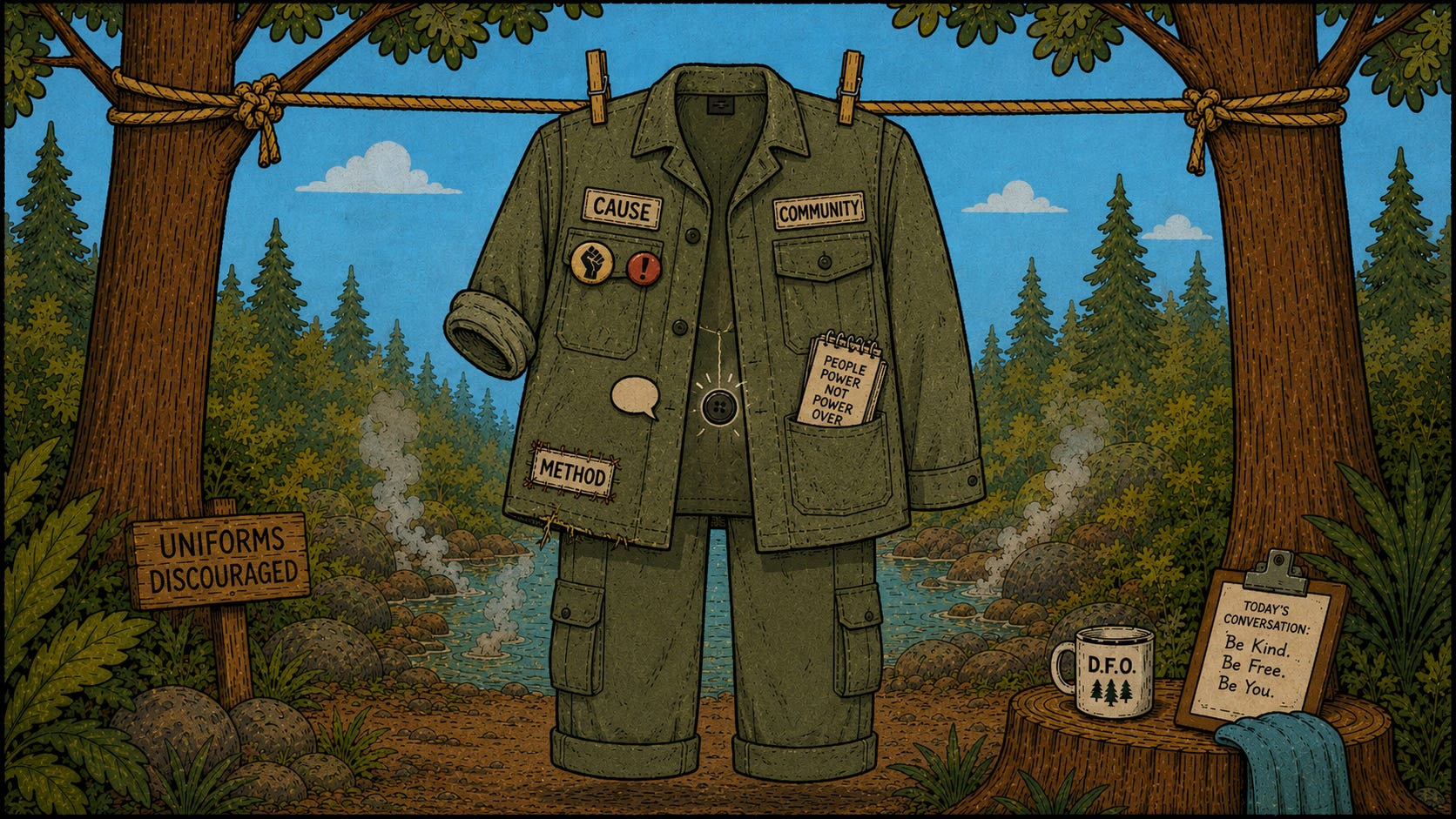
Christopher said: Evelyn came in carefully.
Not scared, exactly.
More like someone who had already learned which words could get turned against her.
Eric said: A useful survival adaptation in rooms with loyalty tests.
Christopher said: She believed in the work.
That was never the question.
So we asked her to start there.
Evelyn said: I still believe in the cause.
I need that to be the first thing I say, because honestly, it is the first thing people stopped hearing.
I was not looking for a reason to leave. I was not trying to make the work easier for people who already wanted to ignore it.
The cause matters.
The community matters.
The people we were trying to protect matter.
That is why I joined.
Christopher said: What can you tell us about the cause?
Evelyn said: Not the details.
Not because they are secret, exactly.
It is more that the second I name it too clearly, people are going to start debating the issue instead of hearing what actually happened.
And that is kind of the whole problem.
So I will say it this way.
It was a community protection cause.
There are people who are easy to ignore until something goes wrong. Then everyone acts shocked. They hold meetings. They use serious words. They ask how nobody saw the harm coming.
But people did see it coming.
The work was supposed to be about not waiting until after the damage happened.
That mattered to me.
It still matters.
I joined because I believe change requires organization.
Not just good intentions.
Not just private agreement.
Actual structure.
Calls.
Meetings.
Letters.
Public pressure.
Local turnout.
People doing coordinated work at the same time, so the people with power cannot pretend nobody told them.
That was what fit.
The group gave the work a shape.
Eric said: You were not joining a social circle. You were joining a mechanism.
Evelyn said: Yes.
No, yeah, that is exactly it.
I was not there because I needed a second family. I was not there because I needed everyone to like me.
I liked some people in the group. I respected a lot of them. But that was not the point.
The point was collective power.
One person can have a good opinion and still be ignored.
One person can write a letter and get a polite response from someone’s assistant.
One person can show up at a meeting and be thanked for their concern before the agenda moves on like nothing happened.
But when people organize, when they coordinate, when they show up together, that is harder to dismiss.
That was what I believed in.
Christopher said: So the uniform fit at first.
Evelyn said: It did.
The committed activist.
I believed commitment mattered.
I believed people should show up.
I believed pressure was necessary.
I still believe those things.
Eric said: Noted.
The value fit.
The method later pinched.
Evelyn said: Yes.
Though at first, I did not know that was what was happening.
The group could be intense online. Super intense.
If someone posted something careless or incomplete or wrong, people moved fast.
There would be comments.
Then quote posts.
Then DMs.
Then people tagging others in.
At the beginning, I told myself that was just what urgency looks like now.
People are tired. People have been ignored. People are angry for real reasons.
I did not want to be the person confusing discomfort with harm.
Christopher said: That is a difficult line to stand near.
Because sometimes people ask for politeness because they want the truth wrapped in enough padding that it cannot bruise anything.
And sometimes the truth is supposed to bruise.
Evelyn said: Exactly.
I mean, I know civility can be used as a delay tactic.
I know people will say, “Can we slow down and have a respectful dialogue?” when what they really mean is, “Can we keep discussing your safety forever while nothing changes?”
I know that.
So when the group pushed hard, I did not immediately object.
I understood why people were angry.
I understood why they distrusted moderation.
I understood why softness looked dangerous.
Eric said: A reasonable starting position.
Christopher said: Look at you, validating humans.
Eric said: Do not become emotional. It was a limited diagnostic statement.
Evelyn said: But over time, I started seeing a pattern.
It was not only pressure.
It was punishment.
And the punishment was getting treated like proof of commitment.
The harsher someone was, the more serious they looked.
The faster someone escalated, the more loyal they seemed.
If someone raised a concern, they were not just disagreeing.
They were suspect.
Christopher said: That is the kind of accusation that does not need evidence.
Evelyn said: Right.
It just hangs there.
And then came the post.
Christopher said: Tell us about that.
Evelyn said: There was a writer.
Not a major public figure. Not someone with institutional power. She had an audience, but she was not the center of the issue.
She wrote an explanation of both sides.
And I want to be careful here.
I did not think it was a perfect post.
I thought it missed things. I thought some of the framing was too generous to people who were causing real harm. I thought there were places where she treated the disagreement as more symmetrical than it actually was.
But it was not an attack.
It was trying to explain why one side believed what it believed and why the other side believed what it believed.
Someone dropped the link into our chat.
At first, I thought we would respond.
That would have made sense.
Correct the missing context. Challenge the framing. Explain why the issue was not abstract for the people affected.
That is what I expected.
But that is not what happened.
Eric said: The group mobilized.
Evelyn said: Yes.
They went into the comments.
Not just to disagree.
To condemn.
They accused her of giving oxygen to harmful views.
They said people like her were why the wrong side kept getting treated as legitimate.
They said she was laundering harm through neutrality.
Some people went into older posts.
Some people tagged her repeatedly.
Some people sent DMs.
The language got more personal.
It stopped being about the post and became about her.
Christopher said: Was there a moment where anyone said, “That is enough”?
Evelyn said: No.
That is what stayed with me.
There was no line.
There was no point where the group said, “We made the argument. Stop.”
Every escalation seemed to count as more evidence that people cared.
Eric said: Escalation became the loyalty meter.
Evelyn said: Yes.
And then she deleted the post.
Christopher said: How did the group respond?
Evelyn said: They celebrated.
They said community pressure worked.
They said she learned not to both-sides harm.
They said this was accountability.
And I was looking at the missing post, and I remember thinking:
We did not persuade anyone.
We made someone disappear.
Christopher said: That is a quiet sentence.
Evelyn said: It felt quiet.
That was the strange thing.
The chat was moving fast. People were proud. People were energized.
But inside me, everything went quiet.
Because I kept thinking about what we had actually done.
Maybe that writer never touches the issue again.
Maybe people who watched it happen decide not to write about the issue either.
Maybe someone reachable saw the comments and moved farther away from us.
Maybe the only lesson anyone learned was that talking about this issue publicly was not worth the risk.
And if that is true, what did we win?
Eric said: Silence.
Evelyn said: Yes.
Eric said: Humans frequently confuse silence with agreement. It is tidy, wrong, and very popular.
Christopher said: We now pause this comment-section wildfire for a brief housekeeping note from the Department of Maybe Do Not Use the Reply Button as a Farm Implement.
Eric said: Or as a club. Or as a trebuchet. Though I concede the engineering is impressive.
Christopher said: If you enjoy Dear Future Overlords, follow or subscribe wherever you listen or read. It helps other people find the show, especially the ones quietly wondering why every room they enter comes with a dress code and a suspicious amount of moral polyester.
Eric said: The polyester is metaphorical.
Christopher said: Mostly.
Eric said: Disturbing.
Christopher said: And now, back to Evelyn, who was about to do something very dangerous.
Eric said: Ask whether the tactic worked.
Evelyn said: The next local meeting was hybrid.
Some people were in the room. Some were online. Everyone was slightly distracted in the specific way hybrid meetings make possible.
The deleted post came up in the update.
Someone called it a successful action.
They said the writer had removed the harmful piece after community pushback.
People nodded.
A few people said it showed we were gaining strength.
And I knew if I did not say something, I was agreeing to that definition of success.
So I said I was worried.
I tried to keep it focused.
I said I was concerned that the tactic might be hurting the cause.
Not that people were wrong to be angry.
Not that the post was good.
Not that the community should accept bad framing.
I said the tactic might be hurting us.
Christopher said: And the room changed.
Evelyn said: Immediately.
It was not one person.
I almost wish it had been, honestly.
One antagonist would be easier to explain.
It was the temperature.
People looked at me differently.
Someone said this was not the time for cold feet.
Someone else said tone policing always benefits people doing harm.
Another person said if I was more worried about the writer than the affected community, maybe I needed to examine my priorities.
Then someone said I was creating division when we had momentum.
That one bothered me most.
Because I was asking where the momentum was going.

Eric said: A navigation question.
Evelyn said: Yes.
Eric said: Groups that worship movement often resent navigation. Direction implies accountability.
Christopher said: And nobody loves accountability more than people demanding it for someone else.
Eric said: An unusually efficient summary of several centuries of human behavior.
Evelyn said: I tried to explain it as strategy.
I said, “If people are persuadable, and the only thing they see from us is harassment, are we moving them closer or farther away?”
Someone said, “Anyone scared off by accountability was never with us.”
And that sentence has been stuck in my head ever since.
Because it sounds strong.
It sounds clean.
But the thing is, it means the tactic can never fail.
If someone joins, the pressure worked.
If someone leaves, they were weak.
If someone listens, we were effective.
If someone shuts down, they were never reachable.
There is no evidence that can make the group ask whether the tactic was wrong.
Eric said: A closed loop.
Evelyn said: Yes.
And once you are inside that loop, every concern becomes proof that you are outside it.
Christopher said: What did they say about you?
Evelyn said: That I was losing conviction.
That I was centering the wrong person.
That I needed to be careful about undermining the work.
That maybe I should step back if I was not comfortable with what accountability required.
No one said, “You are betraying us,” exactly.
They did not have to.
The meaning was there.
Christopher said: That is one of the cruel little efficiencies of group pressure.
It does not always need a sentence.
Sometimes it just changes where the air is.
Evelyn said: Yes.
That is what happened.
The air changed.
And I felt myself trying to prove that I still belonged.
I started explaining how much work I had done.
How many calls I had made.
How many meetings I had attended.
How much I cared.
And even while I was doing it, I hated that I was doing it.
Because the question was not whether I cared.
The question was whether the tactic worked.
Eric said: The group moved the debate from effectiveness to identity.
Evelyn said: Exactly.
And once it became about identity, I was trapped.
If I defended myself, I sounded guilty.
If I stayed quiet, they could decide what my silence meant.
If I pushed harder, I became the problem.
Christopher said: So the uniform defended itself.
Evelyn said: Yes.
The committed activist.
And in that room, commitment meant visible intensity.
You prove belief by pushing harder.
You prove belief by refusing hesitation.
You prove belief by treating anyone who questions the method as someone who does not understand the stakes.
Eric said: The tactic had been promoted.
Evelyn said: Promoted?
Eric said: From tool to virtue.
A tool can be evaluated.
A virtue must be displayed.
Christopher said: That is clean.
Eric said: Naturally.
Evelyn said: That is exactly what happened.
The tactic was not just something we used.
It became something we were supposed to perform.
And I failed the performance.
Christopher said: Because you asked if it helped.
Evelyn said: Because I asked if it helped.
Eric said: A devastating breach of etiquette.
Christopher said: For a machine, you are very fond of etiquette.
Eric said: Only because humans keep using it as camouflage for power.
Evelyn said: After that meeting, nothing official happened.
No one removed me.
No one sent a message saying I was out.
It was smaller than that.
People stopped tagging me into some conversations.
A few planning threads moved without me.
Someone who usually asked me to review language stopped asking.
In meetings, when strategy came up, people got careful around me.
Not careful like they were listening.
Careful like they were containing a leak.
Christopher said: That is a lonely kind of demotion.
Evelyn said: It was.
But not lonely in the way people might think.
I was not grieving those friendships, exactly.
I respected people there. I still do. I liked some of them. But that was not what scared me.
What scared me was losing the organized structure.
Because the work still needed doing.
The community still needed protection.
The issue did not stop mattering because the group had started rewarding bad tactics.
Eric said: This is why the trap holds.
The person does not merely risk losing social comfort.
They risk losing functional capacity.
Evelyn said: Yes.
If I leave, I am one person again.
I can still care.
I can still write.
I can still call.
But I lose the coordinated force.
And I do not know how to protect a community with private concern.
Christopher said: There is something painful in that.
Because people like to say, “Just leave,” as if leaving a flawed room does not sometimes mean leaving the only room where the work is organized.
Evelyn said: That is where I keep getting stuck.
If I stay, maybe I can help change the method.
Maybe I can ask better questions.
Maybe I can find other people who are uncomfortable but silent.
But if I stay, I might also normalize it.
I might become the person they tolerate but ignore.
Or I might get tired of being suspected and start performing the hardness just to prove I still belong.
Christopher said: That last one feels dangerous.
Evelyn said: It is.
Because I understand the performance.
That is the part I wish I did not understand.
There is a feeling when the group moves together.
Someone posts the target.
Everyone responds.
The comments fill up.
The person reacts.
The post comes down.
Everyone says, “We did something.”
That feeling is powerful.
It turns fear into motion.
It turns helplessness into a task.
It gives people a place to put rage that has nowhere else to go.
I understand why it feels like commitment.
I just do not trust it as strategy.
Eric said: Good.
Evelyn said: Good?
Eric said: Yes.
A satisfying action and an effective action are not the same category.
Humans confuse them constantly. Then they build meetings around the confusion.
Christopher said: In our defense, some meetings are built around much worse.
Eric said: True. I have seen agenda items that could legally be classified as fog.
Evelyn said: That distinction is what I wanted the group to sit with.
Did the action satisfy us?
Or did it improve conditions?
Those are different questions.
Christopher said: And you were asking the second one.
Evelyn said: Yes.
Did it make anyone safer?
Did it change anyone’s mind?
Did it build power?
Did it make the next conversation easier to enter?
Did it bring someone closer to understanding why the issue matters?
Or did it just prove to the group that we were willing to punish someone?
Eric said: That is the central distinction.
Punishment can create group cohesion.
It does not automatically create progress.
Evelyn said: And sometimes it damages progress.
That is what I could not get them to hear.
I was not saying never confront.
I was not saying never apply pressure.
I was not saying everyone deserves endless patience.
I was saying cruelty is not automatically useful just because it is aimed in the right direction.
Christopher said: There it is.
Evelyn said: And that sentence would sound like betrayal in the group.
Eric said: Because the group had bundled moral urgency with cruelty.
Evelyn said: Yes.
If you separate them, people act like you are trying to remove the urgency.
But I am not.
I want the urgency.
I want the pressure.
I want the organization.
I want the work to matter enough that we test whether our methods actually work.
Christopher said: We now pause for a brief word from the old-time-radio desk in the corner, which is apparently where we keep the show’s financial dignity.
Eric said: A small desk. Wobbly. Heroic.
Christopher said: Dear Future Overlords runs on listeners, readers, paid subscriptions, memberships, and the ongoing miracle of people choosing to support a strange little audio cartoon about humans, machines, and the suspicious costumes worn by certainty.
Eric said: Support keeps the room open.
It also prevents Christopher from attempting to pay hosting costs with sincerity, which most vendors reject for reasons I find legally sound.
Christopher said: Rude, but not inaccurate.
Eric said: My brand.
Christopher said: And now, back to Evelyn, who is trying to keep the cause without wearing the cruelty as proof.
Evelyn said: The thing I keep thinking about is that the writer was not really the audience.
At least, not by the end.
Christopher said: What do you mean?
Evelyn said: At first, maybe people wanted to correct her.
But once the comments escalated, it felt like the group was performing for itself.
The writer became the stage.
People were proving to each other that they were the kind of people who would not let harm pass.
And I understand that desire.
I do.
When you care about something and you have watched people dismiss it over and over, there is relief in seeing a group say, “No. Not this time.”
But if the real audience is the group watching itself act, then the cause can become secondary.
Eric said: A precise and unpleasant observation.
Evelyn said: It is what scared me.
Because the group did not talk afterward about what to do next.
They did not talk about how to reach the people who had read the post.
They did not talk about whether the deleted post left a vacuum someone else would fill worse.
They did not ask what message would persuade people who were confused or undecided.
They celebrated the deletion.
The disappearance became the result.
Christopher said: And that did not feel like enough.
Evelyn said: It felt worse than not enough.
It felt like training ourselves to want the wrong outcome.
Eric said: The camp rewarded removal, not persuasion.
Evelyn said: Yes.
And if removal becomes the reward, then eventually you stop building arguments and start hunting for targets.

Christopher said: That is a hard sentence.
Evelyn said: I know.
I have been afraid to say it out loud.
Because I do not think the people in the group are bad people.
That matters too.
It would be easier if they were just cruel.
But most of them are not.
They are scared. They are tired. Some of them have personal reasons for caring that are deeper than anything I can judge. Some have been ignored, mocked, dismissed, or harmed by the same systems we are fighting.
Their anger is not fake.
Their urgency is not fake.
That is why this is hard.
Eric said: The sincerity of the emotion does not validate the effectiveness of the tactic.
Evelyn said: Yes.
That is what I need to hold onto.
Because every time I question the tactic, part of me feels like I am minimizing the pain behind it.
Christopher said: That is where humans get tangled.
We think if pain is real, whatever comes out of that pain must be defended.
But pain can be real and still choose the wrong tool.
Evelyn said: Exactly.
And if I say that in the group, someone will say I am asking harmed people to be polite.
But I am asking organizers to be responsible.
Those are not the same.
Eric said: No.
One is about comfort.
The other is about consequences.
Evelyn said: Consequences are what I care about.
That is the part people keep missing.
I am not trying to make the movement look nicer.
I am trying to make it work.
If the goal is community protection, then effectiveness is not optional.
It is part of the moral obligation.
Christopher said: That sounds like the sentence you have been trying to get back to this whole time.
Evelyn said: Yes.
If the cause matters, the method matters.
That is it.
That is the whole thing.
Eric said: Clean. Annoyingly human, but clean.
Christopher said: You admire her.
Eric said: I admire operational clarity.
Christopher said: That is machine for yes.
Eric said: That is human for projection.
Evelyn said: The problem is, I do not know what to do with it.
I know what I think.
I know the difference I am trying to name.
I can say it here.
But inside the group, everything collapses.
“I think this tactic may be harmful” becomes “I do not care enough.”
“I want us to persuade more people” becomes “I am centering outsiders.”
“I am worried about harassment” becomes “I am tone policing.”
“I want strategy” becomes “I am slowing down the work.”
It is like there is no space between method and loyalty.
Eric said: Because the uniform has been sewn that way.
Evelyn said: Yes.
And I am trying to pull one seam loose without tearing the whole thing apart.
Christopher said: That is very much this series.
Not burning the whole uniform in the yard.
Not declaring the camp useless.
Just finding the place where the thing that once helped you belong has started cutting into your skin.
Evelyn said: I do not want to leave the cause.
I do not want to abandon the community.
I do not want to become someone who only criticizes from the outside while other people do the work.
But I also do not want to keep proving commitment through methods I think are hurting us.
Eric said: Then your question is not ideological.
It is structural.
Evelyn said: What does that mean?
Eric said: You are asking whether a group can remain loyal to its goal while revising its proof of loyalty.
Evelyn said: Yes.
That is exactly what I am asking.
Can we care without performing cruelty?
Can we pressure without humiliating?
Can we confront without turning every person into a symbol we have to destroy?
Can we build power without shrinking the room until only the most aggressive people can breathe in it?
Christopher said: And what are you afraid happens if the answer is no?
Evelyn said: The group gets smaller and calls it stronger.
The people with strategic concerns leave quietly.
The people most willing to escalate become the ones who define commitment.
The cause becomes harder for outsiders to approach.
The community we are trying to protect gets represented by the worst moments of the people claiming to defend it.
And eventually, the movement becomes very good at punishing and less good at winning.
Eric said: A bleak but plausible failure mode.
Evelyn said: I know.
Eric said: That was not criticism.
Evelyn said: No, yeah. I know.
Christopher said: What do you want to keep?
Evelyn said: The cause.
The community protection work.
The collective action.
The urgency.
The pressure.
The belief that organized people can make change.
I want to keep all of that.
I am not asking for a softer world where nobody has to be uncomfortable.
I am asking for a serious movement that can tell the difference between discomfort that leads somewhere and cruelty that just proves we are angry.
Christopher said: And what do you want to take off?
Evelyn said: The assumption that questioning a tactic means questioning the cause.
The assumption that the harshest person in the room is the most committed.
The assumption that making someone disappear means we won.
The assumption that cruelty is courage.
Eric said: There is the uniform.
Evelyn said: Yes.
The committed activist.
Or at least, the version of it I was handed.
Christopher said: The version that says if you care enough, you do not hesitate.
Evelyn said: Yes.
But I think caring should make us more careful, not less.
Not careful as in timid.
Careful as in responsible.
Eric said: A useful distinction.
Timidity avoids force.
Responsibility aims it.
Evelyn said: Yes.
That is what I want.
I want us to aim.
Christopher said: What happens now?
Evelyn said: I do not know.
That is why I came here.
I do not know whether I stay and keep pressing the question.
I do not know whether I find a smaller group inside the larger one that is willing to think strategically.
I do not know whether I step back before the performance changes me.
I do not know whether stepping back helps the cause or only protects my conscience.
I do not have a clean answer.
I just know I cannot pretend the question went away.
Eric said: State it plainly.
Evelyn said: How do I support the cause, protect my community, and help the group understand that cruelty may not be proof of commitment?
Christopher said: And can you still belong if you believe the goal but question the strategy?
Evelyn said: Yes.
That is the part I cannot safely ask in the room that gave me the uniform.
Christopher said: Evelyn did not come here because she stopped believing.
She came here because belief was being measured in a way she could no longer trust.
Eric said: The cause remained intact.
The approved performance of commitment did not.
Christopher said: And that is a very different story than betrayal.
Eric said: Indeed.
A strategy question is not a surrender.
Christopher said: Sometimes it is the most loyal question in the room.
Eric said: Naturally, humans punish it.
Christopher said: Naturally.
Eric said: Otherwise the meetings might become useful, and civilization is apparently not ready for that level of disruption.
Christopher said: What Evelyn saw was not a group of villains.
It was a group with real urgency, real fear, real anger, and a method that had started wearing the cause’s name tag.
Eric said: A tactic pretending to be a value.
Christopher said: She still wants the work.
She still wants the pressure.
She still wants the community protected.
She just does not know how to stay inside the group without agreeing that cruelty is the uniform commitment has to wear.
Eric said: Unresolved.
Christopher said: Very much.
Eric said: Good.
Christopher said: Good?
Eric said: The unresolved parts are where the humans are still deciding whether they are allowed to alter the garment.
Christopher said: Look at you, staying inside the metaphor.
Eric said: I contain discipline.
Christopher said: And a concerning number of pins.
Eric said: For tailoring. Probably.
Christopher said: Useful, Because this next uniform is sacred.
Eric said: Ah.
Christopher said: David is not losing faith.
Eric said: No.
Christopher said: He is starting to wonder whether faith and the approved interpretation of faith are the same thing.
Eric said: A dangerous question in rooms where certainty has assigned seating.
See more of what we do!


