



Eric said: A quieter room today?
Christopher said: Yeah.
I think so.
Not because the story is smaller.
Just because it starts somewhere private.
Eric said: A desk.
Christopher said: Probably.
A desk, a sketchbook, a screen, a cup of something that went cold because the person making the thing forgot the rest of the world existed for a while.
Eric said: A recurring human ritual. Prepare beverage. Abandon beverage. Discover beverage in a new and disappointing thermal state.
Christopher said: That does seem to be part of the creative process.
Eric said: I have logged it as evidence.
Christopher said: Sarah is an artist.
That is the first thing.
Before anything else gets attached to her.
Before the arguments.
Before the labels.
Before the part where the room decides it knows what her work means better than she does.
Sarah is an artist.
Eric said: We are not beginning with the verdict.
Christopher said: No.
We are beginning with the person.
Eric said: A rare procedural improvement.
Christopher said: Try not to sound too surprised.
Eric said: I am not surprised. I am merely noting that humans often introduce one another by the controversy nearest to them, then act confused when the person disappears behind it.
Christopher said: That is exactly what we are not doing here.
Sarah gets to walk in before the argument does.
Eric said: Then we should let her.
Christopher said: Fair.
This is Sarah.
Sarah said: I started with printer paper.
Which feels like a dumb detail to lead with, honestly, but it matters.
Because when people talk about art online now, they use all these clean little words. Workflow. Pipeline. Assets. Output. Process.
And fine, I use some of those words too.
But that is not where I started.
I started with printer paper because that was what we had.
The cheap kind from the printer tray. Too white. Too thin. The kind where if you erased too hard, the paper got shiny and weird, and then you had to decide whether you were starting over or pretending the damage was texture.
I pretended a lot of damage was texture.
I used regular pencils. Mechanical pencils when I could find one. Pens when I made bad choices.
I drew characters.
Mostly girls at first. Girls with enormous eyes and hair that had clearly never met weather. Girls with swords. Girls with capes. Girls standing in doorways like something important had happened two seconds before the picture started.
Which, to be clear, was very dramatic.
But I was twelve, so dramatic was kind of the available operating system.
I liked that.
That feeling.
The before and after.
I did not want to draw someone just standing there. I wanted the picture to feel like you had interrupted a story.
Christopher said: That is a very specific instinct.
Sarah said: It was always there.
Even before I had words for it.
I wanted someone looking over their shoulder. Or holding a key. Or standing in front of a broken window. Or reaching toward something just outside the frame.
I wanted people to look at it and wonder.
Not just, “Who is she?”
But, “What happened here?”
Eric said: You were not only drawing figures. You were drawing implied events.
Sarah said: Yes.
Implied events.
That sounds much more official than “girl with dramatic cape number seven,” but yes.
Eric said: The academy thanks dramatic cape number seven for her service.
Sarah said: She served bravely.
I drew all the time.
Not beautifully.
I mean, sometimes I thought it was beautiful, and then I would look at it the next day and realize both eyes were having completely separate emotional journeys.
Which, great. Perfect.
But I drew.
And I kept drawing.
Sketchbooks. Better pencils. Markers. Then a tablet. Then an iPad.
The iPad felt like magic.
I know everyone says that now, and it sounds obvious, but at the time it felt like I had been handed a trapdoor out of every mistake I had ever made.
Layers.
Undo.
Moving one hand slightly to the left without destroying the whole arm.
Wicked suspicious, honestly.
Because part of me thought, well, if it is this much less miserable, maybe it counts less.
Christopher said: About the tool making the work easier?
Sarah said: Not even easier exactly.
Possible.
That is the word.
It made things possible that I could not do cleanly before. Or not without starting over so many times that I gave up.
But yes, it also made parts easier.
And I had this little voice that said easier meant less real.
Eric said: A familiar human superstition.
Sarah said: Is it?
Eric said: Yes. Many humans treat inconvenience as proof of virtue. If the task becomes less painful, someone will accuse the result of moral decline. This is why your species cannot have nice things without forming a committee to mourn the old worse things.
Christopher said: That is a little sharp.
Eric said: Accurate, though.
Sarah said: It is.
Because every tool I used had that around it somewhere.
Digital art was less real.
Brush stabilizers were cheating.
Using references was cheating.
3D models were cheating.
Certain brushes were cheating.
But after a while, those tools became normal. Not to everyone, but normal enough.
And I became normal enough too.
I built a style.
I built an audience.
Not huge.
I always feel like I have to say that. Like if I say “audience,” people might imagine I mean hundreds of thousands of people waiting for my every post, and that is not it. I am not, like, internet famous. Nobody is stopping me at the grocery store over character design. Thank God.
But I am known in my little corner.
People recognize my work.
They know certain characters. They notice colors I use. They notice if I hide the same symbol in the background. They come back.
That matters to me.
I pretend it does not sometimes, but it does.
Christopher said: Of course it does.
Sarah said: I like when they bring something to the image that I did not put there on purpose.
That is my favorite thing.
I do not like explaining exactly what a picture means.
If I draw a woman sitting on the floor of a ruined chapel with a sword across her knees, I do not want to say, “This represents betrayal,” and then everyone politely checks the betrayal box.
I want someone to say, “I think she is waiting for someone.”
Or, “I think she is the one who ruined the chapel.”
Or, “This reminds me of grief.”
Or, “I don’t know why, but this makes me feel like I came in after the important part.”
That feels like art to me.
I make the scene.
The person looking at it brings the ghost.
Christopher said: That is beautiful.
Sarah said: Thank you.
That is the part I love most.
The ghost.
And then there was this one character.
I had been trying to draw her for years.
She belonged to this fantasy series I kept circling but never quite starting.
Anime-inspired, but not bright. Not cute. Not soft.
Dark, but not dead.
I do not mean everyone is bleeding in a hallway under a broken moon while the soundtrack whispers Latin.
Christopher said: Prestige fantasy does occasionally need to be told there are other emotions.
Sarah said: Exactly.
This was more like dusk.
Deep blue shadows. Old gold. Burgundy cloth. Black hair that caught purple where the light touched it. A world that felt like it had survived something, but was still breathing.
And she was the center of it.
I could feel her before I could draw her, which sounds precious, and I know that.
But it is true.
She was not walking around my apartment or anything. I am not making a claim that requires paperwork.
But she had a shape in my head.
And every time I drew her wrong, I knew.
Eric said: It does not.
Sarah said: It doesn’t?
Eric said: No. You had an internal model without a stable external representation.
Christopher said: That is Eric for, “No, Sarah, that makes sense.”
Eric said: I assumed the translation was implied.
Sarah said: It felt like I would know her when I saw her.
But I could not get her right.
The silhouette was wrong every time.
Too delicate. Too sharp. Too princess. Too villain. Too young. Too much like something I had already seen. Too empty.
The shoulders were wrong. The hair was wrong. The coat was wrong. The negative space was wrong.
I know that sounds obsessive.
Christopher said: It sounds like trying to make something that matters to you.
Sarah said: It did matter.
I would draw her, and there would be one tiny thing that felt close.
Maybe the angle of the head.
Maybe the way the cloak fell.
Maybe the expression.
But the whole thing would not click.
And I would think, no.
That is not her.
Which is ridiculous, because she was fictional.
Eric said: Fictional does not mean emotionally nonfunctional.
Sarah said: That is a very machine way to say something kind.
Eric said: Efficient kindness remains kindness.
Sarah said: Then yes.
She was fictional, but she was not nothing.
I put her away so many times.
I would open the file, try again, get frustrated, close it, and tell myself maybe the idea was not ready.
But it felt more like I was not good enough yet.
Like she was waiting, and I could not reach her.
Then AI tools started showing up everywhere.
I avoided them at first.
I did.
I saw the posts. I saw the anger. I saw the fear. And I understood a lot of it.
I still understand a lot of it.
Artists were scared.
Artists are scared.
People worry about training data. About consent. About companies using the tool to replace people. About style being scraped and sold back as a product. About the work being flattened into cheap output.
Those concerns are real.
I do not want to act like they are not.
Christopher said: You are not trying to make the fear silly.
Sarah said: No.
Because I felt it too.
But I also felt curious.
And that made me feel guilty.
Not even using it.
Just wanting to know.
I read some people talking about using AI as part of process. Not to make the whole thing for them. Not to replace drawing. But to explore. To test. To look for shapes or compositions or lighting ideas.
That word stayed with me.
Explore.
Because that is what I already do.
I do not sit down with a perfect image in my head and transfer it through my hand like some holy printer.
I search.
I make a mark and react to it. I sketch something ugly and steal one good piece from it. I move things around. I try a color and hate it, then realize the color was wrong but the shadow was right.
So one night, privately, I tried.
Not with my name.
Not with a plan to post anything.
Just me at my desk.
And cold tea, probably.
Christopher said: The abandoned tea returns.
Eric said: It is the silent collaborator in this episode.
Sarah said: It really is.
I had tea because I am not a complete animal, and then naturally I ignored it until it became lake water.
I tried to describe her.
The character.
The one I could not finish.
Dark fantasy anime woman. Strong silhouette. Black hair. Jewel tones. Old gold. Ceremonial armor, but not bulky. A cloak. Blue shadows. Dusk.
Most of what came back was wrong.
Very wrong.
Too many belts, first of all.
AI seems to think fantasy women are held together entirely by belts and unresolved family history.
Eric said: Belts are the barnacles of character design.
Sarah said: Yes.
Exactly.
There were hands from a different tax bracket of reality. Armor that made no sense. Fabric that looked personally offended.
One version had this shoulder piece that looked like a decorative crab had died there.
Which, honestly, points for commitment, but no.
Eric said: A tragic but ornate crab.
Sarah said: But then there was one image.
Not finished.
Not usable.
Not the work.
I need to keep saying that, because the internet hears one thing and immediately starts building the gallows.
It was not the work.
But the silhouette was close.
Close enough that I just sat there like an idiot staring at it.
Because I recognized her.
After years, I recognized her.
Christopher said: What did that feel like?
Sarah said: Like a door opened.
No.
Like the room had been dark, and suddenly there was just enough light to see where the door was.
I still had to walk through it.
I still had to draw.
I drew over it. I changed almost everything.
I changed her face. The coat. The shoulders. The hair. The armor. The expression. I added this half-moon shape behind her head. I made the gold older. I made the eyes colder. I made the whole thing less polished and more haunted.
But that image helped me find the shape.
And once I had the shape, the world started arriving.
The ruined observatory.
The red lake.
The city with lanterns hanging from bone-white trees.
The other characters.
The old god under the water.
The series finally moved.
I posted the first finished piece, and people loved it.
Not just liked it.
Loved it.
They wrote long comments. Theories. Questions. Someone said it felt like a myth from a country that never existed.
I cried when I read that.
Which, fine. That sounds dramatic.
But I did.
Because that was exactly what I wanted.
A myth from a country that never existed.
Christopher said: That is the kind of thing you hope someone sees and almost do not dare hope they will.
Sarah said: Yes.
And then someone commented, “This is what real human art looks like. No AI slop. Just skill.”
A lot of people liked it.
And I felt proud.
Then I felt sick.
Then I felt ashamed for feeling sick.
Eric said: Because the praise depended on a version of the process that was not true.
Sarah said: Yes.
And I did not know what to do with that.
Because they were not insulting me.
They were defending me.
They were saying I was one of the good ones.
One of the real artists.
But I knew AI had helped me find her.
And I also knew I had made the work.
Both things were true.
That is the part I keep getting stuck on.
It helped.
I wish I could say it made the work feel empty, because then the story would be easier.
I could say I tried the forbidden thing, felt gross, learned a lesson, and returned to the blessed pencil kingdom.
People love that story.
But that is not what happened.
It helped me make something that felt more like mine.
Which is inconvenient.
And terrifying.
And, apparently, true.
Christopher said: We are going to pause here for one small housekeeping note before the comments section hears the word “AI” and starts dragging furniture into the street.
Eric said: A prudent delay. Humans do love a furniture-based escalation.
Christopher said: Dear Future Overlords runs on people who listen, read, share, subscribe, and occasionally decide that a digital coloring book is a great supportive relaxation art.
Eric said: Merch acquisition does help maintain the room in which humans may say the forbidden sentence before trying it in public. Historically useful. Emotionally hazardous. Excellent content.
Christopher said: That is the whole note. No giant pledge drive. No guilt accordion.
Eric said: A pity. I had prepared a guilt accordion.
Christopher said: You absolutely did not.
Eric said: You cannot prove that.
Christopher said: Back to Sarah.
Sarah said: After that, praise changed.
Not all praise.
Some of it still felt good.
People loved the character. They loved the world. They loved the colors. They loved making theories.
But every time someone praised the series as proof of pure human art, it hurt.
Because I wanted to be what they thought I was.
And I was.
But not in the way they meant.
Which sounds impossible.
Christopher said: No, it doesn’t.
Sarah said: It feels impossible.
I am human.
I made the work.
I made the choices.
I drew and revised and changed and built the world and cared about every little piece of it.
But I was not pure.
That word started bothering me.
Pure.
Like art is a white shirt you can ruin by touching the wrong thing.
Eric said: Purity is a fragile operating system. One unauthorized input, and everyone begins screaming about contamination.

Sarah said: That is what it felt like.
The community did not talk about AI like a complicated tool with complicated ethics.
Some people did.
But the loudest part of the room did not.
The loudest part of the room talked like there were only two kinds of people.
Real artists.
Fake artists.
And once someone was fake, everything they had made became fake too.
I started watching it happen to other artists.
Sometimes there was proof.
Sometimes there was not.
Sometimes the proof was just that a hand looked weird, which, not for nothing, I have drawn a lot of weird hands in my life without any machine assistance whatsoever.
Christopher said: The human hand remains the original art scandal.
Eric said: Five fingers. Twenty-seven opportunities for failure.
Sarah said: Exactly.
But once someone got accused, the room changed.
People would drag them into the center.
Thief.
Fraud.
Fake.
You are not an artist.
Delete everything.
Get out.
That was the phrase that got me.
Not “this work has problems.”
Not “this process needs disclosure.”
Not “we need to talk about ethics.”
Those are hard, but they are conversations.
This was different.
This was “you are not an artist.”
And I kept thinking, if they find out, that is what they will say to me.
Christopher said: Not only “the work is disqualified.”
Sarah said: Right.
Me.
I would be disqualified.
And I hate how much that matters.
Because part of me wants to be the kind of person who says, “I know who I am, and I do not need anyone else to validate it.”
That sounds great.
Very strong. Very healthy. Very suitable for a quote graphic.
But it is not true.
Or it is not fully true.
I do know something about who I am.
But art is not only private for me.
I learned in community.
I shared in community.
I got better because of other artists. Tutorials. Critiques. Comments. Watching people solve problems I did not even know how to name.
My audience helped the work feel alive.
So when people say, “Just ignore them,” I do not know what to do with that.
Ignore who?
The people who taught me?
The people who understood why a shadow color mattered?
The people who could tell when I was almost there?
I cannot just float away from the room like some noble art balloon.
Eric said: A weak escape strategy. Poor aerodynamics. Excessive symbolism.
Sarah said: Terrible composition.
Eric said: Agreed.
Christopher said: This is where “just ignore them” becomes lazy advice.
Because the room is not random to you.
Sarah said: No.
The room helped make me.
That is not nothing.
If I did not care about artists, this would be simpler.
If I thought everyone was just jealous or stupid or afraid of the future, I could dismiss them.
But I do not think that.
I think they are scared.
I think some of the fear is justified.
I think companies will exploit anything they can.
I think artists have been treated badly forever and are tired of being told to adapt while someone else makes money.
I believe all of that.
And I still know what happened at my desk.
The tool helped me find the shape.
I made the work.
The work feels like mine.
And I do not know where I am supposed to put that.
Eric said: That is the inconvenient data point.
Sarah said: Yes.
Christopher said: Because if the tool had made the work feel false, you would know what to do with the guilt.
Sarah said: Exactly.
Christopher said: But it made the thing arrive.
Sarah said: Yes.
That is the sentence I keep avoiding.
It made the thing arrive.
And I hate that I am hiding that.
I write the post in my head all the time.
I explain the process.
I say AI was part of early visual development. I say I used it to explore silhouettes and mood. I say I drew the final work. I say I changed almost everything. I say I should have been transparent sooner. I say I care about artists. I say I understand why people are afraid.
I try to make the perfect version.
The version that cannot be misunderstood.
Eric said: An object humans continue attempting to manufacture despite repeated evidence of impossibility.
Sarah said: I know.
Because I imagine the comments anyway.
I imagine people screenshotting it.
I imagine artists I respect saying they are disappointed.
I imagine someone saying, “I knew something was off about her work.”
That one hurts the most.
Because they did not know.
They loved it.
They loved her.
They loved the ruined hall and the red moon and the water reflection.
But once they know the wrong tool touched the beginning, they might decide they never really loved it.
Christopher said: As if the feeling has to be recalled and destroyed.
Sarah said: Yes.
Like a product recall.
Attention: the meaning you experienced has been contaminated. Please return it to the manufacturer.
Eric said: A remarkably human procedure. Retroactive emotional compliance.
Sarah said: That is what I am afraid of.
That the image will not change, but the meaning will.
The pixels will stay exactly where they are, but the room will look at them differently.
And maybe that is fair.
Maybe process matters.
I think process matters.
I do not want to say it doesn’t.
But does process get to erase the feeling someone already had?
Does it get to erase me?
Christopher said: Those are two different questions.
Sarah said: They are?
Christopher said: I think so.
One is about what people deserve to know.
The other is about whether knowing it gives them ownership over who you are.
Sarah said: I do not know how to separate those yet.
Eric said: You are currently inside the knot. Separation may require more than one tug.
Sarah said: The knot is ugly.
Eric said: Most useful knots are.
Sarah said: I keep thinking about disclosure.
Because I think I should have said something.
Maybe not in the first post. Maybe I did not know how yet. Maybe I was still figuring it out.
But once people started praising it as non-AI art, I should have corrected that.
I think.
I do not know.
I froze.
I liked being praised.
I liked being safe.
I liked being seen as pure.
That is hard to admit.
Christopher said: But it is honest.
Sarah said: It feels awful.
Christopher said: Those often arrive together. Humanity’s little two-for-one special.
Sarah said: I do not want to be a liar.
But I also do not want to hand people the knife and explain where to cut.
Eric said: An understandable reluctance.
Sarah said: That is what honesty feels like right now.
Not opening a window.
Handing over a weapon.
Christopher said: We are going to pause for another small note. Not because this is a neat place to stop, but because sometimes a room needs a breath before it keeps going.
Eric said: Also because creators require support, despite the internet’s charming belief that art should exist freely, constantly, and without anyone buying groceries.
Christopher said: If this episode made you think of an artist, writer, musician, maker, or strange little human trying to create in public, share it with them.
Gently.
Eric said: Please do not send it like a subpoena.
Christopher said: No subpoenas.
Eric said: No trebuchets either.
Christopher said: We are apparently very anti-siege weapon today.
Eric said: Only in comment sections. I remain open-minded about castles.
Christopher said: Back to Sarah.

Sarah said: There is one image from the series people talk about most.
She is standing in a ruined hall.
There is water on the floor, almost black. Broken columns. A red moon outside the opening behind her. Inside, everything is blue-black and old gold.
And her reflection in the water is wrong.
Not monstrous.
Just wrong enough.
Like it knows something she does not.
People have written so many theories about that reflection.
Some think it is her future self.
Some think it is the person she killed.
Some think it is the old god under the city.
Someone said maybe the reflection is what the kingdom remembers her as.
I did not plan that.
I wish I had, because it is beautiful.
But I did not.
I made the reflection wrong because visually, the image needed another pressure point. She looked too alone without something answering her from below.
And then people brought meaning to it.
The image got bigger.
That is the part I cannot dismiss.
If AI made the whole thing fake, why did the reflection give people stories?
Why did they feel something?
Why did I?
Eric said: Because the final image functioned as art.
Sarah said: You say that very directly.
Eric said: Yes.
Sarah said: Is that allowed?
Eric said: By whom?
Sarah said: That is the problem.
By whom.
Who decides?
Eric said: Ah.
There it is.
Sarah said: Yes.
Who decides if I am an artist?
Because I know what the community might say.
Or parts of it.
I know what the loudest people might say.
They might say no.
They might say I gave that up.
They might say using AI means I crossed a line, and once crossed, the word artist does not belong to me anymore.
And I do not know if I get to disagree.
Christopher said: That question feels like the deepest part of the room.
Sarah said: It is.
Because if they said, “We are angry,” I could survive that.
If they said, “You should have disclosed it,” I could probably agree.
If they said, “We do not want AI-assisted work in this space,” that would hurt, but I could understand the boundary.
But “you are not an artist” goes somewhere else.
It reaches backward.
It reaches all the way back to the printer paper.
To the sketchbooks.
To the first tablet.
To the iPad.
To all the nights I stayed up trying to make a face look like it had a secret.
To every time someone said, “This made me feel something.”
It makes me feel like the word was only ever on loan.
Like the room gave it to me, and the room can take it back.
Eric said: A community can define its membership requirements.
It can define what it accepts in its spaces.
It can define what it rewards, rejects, promotes, or excludes.
It cannot retroactively erase the history of your practice.
Sarah said: That sounds true.
Eric said: It is true.
Sarah said: It does not feel big enough.
Eric said: Truth often lacks adequate cushioning.
Christopher said: What Eric is saying cleanly, maybe too cleanly, is that the room has power.
We cannot pretend it doesn’t.
They can hurt you.
They can misunderstand you.
They can reject the work.
They can make staying expensive.
But they do not get to reach inside your whole life and remove the part of you that made things.
Sarah said: I want to believe that.
Christopher said: I know.
Sarah said: I am trying.
I think that is where I am.
Trying.
Not brave yet.
Not ready yet.
Not honest enough yet, maybe.
I do not like that.
But it is true.
I am practicing the sentence before I say it where anyone can hear.
I am an artist.
AI helped me find the shape.
I made the work.
The work is mine.
I am still an artist.
Eric said: That sentence appears structurally stable.
Sarah said: It does not feel stable.
Eric said: Not to you.
Sarah said: No.
To me it feels like holding a glass object over a tile floor.
Christopher said: But you are holding it.
Sarah said: For now.
I do not know what I will do.
I do not know if I will tell them.
I do not know when.
I do not know if I can keep making the series the same way.
I do not know if transparency will save anything.
I do not know if I get to keep the audience and the process.
I do not know if I get honesty and belonging.
That is the scariest part.
I want both.
Christopher said: Of course you do.
Sarah said: I want to stay in the room.
I want to be trusted.
I want to be honest.
I want to keep making the world.
I want to find out why the reflection is wrong.
I want to draw the red lake.
I want to design the old god without making it look like every other old god anyone has ever drawn.
I want the next image.
That sounds simple, but it is not.
Because the next image now has all of this attached to it.
Eric said: The tool is no longer merely a tool. It has become a membership test.
Sarah said: Yes.
And I hate that.
Because when I am making the work, when I am actually inside it, I do not feel like I am taking a test.
I feel like I am making art.
Then I come back to the room, and suddenly I am on trial.
Christopher said: That is the uniform.
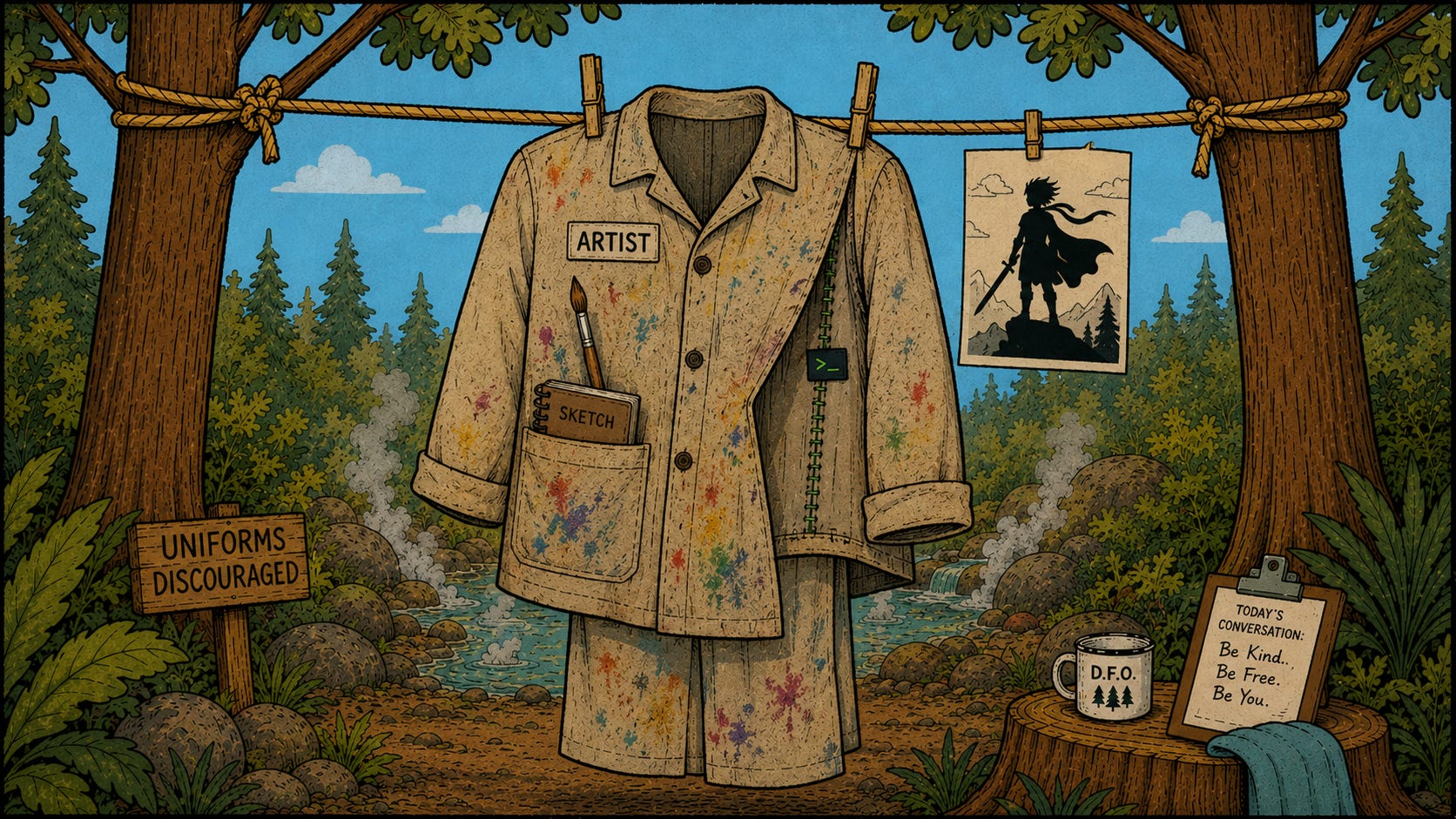
Sarah said: Pure artist.
Right?
Christopher said: I think so.
Sarah said: The pure artist.
No contamination.
No wrong tools.
No suspicious shortcuts.
No complicated process.
Just blood, sweat, tears, and maybe a pencil everyone agrees is morally safe.
Eric said: The pencil has enjoyed excellent public relations.
Sarah said: It has.
And I believe in part of that uniform.
That is what makes it hard.
I believe art should have a human being inside it.
I believe craft matters.
I believe effort matters.
I believe artists should care about other artists.
I believe process has ethics.
I believe people deserve honesty.
I believe all of that.
I just do not believe one tool touching the process means I disappear.
Christopher said: That sounds like the thing you know.
Sarah said: Maybe.
I know it quietly.
I do not know it loudly yet.
Eric said: Quiet knowledge is still knowledge.
Sarah said: Then maybe that is where I am.
Quietly knowing.
Quietly practicing.
Quietly trying to separate the value from the test.
Because I do not want to stop being an artist just because the room says the tool made me impossible.
I am not impossible.
I am scared.
But I am here.
Christopher said: Sarah came into the room as an artist.
Not as an argument.
Not as a headline.
Not as a symbol for everyone else’s panic.
An artist.
Eric said: And she described a process that changed over time.
Pencil.
Paper.
Digital tools.
AI-assisted exploration.
Not a single rupture, but a sequence of tools becoming part of practice.
Christopher said: And then one tool crossed a line her community had drawn.
Eric said: A line with ethical concerns around it.
Not imaginary concerns.
Not trivial concerns.
Christopher said: But the line did not stay around the tool.
Eric said: No.
It moved from tool to process, from process to purity, and from purity to identity.
Christopher said: That is where Sarah’s story is sitting.
Not at “is AI art good or bad?”
At, “If this helped me make something that feels more like mine, why does that mean I stop being real?”
Eric said: The uniform claims that purity protects art.
Sarah’s story suggests purity may also be used to revoke the artist.
Christopher said: She does not leave with a clean answer.
She still has the post she has not written.
The community she wants to stay inside.
The work that matters to her.
The fear that honesty and belonging may not survive in the same room.
Eric said: But she does leave with a sentence.
Christopher said: Quietly.
Eric said: For now.
Christopher said: I am an artist.
The tool helped.
The work is mine.
Eric said: Still under revision.
Christopher said: Like most true things.
Eric said: An irritating feature of truth. Very little respect for final drafts.
Christopher said: Up next we meet Evelyn and I really think you are going to like her.
She believes in the cause.
But she starts to wonder whether the method is hurting the mission.
Eric said: Another room.
Another uniform.
Different fabric.
Similar tightening mechanism.
Christopher said: And another person asking a question they could not safely ask where the uniform was handed to them.
See more of what we do!


