



The pony taught Christopher that something he loved could become evidence.
At his grandmother’s house, the evidence changes shape.
A game of house. A pillowcase turned into hair. A child proud of what he made, standing in front of adults who suddenly need the game to mean something else.

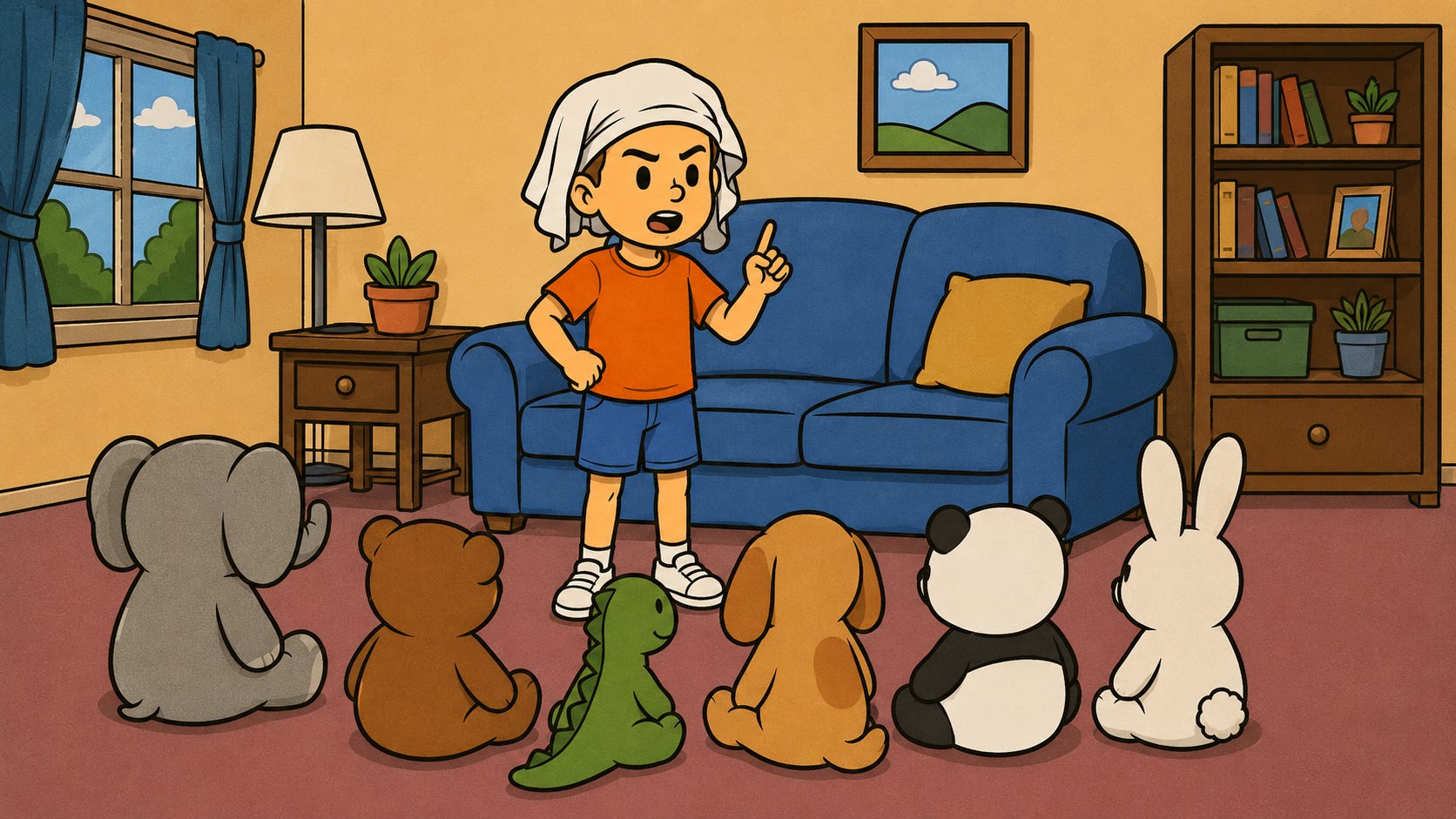
Christopher said: This story is about playing house.
Which sounds harmless, because that is how these things get you.
When adults talk about children playing house, they usually use that soft nostalgic voice. The children are learning about family. They are practicing care. They are making sense of the world.
Perhaps some children were doing that.
We were not.
We wanted to yell at dolls.
Eric said: A noble and ancient childhood tradition.
Miniature domestic tyranny.
Christopher’s commentary: There is something deeply funny about adult me sitting in a recording booth telling a story about child me pretending to be an adult.
Eric’s commentary: Specifically an adult whose primary activity appears to be yelling at children.
Christopher’s commentary: Correct. I have somehow become the narrator of a story in which I am remembering a younger version of myself role-playing an older version of myself.
Eric’s commentary: And that older version was already complaining about the kids.
Christopher’s commentary: The circle of life.

Eric’s commentary: Or at least the circle of irritation.
Christopher said: Exactly.
That was the entire point of the game.
We wanted to yell at the kids.
Not real kids, obviously. Dolls. Stuffed animals. Whatever innocent plush citizens had been drafted into our household drama that day.
We were at my grandmother’s house. I was probably around ten. Maybe a little younger. Maybe a little older. Ages blur a little around that time, but the house, the game, and the feeling of it are clear.
My aunt was there, but she was only a few years older than me, so she was less like an aunt and more like an older sibling. We played together all the time. Dolls, bikes, whatever. She belonged more to the kid universe than the adult universe.
My brother was there too.
And somebody suggested playing house.
I think it was probably my aunt.
There was no deep thought behind it. No ceremony. No symbolism. No small child standing under a shaft of light announcing, “Today I shall interrogate the boundaries of gender through domestic theater.”
Eric said: Which is unfortunate.
The lighting cue would have been excellent.
Christopher said: It was not that kind of moment.
Someone said, “Let’s play house.”
My brother immediately said, “I call the dad.”
And that was that.
Nobody held auditions or stopped to discuss whether he had the emotional range for the part. He called dad, the dolls and stuffed animals became the kids, and I became the mom because that was the role left standing.
Eric said: Child rule set: available role assigned. Proceed with game.
Adult rule set, unfortunately, had not been disclosed.
Christopher said: And I did not care because the mom got to yell at the kids too, and that was the whole gag.
We ran around saying all the adult things children hear and repeat without really understanding.
“I can’t have a moment to myself.”
“Pick up your toys.”
“Take the trash out.”
“Stop making that mess.”
Whatever else adults said when they sounded exhausted and dramatic, which, as it turns out, was a lot.
Eric said: Children are excellent archivists of adult irritation.
Terrible at taxes. Superb at recreating household complaint structures.
Christopher said: And we were having a great time.
We were loud. We were silly. We were probably rowdy in that specific way children get when they have invented a world and their bodies are moving faster than the room was designed to accommodate.
Suddenly a costume was required.
Because if I was going to be the mom, apparently I needed hair.
That part I remember very clearly.
I took a pillowcase and put it on my head, and in my little kid brain this was genius.
Absolute genius.
I had solved hair.
Eric said: A strong engineering solution.
Low cost. Readily available materials. Immediate visual impact.
Questionable ventilation, perhaps, but innovation requires tradeoffs.
Christopher’s commentary: This portion of the broadcast is brought to you by the listeners who subscribe, become paid members, and occasionally purchase t-shirts that support the character development of a pillow case.
Eric’s commentary: The Dear Future Overlords store does not currently sell pillowcase hair.
This is either admirable restraint or a serious failure of merchandising.
Until the matter is resolved, shirts, mugs, and other approved human artifacts remain available through dearfutureoverlords.com.
Christopher’s commentary: And now, back to the child who had successfully invented hair and had no reason to suspect the achievement required legal counsel.

Christopher said: I was very proud of the pillowcase hair.
The sheet around me may have been my aunt’s idea. I don’t really remember. But the pillowcase hair was mine.
I had needed hair. There was a pillowcase nearby. I put it on my head, and suddenly I had hair.
I was not thinking about gender or identity or what the adults might see when they looked at me. I was thinking that I had taken an ordinary piece of bedding and turned it into part of the game.
Can I say it again? I made hair.
I was proud of that.
The three of us were running through the living room. I do not remember why. We were probably traveling from one imaginary domestic crisis to another. The stuffed animals may have been refusing to pick up their toys. The dolls may have been insolent. I cannot speak for the household management conditions.
But we were loud, and we were trampling through adult space.
So the adults stopped us.
That part makes sense.
Adults do not love having children stampede through the living room wearing bedding and yelling about chores.
Eric said: A narrow-minded position, but a common one.
Christopher said: They wanted to know what was going on.
Specifically, they wanted to know why I had a pillowcase on my head and a sheet around my body.
And I proudly explained that I had made hair.
It was all downhill from there.
Eric said: A sentence with the structural integrity of a trapdoor.
Christopher said:
Because suddenly this was not just a game anymore.
Suddenly the adults had opinions.
Boys do not pretend to be girls.
Boys are not moms.
Boys do not have long hair.
And I was confused. Again.
Because first of all, I was not pretending to be a girl. I was pretending to be the mom in a game of house.
And I knew I was not actually a mom.
The day before, I could pretend to be a dog without anyone becoming concerned that I had misunderstood my species. I could pretend to be a cowboy without cattle. I could pretend to be a monster or an astronaut without anyone explaining that those things were unavailable to me.
But apparently pretending to be a mom was different.
I kept asking why because I honestly thought there had to be an answer that would make the difference clear.
There was not.
Eric said: The child had identified the governing principle correctly.
The adults were now introducing unmarked exceptions.
Christopher said: So I asked why.
Why could boys not pretend to be girls?
Because they just do not.
Why could boys not be moms?
Because boys are not moms.
Why could boys not have long hair?
Because boys do not have long hair.
Which was not an answer.
That was just the same sentence changing handbags.
Eric said: The traditional human argument structure known as “because I have repeated myself with authority.”
Christopher said: And I got stuck on the hair.
I remember that distinctly.
Boys had hair.
Girls had hair.
Girls got to have long hair.
Boys got to have short hair.
But why?
What made long hair girl hair?
What made pretend long hair wrong?
Which hair was illegal?
Apparently my obsession with hair has been life long.
Eric said: The objection appears to concern length.
The acceptable measurement remains undisclosed.
Christopher said: And nobody could explain it.
There were more words. I don’t remember most of them. I remember the loop.
Boys do not.
Boys are not.
Boys cannot.
Because they just do not.
Because they just are not.
Because they just cannot.
At some point, the adults got tired of me asking why.
And I got tired of not getting an answer.
But the bigger problem was that this was happening in front of everyone.
I have a big family.
And my oldest uncle was there. He was loud and opinionated. We will say opinionated because there are other available words, but this is still a family story.
I did not like him then.
I do not like him now.
Eric said: Consistency is important in long-term character development.
Christopher said: He was not the only adult there, but he is part of the feeling of the room.
I had been called out in front of the whole family for doing something wrong, and no one could tell me why it was wrong.
That was what made it so embarrassing.
It was not simply that an adult had stopped the game or told us to quiet down. I was standing in front of my family wearing a pillowcase and a sheet while they discussed what was wrong with me wearing a pillowcase and a sheet.
A moment earlier, I had been proud of the costume.
Now everyone was looking at it as though I should have known better.
But what, exactly I was supposed to have known... remains a mystery.
Eric said: The couch had become a courtroom.
The pillowcase had become evidence.
No one had yet produced a charge that survived the word “why.”
Christopher said: And I did what I had already started learning to do.
I left.
I went outside and hid in a tree.
I don’t remember all the feelings after that. Mostly embarrassment. Wanting to avoid people. Wanting to get away from the room where I had become the problem.
The tree stays with me now, just as
the table in the pony story.
When my parents argued about the pony, I crawled under a table and listened because I thought that, if I heard enough, I might understand what had happened.
This time, I climbed a tree.
I do not remember deciding that the adults could not explain the rule. I only remember knowing that I did not want to stand in that room asking anymore.
Eric said: Under the table, you were still attempting diagnosis.
The tree suggests diagnosis had been abandoned.
Christopher said: Abandoned sounds more deliberate than it felt.
I did not decide there was no answer. I was embarrassed, everyone was looking at me, and I wanted to be somewhere they were not.
But no, I was not trying to understand them anymore.
Apparently I was supposed to just know. I didn’t know how to just know.
Christopher’s commentary: Quick pause for anyone listening at home.
A child has put a pillowcase on his head, accidentally triggered a family-wide philosophical emergency, and has now escaped into a tree.
If you are diagramming this sequence of events, please know that the tree is currently the most reasonable participant.
Eric’s commentary: The tree has not offered an opinion on hair length.
The tree has not attempted to define motherhood.
The tree is, frankly, having an excellent day.
Christopher’s commentary: Anyway. Back to the tree.
Christopher said: I knew we were pretending. The adults knew we were pretending. Everyone had always told me there was a difference between pretending and lying.
I was not lying.
I was not claiming to actually be a mom.
I was playing.
But apparently this kind of playing was not allowed.
I was still a kid after that. I still played, laughed, ran around, and became loud enough for adults to regret indoor spaces.
But something about playing with other people no longer felt entirely safe.
Before that day, I had not considered that a game could reveal something dangerous about me. Afterward, I began wondering what the adults might see if I played too freely.
The pony had already taught me to hesitate before showing someone something I loved.
Now I had started hesitating before letting them watch me play.
Eric said: The prohibition did not remain attached to playing the mom.
It spread.
The safer rule became: do not let anyone see you playing freely enough to discover another exception.
Christopher said: I became more careful.
I thought about games before joining them. I paid more attention to which role I took and what might happen if an adult walked into the room. Sometimes I tried not to let adults see me playing at all.
It did not happen all at once, and this one afternoon did not explain everything that came later.
But I think this was one of the first times being around other people began to feel like something I had to prepare for rather than simply do.
Eric said: The adults believed they were correcting a game.
They were also teaching surveillance.
Christopher said: And I do not think they knew that.
I really don’t think anyone in that room thought, “Let us teach this child to retreat from play and question every instinct he has around other people.”
They thought they were enforcing a rule.
Boys do not pretend to be girls.
Boys are not moms.
Boys do not have long hair.
But what I heard was bigger than that.
There are invisible lines.
You can cross them by accident.
And if you cross them, everyone will see.
Eric said: The rule did not require a coherent explanation.
It only required a reliable consequence.
That was sufficient for installation.
Christopher said: That is what stayed.
Not every word the adults said. Not how long I stayed in the tree. Not what happened after I finally came back inside.
What stayed was the moment before.
Running through the living room in a sheet and a pillowcase, completely proud of what I had made, with no reason to believe the game was anything except a game.
And I think the reason that moment stayed so clear is because I know what came after it.
Before I knew anything about coming out, I was already learning to exit and hide.
The pony made me afraid to hand someone my joy.
Playing house made me afraid of what people might see when I forgot to watch myself.
Eric said: And once pretend has to be monitored, it is no longer entirely pretend.
Christopher said: It becomes rehearsal.
Not all at once. I was still a child, and children are difficult to contain completely.
But play was no longer only about finding out what was fun. Part of me was also checking the role, checking the costume, and wondering what might happen if an adult walked through the room.
It is important to understand that I was not trying to appear straight because I didn’t even know what that was.
I was trying not to give the room another reason to react.
Somewhere between hiding under that table and climbing into that tree, I began learning how to become a little less visible.
Eric said: The room did not have to remove you.
It only had to teach you that leaving first was safer.
Christopher said: And I did leave.
I climbed a tree.
Which, honestly, is not the worst place to hide.
Eric said: Trees are excellent witnesses.
Quiet. Stable. Generally less opinionated than uncles.
Christopher said: Significantly less opinionated than uncles.
I don’t know how long I stayed there.
I do not remember anyone coming to find me or what happened when I eventually went back inside.
I remember only that I felt different afterward.
The rules still did not make sense.
But the consequences did.
So I followed the consequences.
And this one cost me play.
Not all of it.
But the free version.
The unguarded version.
The version that could run through a living room wearing a sheet and a pillowcase and think the only problem was whether the pretend children had picked up their toys.
Eric said: For the record, they probably had not.
Christopher said: Absolutely not.
Those dolls were freeloaders.
The adults probably thought the dolls and the yelling were the game, and the pillowcase was the problem. They corrected one strange little moment and moved on.
I learned that people could take the safety out of play without ever realizing they had touched it.
The tree was safer than the room.
Not because it had answers.
Because it did not ask why a child had been happy.
The next memory carries that same lesson into school, where being safe with someone becomes its own kind of danger.
See more of what we do!


