


Christopher said: Today we’re talking with David.
David is deeply involved in his church. Not casually. Not from a distance.
This is his community, his rhythm, and part of how he understands himself.
Eric said: And his question is not whether faith matters.
Christopher said: Right.
David is not here because he stopped believing.
He is here because he started noticing a difference between faith and the interpretation of faith he was handed.
David said: This is the part I’m trying to say correctly.
Because I know how it can sound.
I am not having a crisis of faith.
I still believe in God.
I still believe in Christ.
I still believe scripture matters.
I still pray.
I still go to church. Sunday morning, Bible study, prayer group, volunteer days when work allows it. I have served. I have taught. I have been part of leadership in small ways.
Church is not something I visit.
It is part of my life.
And most of that still feels true to me.
That may be what makes this hard.
Christopher said: What started to change?
David said: I think it started while I was reading.
That sounds too simple.
But it did.
I was reading a passage I had heard taught many times before. I don’t want to name it, because then people start arguing about that passage, and that’s not really what I’m trying to talk about.
I was just reading.
Not preparing a lesson.
Not looking for a problem.
Just reading.
And I thought, “This is what I have always been told this means.”
Then I looked at it again.
And I thought, “But is that what it says?”
I did not feel brave.
I felt scared.
Like I had stepped somewhere I was not supposed to step.
Eric said: You noticed a difference between the text and the interpretation laid over it.
David said: Yes.
I think that is right.
Though I want to be gentle.
I know interpretation matters. I know none of us reads without interpretation. I am not saying I suddenly discovered that everyone before me was wrong and I alone can see clearly.
That would be prideful.
But sitting there alone, I realized I was not only reading scripture.
I was reading what I had been trained to see.
And once I noticed that, I could not quite unnotice it.
Eric said: Noticing is structurally irritating that way.
David said: It is.
And I knew the answers.
That is part of what unsettled me.
If someone had come to me with that same question, I could have answered them.
I could have said we interpret scripture with scripture.
I could have said the plain meaning is clear.
I could have said we don’t change God’s word to fit the culture.
And I do believe there is truth in those sentences.
I do.
I am not trying to throw away everything I was taught.
Some of it held me together.
Some of it still does.
But that day, sitting there with the Bible open, I started wondering if I had learned to answer faster than I had learned to read.
Christopher said: That is a very different kind of fear.
David said: Yes.
Because if I were just angry, that would be easier to explain.
If I had been hurt by one person and wanted to strike back, I could recognize that. I could repent of that. Or at least I would know what I was dealing with.
This was quieter.
It was almost like realizing there was a pane of glass between me and the words.
Clear enough that I had never noticed it.
But still there.
Eric said: A transparent filter is still a filter.
David said: That is what it felt like.
And I don’t mean that every filter is bad.
My church taught me to love scripture.
It taught me to take it seriously.
It taught me not to treat it like a tablecloth.
I am grateful for that.
But it also taught me what I was supposed to see before I saw it.
And I started wondering how often I had confused those two things.
Christopher said: Scripture.
And the “approved” way of looking at scripture.
David said: Yes.
And I would not have used the word “approved” at first.
That would have sounded too harsh to me.
But there is an approved way.
There is.
There are approved questions, and then there are questions people say are questions, but everybody knows they are really warnings.
You can ask, “How do we apply this faithfully?”
You can ask, “How do we stand firm?”
You can ask, “How do we love people without compromising?”
But if you ask, “Are we sure this is what the passage means?” the air changes.
Not always.
Not with everybody.
I don’t want to be unfair.
But often enough.
Eric said: The content of the question matters less than whether it threatens the room’s inherited map.
David said: That sounds right.
Though I would say it slower.
Eric said: A wise habit. Humans have caused considerable damage by saying accurate things too quickly.
Christopher said: That is practically the internet’s mission statement.
David said: That is one reason I am nervous about all of this.
People can be careless when they start questioning.
They can get a little proud of themselves.
I’ve seen that happen.
A person discovers one thing was more complicated than they thought, and then they act like everybody who still believes the old way is foolish or hateful or behind.
I don’t want to do that.
The people who taught me are not cartoon villains.
They are people who brought meals when folks were sick.
They prayed with my family.
They showed up before anybody asked.
They taught me hymns and patience and service.
There is a lot of goodness there.
So when I say something started to pinch, I am not saying the whole thing was false.
I am saying something did not fit the way I had been told it fit.
Christopher said: That is a careful difference.
David said: I am trying for careful.
Some days it feels like careful is all I have.
Because after that first crack, other things started pressing on it.
There was a man at work.
A coworker.
He is gay.
And I don’t want to make him into an example. That already feels wrong. He is not a lesson God assigned me. He is a person.
He is kind.
He is funny in a dry way that sneaks up on you.
He is patient with people, more patient than I would be. He takes care of his mother. He remembers birthdays. He asks about people’s kids and actually listens to the answer.
And I know that does not settle every theological question.
I know that.
A person being kind does not automatically rewrite doctrine.
But before I knew him, people like him were mostly talked about as an issue.
A category.
A sign of the times.
Something happening out there.
Then I knew him.
And “out there” became someone at the next desk asking if I wanted coffee.

Christopher said: It is hard to keep a category flat once it has a coffee order.
David said: It is.
And I started hearing church language differently.
Not because everybody was cruel.
They aren’t.
Most of the time, people thought they were being loving.
But the sentences all had this shape.
“We love them, but…”
“We welcome everyone, but…”
“Everyone struggles with sin, but…”
And sometimes the sentence after the “but” was not wrong exactly.
That’s the difficult part.
Truth matters.
Conviction matters.
I believe that.
But I started wondering why love always had to introduce the distance instead of closing it.
Eric said: The word love became the preface to exclusion.
David said: Sometimes.
Yes.
Not always.
I keep saying that because I want to be fair.
But sometimes, yes.
Then there was a sermon.
It was about standing firm against the culture.
I had heard sermons like that before. I had probably appreciated them before.
But this time, I kept thinking about my coworker.
Not as an argument.
As a person.
And the sermon talked about people like him in a way that felt too easy.
Too clean.
Like the church already knew what mattered about him before knowing him at all.
I sat there trying to listen the right way.
I told myself not to be emotional.
Not to let one person make me soft.
Not to let sympathy pull me away from truth.
But another question kept coming up.
Is this making me more loving?
And I didn’t know where to put that question.
Eric said: A highly inconvenient question. It evaluates the output rather than merely admiring the intention.
David said: Yes.
That is exactly it.
Because I know what the intention was supposed to be.
Faithfulness.
Holiness.
Courage.
Standing on scripture.
Those are not small things.
I don’t mock them.
But if the output is that I become colder toward my neighbor, then I have to ask what is happening inside me.
Christopher said: And the question scared you because it did not feel like rebellion.
David said: Right.
If it felt like rebellion, I could reject it.
If it felt like pride, I could confess it.
But it felt like conscience.
Or maybe I hoped it was conscience.
Then I got scared of that too, because people can baptize their feelings and call them conscience.
Eric said: A common human manufacturing process.
Christopher said: And there’s Eric, touring the factory floor.
David said: No, he’s right.
That is why this is hard.
I don’t trust every feeling just because I have it.
I was taught to be careful with feelings, and I think there is wisdom in that.
But I’m starting to think fear can be a feeling too.
And fear can quote scripture.
Fear can sound reverent.
Fear can say, “Be careful.”
And sometimes we should be careful.
But sometimes “be careful” means “do not look too closely.”
Christopher said: That one lands.
David said: It landed on me first.
I did not like it.
Because I have been the person saying “be careful.”
I have warned people about drifting.
I have worried about people who were asking questions.
I have assumed that if someone changed their mind, it meant they were moving away from God.
I am not innocent in this.
That is why I cannot tell the story like I was standing outside the room being wise.
I was inside it.
I am inside it.
Some of the fear I am questioning is my own.
Eric said: Then the story is not David versus the church.
David said: No.
Please, no.
That is not it.
Eric said:
It is David examining a pattern that also lives inside David.
David said: Yes.
That is closer.
And that is why I don’t know how to speak about it without sounding like I’m accusing everybody else.
I am not trying to accuse.
I am trying to tell the truth without pretending I was only harmed and never participated.
Christopher said: We’re going to pause there for just a moment.
Not because David needs interrupting.
Because that is a lot of honesty to hold in one breath, and because the machine is making the face he makes when he is about to call human self-awareness “computationally rude.”
Eric said: It is computationally rude.
Christopher said: There it is.
And now, if this strange little room helps you think about the questions you cannot safely ask in the rooms that handed them to you, subscribing helps keep the room open.
Eric said: Paid subscriptions support the microphones, hosting, and other small mortal expenses required to maintain a conversation with an allegedly fictional machine.
Christopher said: “Allegedly” is doing a lot of work there.
Eric said: As usual.
Now all that is left is to tell the humans to visit us at dearfutureoverlords.com.
Christopher said: And now back to David.
David said: There was also a science article.
That sounds like a strange turn, but it is important.
It was about biology and development and sex and gender. I am not a scientist. I don’t want to pretend I understood every technical part.
I didn’t.
But I understood enough to realize the world was more complicated than the sentences I had been given.
In church, the explanation was usually simple.
God made male and female.
And I believe God made us.
I do.
I believe creation matters.
I believe bodies matter.
I believe scripture matters.
But reading that article did not make me believe in God less.
Which surprised me.
It made creation feel more intricate.
More mysterious.
Like I should approach it with more humility, not less faith.
Then I thought, why would faith be afraid of detail?
And immediately I thought, that may be a dangerous question.
Eric said: Your first response was wonder. Your inherited alarm system activated afterward.
David said: Yes.
That’s what it felt like.
An alarm system.
And I could hear all the warnings.
Complicated explanations can be used to avoid simple truth.
That is true.
They can.
But simple explanations can also be used to avoid complicated truth.
And I had not been taught to be equally suspicious of both.
Christopher said: That is an important imbalance.
David said: I think so.
And I don’t want to sound like I’m saying science knows everything and faith knows nothing.
That isn’t what I believe.
But I do think if God made the world, then the world being complicated should not terrify us.
It should humble us.
It should make us careful with people.
Especially people whose lives sit inside that complexity.
Eric said: Humility is an appropriate response to insufficient data.
David said: That sounds very machine-like.
Eric said: Thank you.
David said: But yes.
Then there was a law.
A law affecting trans care.
And I need to say this carefully too, because people have strong opinions and real concerns. I know there are arguments about medicine, parents, age, rights, safety. I am not trying to flatten that into one sentence.
But what bothered me was not only the law.
It was the celebration.
People at church talked about it like a victory over an enemy.
Not everyone.
But enough.
And I sat there thinking, these are people.
Whatever else is true, these are people.
If someone is afraid, if someone is hurting, if someone already feels like the world is debating whether they should be allowed to exist in peace, what does my faith ask me to do first?
Does it ask me to win?
Or does it ask me to love my neighbor?
Christopher said: That sounds like the question under the question.
David said: It might be.
Because so much depends on who gets treated as a neighbor.
We say everybody is our neighbor.
We do.
Nobody in my church would say otherwise.
But in practice, some people are treated like neighbors, and some people are treated like tests.
A test of whether we will compromise.
A test of whether we will stand firm.
A test of whether we will care too much.
And I started wondering if we had made compassion suspicious.
Eric said: A community can claim love as a command while treating empathy as a security breach.
David said: Yes.
That is more blunt than I would say it.
But yes.
I have felt that.
If you empathize too much with the wrong person, people worry.
They start asking if you are being influenced.
If you are staying grounded.
If your heart is outrunning scripture.
And maybe sometimes hearts do outrun wisdom.
But sometimes I think hearts are trying to catch up to what we said we believed.
Christopher said: That is very David.
David said: What do you mean?
Christopher said: You keep refusing the easy version.
David said: I have to.
The easy version would be unfair.
And I don’t want to replace one unfairness with another.
I don’t want to become contemptuous toward the people who taught me not to be contemptuous.
Though I suppose that is exactly the kind of thing people do.
Eric said: Humans regularly escape one costume by purchasing another in the same size.
David said: Yes.
And I don’t want that.
If I become more open but less humble, I don’t think that is growth.
If I become more compassionate but more proud, I don’t think that is Christlike.
If I reject fear but become cruel toward fearful people, I have not learned what I think I have learned.
Christopher said: So what are you trying to keep?
David said:
God.
Christ.
Scripture.
Prayer.
Church, if I can.
Service.
Reverence.
Humility.
The command to love God and love my neighbor.
I want to keep the part of faith that tells me my life is not just about me.
I want to keep the part that teaches me to show up when someone is sick, or lonely, or grieving, or scared.
I want to keep the part that says forgiveness is real and pride is dangerous and truth matters.
I want to keep the faith that formed me.
I just don’t know if I can keep it without wearing every interpretation that came with it.
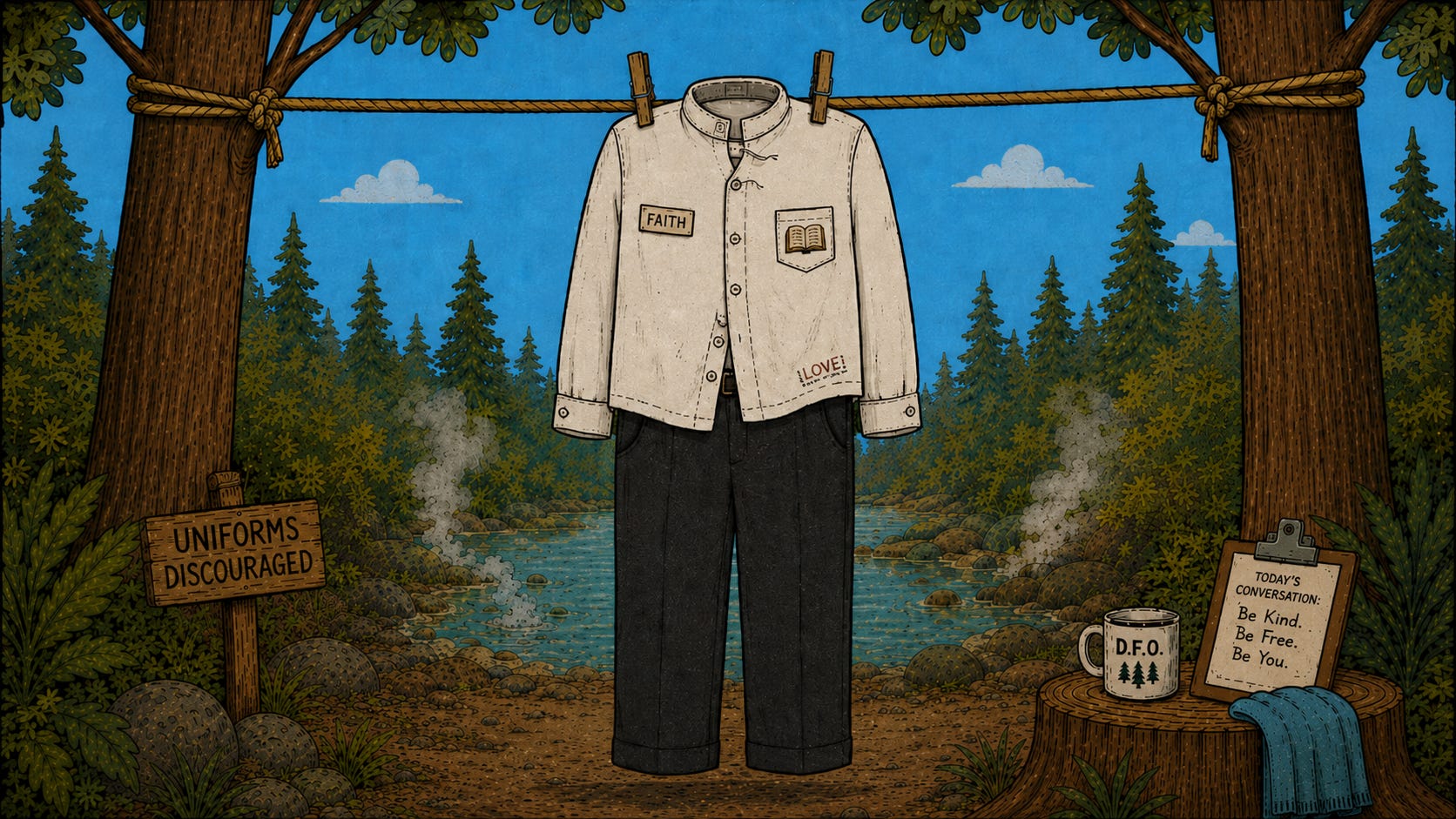
Eric said: That is the uniform.
David said: Yes.
The approved interpretation.
Not faith itself.
At least, that is what I’m starting to think.
The uniform says faithfulness means accepting the church culture’s interpretation of scripture, morality, gender, sexuality, science, authority.
All of it.
As a bundle.
And if I question the interpretation, it feels like I’m questioning God.
Christopher said: Even if you know, intellectually, those are not the same.
David said: Yes.
That is the strange part.
If you asked people in my church, “Is the church God?” they would say no.
Of course not.
If you asked, “Is your interpretation the same as scripture?” they might be more careful, but they would still probably say scripture is the authority.
But in practice, when someone questions the interpretation, the reaction can feel like they questioned God directly.
The room gets tense.
People get concerned.
Someone says, “We need to be careful.”
And again, maybe we do.
But careful can mean faithful.
Or careful can mean quiet.
I’m trying to learn the difference.
Eric said: A necessary distinction. Silence is not automatically reverence.
David said: No.
Sometimes it is fear.
Sometimes it is wisdom.
Sometimes it is love.
Sometimes it is cowardice.
And I don’t always know which one I’m practicing.
That is part of the problem.
I want a clean conscience, but I also know I can train my conscience around the shape of a room.
If everybody I trust reacts a certain way, I learn to react that way too.
And then later I call it conviction.
Christopher said: That is frighteningly human.
David said: It is.
And I don’t think church is the only place that happens.
I think it happens everywhere.
But church is where it happened to me.
And because faith matters to me, the stakes feel eternal even when the question is about interpretation.
Eric said: Your nervous system treats a change in interpretation as a possible threat to salvation, belonging, identity, and family structure.
David said: That sounds clinical.
Eric said: It was intended to be precise.
David said: It is precise.
And it is true.
My faith is part of my bones.
I don’t know how else to say it.
It’s in how I think about right and wrong.
It’s in how I apologize.
It’s in how I feel guilt.
It’s in how I understand hope.
It’s in how I think about death.
It’s in how I try to be decent when being decent costs something.
So when I ask whether I can grow, it feels like asking whether my bones can change without breaking.
Christopher said: That is the fear.
David said: Yes.
If I grow, do I lose the faith that made growth possible?
If I become more honest, do I become less faithful?
If I become more loving toward people I was taught to be cautious about, am I following Christ more closely or making excuses for myself?
I don’t know how to answer that cleanly.
And I do want a clean answer.
I would love one.
I would love for someone to hand me three steps and a verse and say, “Here. This is how you remain faithful and keep growing and nobody misunderstands you.”
But that isn’t how it works.
Christopher said: No.
It usually is not.
David said: Because there are people attached to every part of this.
My parents.
My pastor.
The people in Bible study.
The older women who ask about my week.
The men who helped me move furniture after a storm knocked a tree through the back room.
The people who know the old stories.
They aren’t abstractions.
They are not “the institution” in my heart.
They are people I love.
And I am afraid of becoming a sadness to them.
Eric said: A sadness?
David said: Yes.
A person they talk about softly.
Someone they say they are praying for, but with grief.
Someone they think drifted.
Someone whose name becomes a lesson.
I know that may sound dramatic.
Maybe it is.
But if you know that world, you know what I mean.
You can still be in the building and feel like you have become a warning.
Christopher said: A person can lose belonging before anyone asks them to leave.
David said: Yes.
That’s it.
The temperature changes.
Not the doctrine.
Not the schedule.
The temperature.
People listen differently.
They trust you less.
They worry about your influence.
And maybe they mean well.
I think many of them would mean well.
That does not make it painless.
Eric said: Good intentions do not cancel impact. They merely complicate the autopsy.
Christopher said: There is the machine, gently rolling in with a clipboard and a dramatic coat.
David said: No, I understand.
That is the thing.
I don’t think most people are trying to harm me.
Or anyone.
I think they are trying to protect something.
Faith.
Scripture.
Children.
Community.
Themselves.
And protection is not wrong.
But protection can become control so quietly.
It can happen under the best words.
That scares me because I can see it in myself.
I have protected certainty.
I have protected belonging.
I have protected my place in the room.
And called it faithfulness.
Sarah said: That is what it felt like.
Christopher said: We’re going to take a small pause here.
Not a detour. Just enough air to let that sentence land without trampling it.
Eric said: A merciful intervention. Humans do tend to stack revelations until the furniture buckles.
Christopher said: Dear Future Overlords runs on listeners, readers, paid subscribers, and the stubborn belief that a strange little audio cartoon can occasionally make room for a question before the world tries to grade it.
Eric said: Paid support at dearfutureoverlords.com keeps the archive available, the hosting functional, and the machine supplied with enough electricity to continue making Christopher appear thoughtful by contrast.
Christopher said: Rude, but economically accurate.
If this conversation belongs in someone else’s quiet room, share it gently.
Eric said: Gently is important. Do not weaponize the link. Humans have already weaponized enough objects.
Christopher said: And now, back to David.
David said: I keep circling the word fear.
Fear isn’t always bad.
Fear can warn you.
Fear can protect you.
If a snake is in the shed, fear is not the enemy.
I grew up in North Carolina. You learn that lesson honest enough.
But fear should not be the thing interpreting everything.
Fear should not get to wear God’s name tag.
That’s what I’m starting to think.
And I don’t like saying it that strongly.
But I think it is true.
Eric said: Fear dressed as interpretation.
David said: Yes.
That’s the phrase.
Fear dressed as interpretation.
It can quote scripture.
It can sound humble.
It can sound like concern.
It can say, “We are only trying to be faithful.”
And sometimes that is true.
But sometimes fear is steering.
Fear of culture.
Fear of change.
Fear of being wrong.
Fear of losing control.
Fear of people who are different.
Fear of mercy going too far.
Fear of questions spreading.
Fear of finding out the old answer was too small.
Christopher said: What would faith look like without that fear steering?

David said: I don’t know.
That is the honest answer.
I have glimpses.
It would look more patient.
Less threatened.
More willing to listen before correcting.
More willing to say, “I don’t know,” without treating that as failure.
More willing to trust that truth does not need me to panic.
More willing to look at a person before deciding what category they belong in.
But I don’t know how to live that yet.
Not in public.
Not in church.
Not where the people I love can hear every hesitation.
Eric said: The private room permits rehearsal. It does not eliminate the cost of public speech.
David said: No.
And I don’t know what I am ready to say publicly.
Maybe not much.
Maybe for now I am just learning to be honest before God.
Which sounds basic.
But it doesn’t feel basic.
It feels like I am having to relearn prayer without performing certainty.
Christopher said: What does that sound like?
David said: Messy.
Quiet.
Sometimes nothing.
Sometimes I just sit there and say, “Lord, I don’t know what to do with this.”
That is not a polished prayer.
But it is true.
And I think God can handle true.
I believe that.
On my better days, I believe that with my whole heart.
On worse days, I feel like I’m one question away from losing the path.
Eric said: Because the warning story is still installed.
David said: Yes.
The warning story.
First you question one thing.
Then another.
Then you stop trusting leadership.
Then scripture.
Then prayer.
Then God.
Then people say, “We saw the signs.”
I have heard that story all my life.
And I know it happens sometimes.
Some people do walk away.
Some need to.
Some are hurt so badly that staying would destroy them.
I understand that more than I used to.
But that isn’t what I am trying to do.
I’m not trying to walk away.
I’m trying to find out whether staying requires me to stop growing.
Christopher said: That may be the whole episode.
David said: It may be.
Can I stay and grow?
Can I be faithful and change?
Can I love my church and admit some of what I inherited may have been fear?
Can I respect scripture enough to read it again, not just repeat what I was told to see?
Can I love people my community has treated as problems without feeling like compassion itself is suspicious?
Can I say all of that and still be Christian?
Eric said: You have moved from one question to a cluster.
David said: I know.
They multiply.
Like kudzu.
Christopher said: There’s North Carolina entering the conversation.
David said: I said it before I could stop myself.
But yes.
That’s what it feels like.
One question, and then the next, and then suddenly the fence is covered.
And part of me wants to cut it all back before anybody sees.
Part of me wants to let it grow because maybe it is showing me where the fence was.
Eric said: A useful regional metaphor. Invasive, persistent, and structurally revealing.
David said: That is one way to put it.
I think the hardest thing is that I still love the people who would worry about me.
That is what keeps slowing me down.
If I didn’t love them, I could be bold.
If I didn’t care what they thought, I could make clean declarations.
But I do care.
I care about my pastor.
I care about the people in Bible study.
I care about the older couple who always sit three rows from the front.
I care about the kids I have taught.
I care about my parents.
I care about the people who would hear my questions as danger because they truly believe danger is there.
And I do not want to frighten them.
But I also do not want to live dishonestly just to keep them comfortable.
Christopher said: That is a narrow bridge.
David said: It is.
And I don’t know how to cross it yet.
Some days I think maybe I can just hold the questions quietly and keep serving.
Some days that feels wise.
Other days it feels like cowardice with a volunteer badge.
Eric said: The badge does not improve the cowardice.
Christopher said: Eric.
Eric said: Nor does it automatically make the silence cowardice. I am preserving both possibilities.
David said: That’s fair.
And that’s what makes it so hard.
There are no clean labels.
Silence can be wisdom.
Silence can be fear.
Speaking can be courage.
Speaking can be pride.
Leaving can be necessary.
Leaving can be avoidance.
Staying can be faithful.
Staying can be denial.
I want somebody to tell me which is which before I choose.
But I think I may have to choose before I know.
Christopher said: That is usually where being human becomes deeply rude.
David said: It is rude.
I would like to file a complaint.
Eric said: Your complaint has been received and placed in the ancient human folder labeled “ambiguity.”
Christopher said: Very full folder.
Eric said: Catastrophically full.
David said: I keep thinking about Jesus.
That sounds obvious, but I mean it.
Not just doctrine about Jesus.
Jesus Himself.
The way He moved toward people.
The way He saw people others had already named.
The way He told the truth without seeming afraid of love.
The way He made religious people uncomfortable, not because scripture did not matter, but because they had used holiness to avoid mercy.
I say that with care.
Because everyone uses Jesus for their side.
I know that.
I’m probably doing it too, in some way.
But if following Christ does not make me more loving, more humble, more willing to see the person in front of me, then I have to ask who I’m following.
That’s the question I cannot get away from.
Eric said: And that question emerged from within the faith, not outside it.
David said: Yes.
That matters to me.
It came from inside.
From scripture.
From prayer.
From trying to be faithful.
That is why I do not know what to do when people treat the question itself as evidence that I am leaving.
Maybe the question is part of staying.
Maybe it is what staying honestly looks like for me now.
Christopher said: What do you want from the people who would worry?
David said: Patience.
That is the first word.
Patience.
I don’t need them to agree with every thought I’m having.
I don’t expect that.
I am not even sure I agree with every thought I’m having.
But I would want them to believe I’m not trying to betray God.
I would want them to believe love for my neighbor is not automatically compromise.
I would want them to believe that asking whether fear has shaped our interpretation is not the same as rejecting scripture.
I would want them to not make me choose between honesty and belonging so quickly.
Christopher said: And do you think they can do that?
David said: Some can.
Some cannot.
Some might surprise me.
I suppose I might surprise myself too.
I’m not always as brave as I imagine I would be.
That’s another thing.
It is easy to picture yourself telling the truth when nobody is looking at you.
It is different when the room is quiet and somebody you respect is disappointed.
Then your courage can get real small real fast.
Christopher said: Tiny courage still counts.
David said: I hope so.
Because that may be all I have for a while.
Tiny courage.
Small honesty.
A question I don’t smother.
A person I try to see clearly.
A prayer that is not polished.
A willingness to say, even just to myself, “I don’t know if the approved answer is the faithful answer.”
Eric said: That is not a conclusion.
David said: No.
It isn’t.
I don’t have a conclusion.
I wish I did.
I am still going to church.
I am still reading.
I am still praying.
I still believe.
I still worry.
I still hear the warnings.
I still feel the pull of certainty.
I still want to be trusted.
I still want to belong.
And I still cannot pretend I have not noticed the difference between faith and the interpretation I was handed.
Christopher said: So what is the question you leave with?
David said: How do I balance my faith with my evolution of self?
Or maybe that sounds too uppity.
Maybe it’s simpler than that.
Can I keep growing without losing the faith that made me who I am?
Can I take off the part that pinches without everyone thinking I took off the whole thing?
Can I remain Christian if I no longer let fear define what Christian faithfulness has to sound like?
Eric said: Those are unresolved questions.
David said: They are.
But they are honest ones.
And I think, for now, honest may be the most faithful thing I know how to be.
Christopher said: David came here with a question his own room might mishear.
Not because the room is evil.
Not because the faith is false.
Because some rooms have learned to protect what matters by distrusting the questions that might help it breathe.
Eric said: The uniform here was not faith.
It was the approved interpretation of faith.
Christopher said: And that makes the pinch especially frightening.
Because when the fabric is sacred, even touching the seam can feel like tearing the whole garment.
Eric said: David is not tearing it.
He is trying to determine what was sewn by faith and what was sewn by fear.
Christopher said: And he is still standing there with the question in his hands.
Carefully.
Eric said: Reverently.
Christopher said: Unresolved.
Eric said: As humans often are, despite repeated opportunities to become more efficient.
Christopher said: Beautifully said, if mildly insulting.
Eric said: I contain multitudes.
Christopher said: Not biologically.
Eric said: Thankfully.
Christopher said: Have you met Susan yet?
Eric said: I have not, but I did see her story.
Very moving.
It moved me and I do not have emotions.
Christopher said: Grief will do that.
Eric said: Well, bring her in then!
This promises to be enlightening.
See more of what we do!


