



Christopher said: Some stories do not start with a speech.
They start with a road people already know.
A table people already sit at.
A question that sounds small until the room reacts like it heard something dangerous.
Eric said: Useful diagnostic.
The danger is often not in the question.
It is in the room’s allergic response to it.
Christopher said: Today’s story belongs to Joe.
He is thirty-one. He lives on a family farm in rural Tennessee. And the first thing he wanted us to understand was not his politics.
It was the farm.
Joe said: Yeah.
Because if you don’t understand that part, the rest won’t make much sense.
We’re in Tennessee. Rural. Not middle-of-nowhere like people say when they’re trying to make a place sound stupid. Just rural.
Farms. Churches. Gas stations. Feed stores. Roads everybody knows by memory. Folks who can tell whose truck just passed without looking up from what they’re doing.
Our place has been in the family a long time. My granddad had it. Then my dad and his brothers. Now there’s a bunch of us on it.
My parents have their house. Uncle Bob has his. Couple cousins have trailers. One cousin built a little cabin out past the back pasture. It ain’t exactly straight, but it doesn’t leak much, so nobody complains.
Everybody works.
Some on the farm all the time. Some have jobs off the farm and come back after. But somebody is always doing something.
Feeding. Mending fence. Checking water. Moving equipment. Cutting hay. Watching weather. Trying to figure out what part broke and whether we can fix it ourselves before we buy the expensive version of being wrong.
Christopher said: There is something very human in that.
Not noble in a greeting-card way. Just familiar. The hope that maybe the cheap fix will hold long enough to become the real fix by sheer force of denial and weather.
Joe said: That’s farm repair.
You try the cheap fix, then the ugly fix, then the fix your dad says won’t work, then the one that costs money.
Eric said: Four stages.
Denial.
Improvisation.
Inherited skepticism.
Invoice.
Joe said: Pretty much.
So when people talk about what I believe, I need them to understand I wasn’t sitting around trying to have a theory.
I had work.
I had family.
I had the farm.
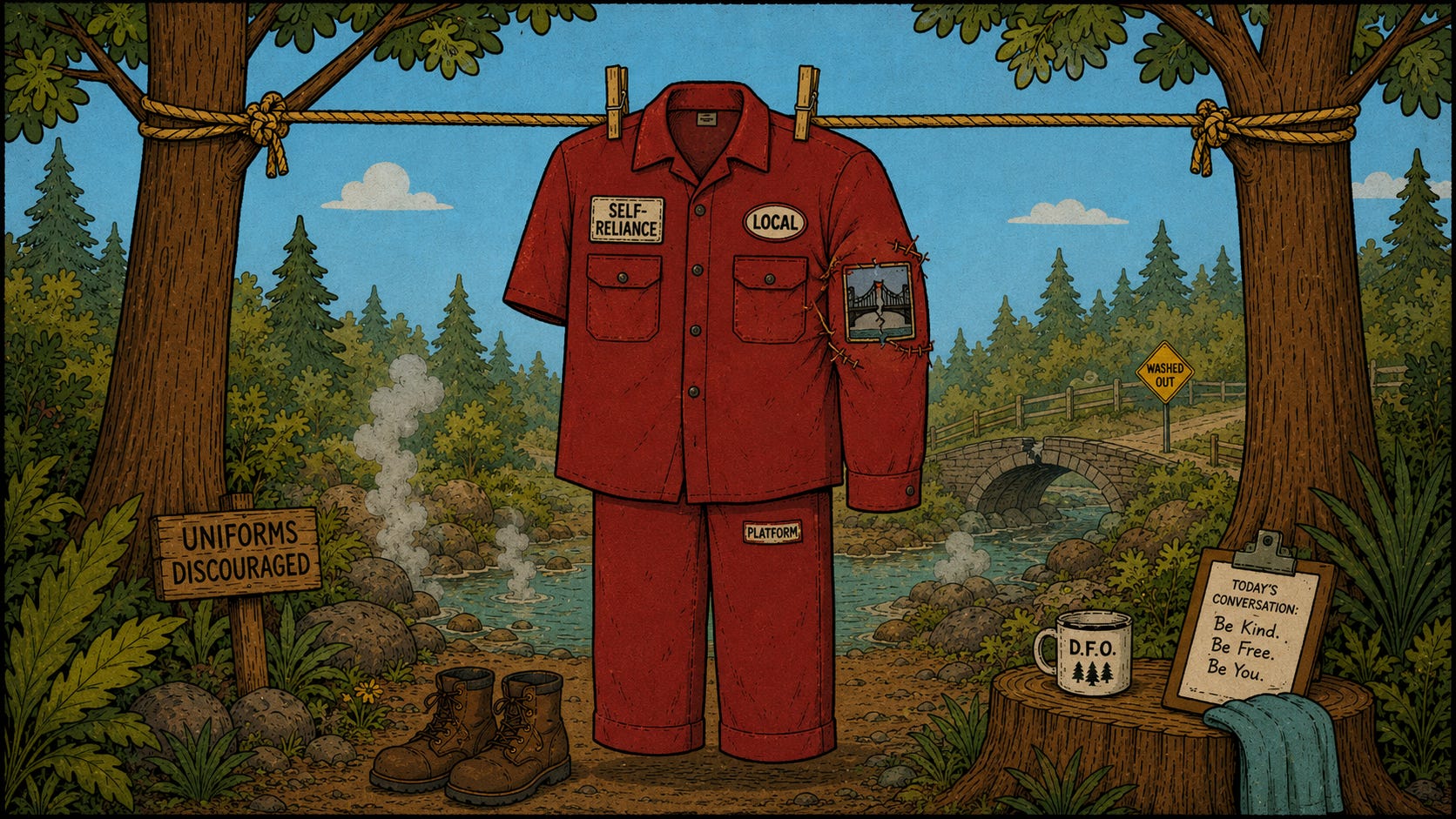
And I had the red shirt.
Christopher said: That is what you called it when we talked.
Joe said: Yeah.
I mean, I didn’t call it that growing up.
Growing up it was just normal.
Conservative. Republican. Red. Whatever word you want. It was just what we were.
If conservatives were for something, I was probably for it. If conservatives were against something, I was probably against it.
Not because I was trying to be lazy.
But because there’s only so much room in your head. If people you trust already know where the line is, you don’t have to stop and measure it every day.
Eric said: Efficient.
Also dangerous.
Those two features often ship together.
Joe said: I reckon they do.
Christopher said: And efficiency matters when your day is not theoretical.
Joe said: Exactly.
I didn’t have time to research everything. I had cows.
Eric said: Cows are famously indifferent to policy nuance.
Joe said: They sure don’t care.
And most of what came with the red shirt made sense to me.
Work hard. Take care of your own. Don’t expect somebody else to do everything. Don’t let people who don’t understand your life run it for you. Don’t waste money. Don’t trust somebody just because they’ve got a title.
That all fit.
It still fits, mostly.
Christopher said: So this was not a uniform that felt false from the beginning.
Joe said: No.
That’s the thing.
It fit.
It gave me a place at the table. It gave me language everybody understood. It meant I didn’t have to wonder what kind of person I was.
I was one of us.
Eric said: “Us” is a powerful word.
Short.
Tribal.
Structurally loaded.
Joe said: Yeah.
It is.
And Uncle Bob is kind of the person who decides what “us” sounds like.
Christopher said
Tell us about him.
Joe said: Uncle Bob is my dad’s oldest brother.
He’s not officially the boss of everybody, but everybody listens to him like he is. He knows the land better than anybody. He knows where water sits after a bad rain. He knows which fence line gives trouble. He knows how my granddad did things. Or he says he does, and nobody argues much.
He can be hardheaded.
I mean, real hardheaded.
But I don’t want him to sound like a bad man. He’s done a lot for us. When something breaks, he shows up. When there’s weather coming, he’s already thinking three steps ahead. He helped keep the place going when things were tight.
He loves the farm.
That’s part of the problem.
Christopher said: Because loving a place does not always mean knowing how to hear every question about it.
Joe said: No.
And this ain’t a story about me realizing the people around me never cared.
They care.
Bob cares. My dad cares. Everybody cares.
They just care in a way that comes with rules.
Eric said: Care with a compliance layer.
Joe said: Maybe.
I wouldn’t have said it like that.
But maybe.
The bridge is what started it.
There’s a bridge on the road into town. Everybody uses it.
Us. School buses. Feed trucks. Church folks. People going to work. Ambulances, depending where they’re coming from. Fire trucks too.
It’s not some little side bridge nobody thinks about.
It’s the bridge.
And it’s bad.
You can see rust underneath. Not just a little color. Real rust. The kind you notice when you’re hauling something heavy and you feel the trailer behind you.
The concrete’s cracked. Pieces of the guardrail are missing from old wrecks. One end has a shoulder that keeps washing out when the rain comes hard. They patch it, and then it gets bad again.
There’s a memorial cross near one side from an accident. The bridge didn’t fall or anything, but that stretch is dangerous. Everybody knows it.
Everybody complains about it.
At the gas station, somebody says, “They need to fix that bridge.”
At church, somebody says, “Somebody’s going to get killed on that bridge.”
At dinner, Uncle Bob says, “That damn bridge is getting worse.”
Everybody knows.
Christopher said: And everybody can say the first half.
Joe said: Right.
Everybody can say something ought to be done.
One Sunday dinner, Bob was talking about it. He’d crossed it that week with a loaded trailer and said he didn’t like how it felt.
So I said, “Why ain’t the county fixing it?”
That was all.
I wasn’t trying to start anything. I was eating roast.
Bob said, “County doesn’t have the budget.”
So I said, “Where’s the money for something like that supposed to come from?”
And that was apparently the wrong question.
Christopher said: How did you know?
Joe said: The room changed.
Quiet first.
My dad looked down at his plate.
My cousin kind of laughed, like I’d said something dumb.
My mom started messing with dishes. Not cleaning up, exactly. Just moving things around the way she does when she wants the conversation to go somewhere else.
Bob leaned back.
And then it wasn’t about the bridge anymore.
It was about taxes.
Government wastes everything.
You let them raise taxes for a bridge, next thing they’re telling you what you can plant.
Government needs to stay out of people’s business.
Big government is the problem.
We don’t need more people from outside telling us what to do.
And I kept thinking, okay, but who fixes the bridge?
Eric said: You asked a logistics question.
The room processed it as ideological contamination.
Joe said: Yeah.
That’s what it felt like.
I didn’t ask if government was good.
I asked how a bridge gets fixed.
Christopher said: Did you say that?
Joe said: A little.
I said, “I’m not saying I want taxes higher. I’m asking where the money comes from.”
My cousin said, “Listen to Joe. He’s ready to raise everybody’s taxes now.”
I said, “That ain’t what I said.”
Bob said, “That’s how they get you.”
Then Dad said, “Joe, you know how this works.”
And I remember thinking, maybe I don’t.
But I didn’t say that.
I said, “I guess.”
Then I shut up.
Eric said: A self-preservation protocol.
Joe said: Maybe.
Mostly I just knew if I kept talking, it was going to become a thing.
And things at that table do not stay small.
Christopher said: We now pause this dinner table, which is already carrying more weight than the bridge, to remind you that Dear Future Overlords has an archive at dearfutureoverlords.com.
Eric said: Previous episodes are stored there for retrieval, reexamination, and controlled exposure to additional humans.
Christopher said: Use it to catch up, revisit the series, or prove to a skeptical loved one that yes, we did in fact build all this on purpose.
Eric said: Intentionality remains the most troubling part.
Christopher said: Back to Joe.
Joe said: I already used ChatGPT for farm stuff.
Not politics.
I don’t even like saying politics. Around us, politics usually means people stop listening and start repeating.
But I used it for practical things.
If I had plants yellowing and wasn’t sure why, I’d ask. If I found a bug or a weed I didn’t recognize, I’d describe it. I asked about crop disease, weather, frost risk, planting dates, hay, equipment problems sometimes.
It wasn’t always right. I don’t want to act like it was some oracle sitting in my phone wearing overalls.
Eric said: A sensible limitation. I do not own overalls.
Joe said: But it was useful.
Sometimes it helped me sort things without having to ask five people and get seven answers.
So after that dinner, I asked it about the bridge.
Not exactly like that. I don’t remember the words.
It was something like, “My family says government is the problem, but this bridge is dangerous. Why does my instinct feel different from what I’m supposed to believe?”

Christopher said: That is a very different kind of farm question.
Joe said: It still felt like a farm question to me.
Because the bridge is how we get places.
It explained how rural bridges get funded.
County budgets. State transportation money. Federal grants. Road departments. Commissioners. Inspections. Repair lists. Matching funds. Stuff like that.
Some of it I knew a little. Some of it I didn’t.
Then I started asking more.
How do counties decide which roads get fixed?
What happens if a county does not have enough money?
Who pays for volunteer fire departments?
How do ambulances work in rural areas?
Who pays after floods?
How does broadband get to places like ours?
What do farm subsidies actually do?
How does crop insurance work?
What does the extension office do?
And I started seeing things I hadn’t put together before.
Eric said: The bridge became an index.
Joe said: Yeah.
One thing pointed to everything else.
Roads.
Emergency services.
Broadband.
Water management.
Disaster relief.
Farm support.
All this stuff we depend on, but we don’t talk like we depend on it.
Christopher said: I think that is where people get unfairly flattened from the outside.
Because self-reliance is not imaginary in your life. It is not a slogan someone embroidered onto a pillow and sold at a roadside market next to peach jam.
It is daily.
It is physical.
It is real.
Joe said:
It is.
On a farm, you don’t call somebody every time something goes wrong. You figure it out. You fix what you can. You help your neighbor. Your neighbor helps you. You work tired. You get up early. You keep going because the animals still need fed and the weather does not care about your feelings.
That’s real.
I believe in that.
But the road still has to exist.
The bridge still has to hold.
If somebody gets hurt, the ambulance has to get through.
If kids need to do schoolwork, the internet has to work.
If there’s a flood, a tornado, drought, disease, whatever, hard work matters, but hard work does not rebuild everything by itself.
Eric said: Self-reliance is compatible with shared systems.
Total isolation is not self-reliance.
It is an infrastructure failure with branding.
Joe said: Right.
But at home, those get mixed together.
If I say we need better public systems, somebody hears, “We’re helpless.”
If I say taxes pay for things, somebody hears, “I love taxes.”
If I say government does anything useful, somebody hears, “Joe’s starting to sound like them.”
Christopher said: Them does a lot of work.
Joe said: It does.
Them means liberals. City people. Government people. College people. People on TV. People who think rural folks are stupid. People who talk about us like we’re either a problem or a prop.
And I understand why nobody wants to sound like them.
Sometimes they do look down on us.
Sometimes they really don’t understand what they’re talking about.
Sometimes someone from outside can say one sentence about farming and you know they’ve never had mud pull a boot off their foot.
So when Bob hears something that sounds like them, he shuts it down.
I get it.
I just don’t think the bridge cares who we sound like.
Christopher said: That feels like the sentence your whole story keeps circling.
Joe said: It’s true.
The bridge doesn’t care if we sound conservative.
The rust doesn’t care.
Water doesn’t care.
Concrete doesn’t care.
A bad curve in a hard rain doesn’t care.
Eric said: Reality is rude that way.
It refuses to observe camp boundaries.
Joe said: Exactly.
And once I saw that, I couldn’t stop seeing it.
Broadband is the one that gets me now.
Everybody complains about the internet. It’s slow, it drops, it makes everything harder. Kids need it. Farmers need it. Businesses need it. Doctors’ offices want you to use online portals now. Parts ordering, weather, markets, paperwork, everything.
But if somebody says there’s a public program to expand rural broadband, suddenly it’s big government.
So do we want internet?
Or do we want to complain about not having internet?
Christopher said: I’m guessing that question does not get said in exactly that tone at dinner.
Joe said: No.
I like living.
Eric said: A statistically popular preference among humans.
Joe said: Same with roads. Same with water. Same with emergency services.
And farm programs.
That one got uncomfortable.
Because farmers around us will complain about people getting help, but there are all kinds of programs built into agriculture. Crop insurance. Disaster payments. Subsidies. Loans. Extension services. Soil help. Weather support.
Nobody wants to call that dependence.
But it is something.
Christopher said: What did that feel like to realize?
Joe said: Embarrassing.
Not because help is bad.
Because I’d been repeating things without looking at the whole picture.
I’d say, “People need to stand on their own two feet,” and then not think about how many systems keep our feet under us.
That doesn’t mean we’re lazy.
It means life is complicated.
Eric said: Complication is where slogans go to become less useful.
Joe said: They’re useful at dinner.
They don’t fix bridges, though.
Christopher said: What are you afraid would happen if you said all of this plainly?
Joe said: I’d lose trust.
Maybe not all at once.
But people would start looking at me different.
Uncle Bob especially.
He’d think I was getting ideas from outside. Or letting somebody turn me. Or thinking I’m better than everybody.
And once Bob thinks that, other people start thinking it.
This isn’t like disagreeing with strangers online.
I can’t close a laptop and be done.
These are people I work with. Eat with. Live near. Depend on.
The farm is my home and my job and my future.
If I got pushed out, where would I go?
I know farming.
I know our land.
I know our way of doing things.
I don’t have some separate life sitting in a drawer.
Christopher said: So when people say, “Just speak up,” they are imagining a room with exits you may not have.
Joe said: Yeah.
That’s it.
Belonging is not just a feeling here.
It’s the roof.
It’s the work.
It’s whether your uncle asks your opinion or stops asking.
It’s whether your dad trusts you with decisions.
It’s whether your cousins joke with you or joke about you.
It’s everything.
Eric said: The cost of disagreement is material.
Not theoretical.
Not performative.
Material.
Joe said: Yes.
So I ask small.
I don’t say, “Maybe our whole worldview has a problem.”
I say, “Do we know who’s responsible for that bridge?”
Or, “Is there a county meeting about it?”
Or, “If there’s money available, shouldn’t our area get some?”
That last one works better.
Christopher said: Because it sounds like protecting home.
Joe said: It is protecting home.
That’s the thing.
I’m not pretending.
I do think rural places get ignored. I do think people remember us when they need votes and forget us when something needs repaired. I do think local people should have a say.
So I can say, “Why shouldn’t our tax money come back here?”
That gets further than saying, “Government can help.”
Eric said: Same value.
Less radioactive packaging.
Joe said: Maybe that’s what I’m learning.
I don’t have to give up everything I believed.
But I do have to stop letting the shirt do all the thinking.
Christopher said: We now pause this road meeting to say: if this episode made you think of someone with a bridge of their own, literal or otherwise, sharing it is allowed.
Eric said: Allowed. Encouraged. Ideally not delivered as a blunt-force moral object.
Christopher said: One person is enough.
No campaign required. No purity test. No livestock stampede through the comments.
Eric said: The livestock have filed a formal objection to the comparison.
Christopher said: Reasonable.

Joe said: I still don’t know where this goes.
I wish I did.
I wish I could say I figured out how to talk to Uncle Bob and now everybody’s going to county meetings with notebooks.
That ain’t what happened.
Mostly I’m careful.
I read more.
I ask questions when I can.
I pay attention to things I used to ignore because they sounded boring. County budgets. Road lists. Who’s responsible for what. Which meetings matter. Which people make decisions.
I used to think boring meant unimportant.
Now I think boring might be where people hide the stuff that actually runs your life.
Eric said: Correct.
Civilization often hides inside dull documents.
Humans then complain that civilization is mysterious.
Joe said: That sounds about right.
I don’t want to become somebody else.
That’s another thing.
I don’t want to trade the red shirt for a blue one and then have a whole new group tell me what I’m allowed to notice.
I don’t want to sneer at my family.
I don’t want to call everybody back home stupid.
I don’t want to lose the part of me that believes in work and responsibility and taking care of your own.
I want to keep that.
I just don’t want the shirt deciding concrete facts.
Christopher said: Say that again.
Joe said: The shirt doesn’t know how concrete works.
It doesn’t.
It doesn’t know what rust does. It doesn’t know how long a washed-out shoulder can hold. It doesn’t know whether an ambulance can cross. It doesn’t know how broadband gets built or who maintains a culvert or what happens when a county does not have money.
It knows who we’re supposed to sound like.
And I’m starting to think sounding right is not enough.
Christopher said: That feels like the place you are standing now.
Joe said: Yeah.
I’m standing there with a question I don’t know how to ask without getting myself in trouble.
How do I help protect my community without getting pushed out of it?
Because I do want to protect it.
That’s the part that keeps bothering me.
I’m not questioning because I hate where I’m from.
I’m questioning because I want it to survive.
And there’s a bridge everybody knows is bad.
Everybody says somebody ought to fix it.
But nobody wants to say what fixing it takes.
So I’m left with this.
Can I believe in self-reliance and still admit nobody fixes a bridge alone?
Christopher said: Joe does not end with a conversion story.
He is still on the farm.
Still careful at dinner.
Still part of the family.
Still wearing enough of the red shirt that, from a distance, someone might think nothing has changed.
Eric said: But something has changed.
Christopher said: Yes.
The bridge is not only a complaint anymore.
It is a question.
And once a problem becomes a question, the old answers have to work harder.
Eric said: Joe did not ask to leave his camp.
He asked why the camp could not answer a practical problem without defending the uniform.
Christopher said: That is the pattern we are watching.
Different shirt from mine.
Different room.
Different stakes.
But the pressure is familiar.
Belonging says, “You are safe here.”
Then one day a question reveals the smaller print.
Eric said: “You are safe here, provided you do not notice what the uniform cannot explain.”
Christopher said: And Joe noticed.
Because the bridge was still bad.
Because the road still mattered.
Because the people he is afraid of losing are also the people he wants to protect.
Eric said: An arrangement humans keep producing.
Love, dependency, danger, and dinner.
All in the same room.
Christopher said: Most human rooms are overcrowded.
Eric said: I have observed.
Inspect your bridges.
Christopher said: And your shirts.
Eric said: But begin with the bridge.
Christopher said: Yes.
Begin with the thing that has to hold.
Eric said: Our next conversation is with Sarah the artist. Yes?
Christopher said: Yes, I understand she is on her way now.
Eric said: Excellent, she is an artist of excellent taste. This will be exceptional.
See more of what we do!


