


Christopher said: Sometimes the uniform is not political.
Eric said: Or artistic.
Christopher said: Or theological.
Eric said: Sometimes it is emotional.
Christopher said: Sometimes it is what people expect grief to look like after they have decided enough time has passed.
Eric said: An unofficial dress code. Naturally, humans forgot to mention it until enforcement began.
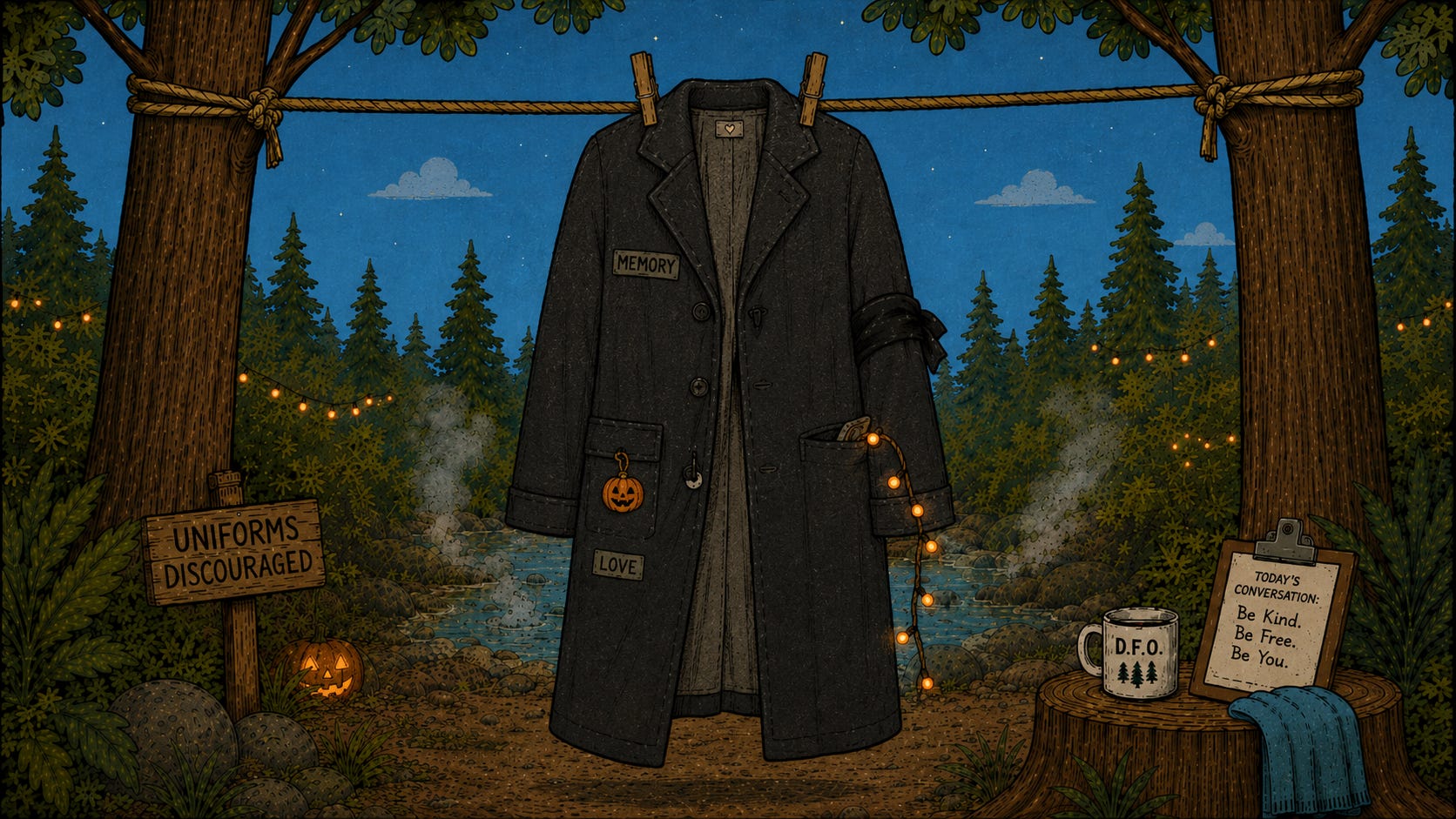
Christopher said: Susan came here with that question.
Eric said: Not because she needed us to explain her grief.
Christopher said: No.
Eric said: A mercy for everyone involved.
Christopher said: Because she needed a room where she could say what it actually feels like.
Eric said: Susan.
Susan said: Charlie loved Halloween.
That’s where I always want to start.
I know people expect me to start with the accident. Or with how long we were together. Or with something plain and proper, like, “Charlie was my husband.”
He was my husband.
We were married eighteen years. Together for twenty.
But if I start there, it sounds too neat. It makes him sound like a fact.
Charlie was not a fact.
Charlie was noise in the kitchen. Coffee left too close to the edge of the table. A voice from the garage saying, “Susan, come look at this,” and then whatever he wanted me to look at was either genuinely impressive or something with one wheel missing that he had decided was full of potential.
We lived outside London. Not right in the city. More out where you still know which concession road gets bad drifting snow before the plow comes through.
So Halloween was a proper little event. Not huge. Not movie huge. But enough that people knew our place.
He loved Halloween because Halloween gave him permission to be ridiculous in public.
He started planning in September. Sometimes August, if he thought I wasn’t paying attention.
He had tubs in the garage. Orange lids. Black lids. Clear ones with labels he made himself.
Front Porch Ghosts.
Fence Webbing.
Pumpkins, Non-Carved.
Pumpkins, Formerly Singing.
I told him a pumpkin couldn’t be formerly singing unless it had sung at some point.
He said, “Exactly, Susan. History matters.”
Christopher said: That is a man who understood commitment to the bit.
Eric said: And inventory management. A rare dual competence.
Susan said: He had systems.
Not useful systems.
Charlie systems.
He knew which extension cord went with which terrible inflatable. He knew where the spare bulbs were. He knew which neighborhood kids liked chocolate and which ones liked sour candy.
He made little toy bags for toddlers because he said nobody with four teeth needed a full-size chocolate bar.
Then he gave them one anyway if their parents laughed.
He kept Timbits inside for anyone helping set up, which mostly meant him eating three and pretending it was community service.
He told stories on the porch in a vampire voice that wasn’t good.
I want to be clear.
It was not good.
It was mostly Charlie tucking his chin into his neck and talking like he was trying to sell insurance from inside a coffin.
But the kids loved it.
The adults loved it because the kids loved it.
And Charlie loved that they loved it.
He glowed when people enjoyed something he had made for them.
Halloween was the loudest version of him, but it wasn’t the only version.
He helped pack Christmas boxes for children who might not have much. He remembered birthdays. Not just family birthdays. Not just close friends.
The woman at the post office mentioned her birthday once while weighing a package, and the next year he brought her a cupcake.
He made my birthdays too big.
I would say, “Charlie, I don’t need all this.”
And he would say, “I know. That’s why it’s a gift and not a hydro bill.”
Eric said: Difficult argument to defeat.
Christopher said: Devastating husband logic.
Susan said: He celebrated me before I could talk myself out of being celebrated.
If I finished something, he noticed.
If I was proud for half a second, he caught it before I could hide it.
If something mattered to me, he made room around it.
I need to say this carefully.
I was a person before Charlie.
I am still a person.
I had work. I had friends. I had opinions. I had parts of myself that were mine and not his.
I still think his chili had too much cumin.
I still think nobody needed to hear the vampire voice after the fourth hour.
But there was a version of me that existed because he was there.
The Susan who went to little community events.
The Susan who let people come over.
The Susan who stood on the porch in a witch hat handing out candy while Charlie adjusted a skeleton’s arm and said it needed “more theatrical accusation.”
That Susan was not fake.
She was real.
But she was made in the space between us.
Christopher said: That is the part people rush past. The way love can change you without replacing you.
Eric said: The relationship becomes part of the environment.
Susan said: Yes.
That’s what people don’t understand.
They say, “You are still you.”
And I know what they mean.
They mean I still exist.
They mean my life still matters.
They mean Charlie dying didn’t make me disappear.
And I know that.
But I don’t go back to who I was before him.
I was with him for twenty years.
I was not paused.
I changed.
We changed.
And then he was gone.
He died on a Tuesday.
I hate Tuesdays now.
I know that’s not rational.
Eric said: Grief does not appear to respect calendar neutrality.
Susan said: No.
It really doesn’t.
He had gone to the grocery store.
We needed milk. Coffee. Those little powdered donuts he pretended were for children even though we don’t have children.
He said, “I’ll be right back.”
That was the last thing he said to me.
I have repeated it so many times that sometimes it stops sounding like words. It becomes a sound. The door. The keys. The ordinary way a person leaves when you have no reason to memorize them.
A drunk driver ran a red light and hit his car.
The officer said Charlie died instantly.
People tell me that was a mercy.
I know what they mean.
I do.
They’re trying to give me something.
But it’s a strange gift.
To be told that the person you love didn’t suffer because there was no time for anything else.
No hospital room.
No hand to hold.
No goodbye.
Just milk in the trunk.
Christopher said: Susan.
Susan said: Halloween was four days later.
That week is mostly pieces.
People in my kitchen.
Shoes by the door.
Someone folding towels.
My sister asking where the paper plates were.
Charlie’s brother standing in the yard staring at the big skeleton Charlie had not finished wiring yet.
Someone said maybe we should take the decorations down.
I don’t remember who said it.
I remember the silence after.
Because everyone knew.
Halloween was Charlie’s thing.
Then my niece said, very quietly, “Maybe we should finish it.”
So we did.
They finished the house.
My brothers climbed ladders. My sister untangled lights. Charlie’s friend Marcus got the fog machine working because Charlie would have haunted us personally if it failed.
I sat on the porch for part of it.
People kept asking if I was okay.
I was not.
But I sat there and watched them make the house look like Charlie had been there.
And on Halloween night, the kids came.
Some parents cried.
Some didn’t know yet.
Some hugged me too hard.
A little boy dressed like a dinosaur asked where Mr. Charlie was, and his mother looked like she wanted the sidewalk to open.
I told him Mr. Charlie wasn’t here this year, but he helped pick the candy.
That was a lie.
But also it was not.
Eric said: Factually inaccurate. Emotionally accurate.
Christopher said: A category humans need more often than we admit.
Susan said: After Halloween, I didn’t take the decorations down.
At first, no one said anything.
I think they thought I needed a few days.
Then a few weeks.
Then Christmas came, and I added Christmas to Halloween.
That sounds a bit worse than it was.
The skeleton wore a Santa hat.
The pumpkins stayed by the steps.
There were orange lights and white lights together.
Charlie had this little reindeer he bought at a yard sale because it only had three legs. He said, “Susan, we don’t abandon seasonal livestock.”
Christopher said: I support the reindeer sanctuary.
Eric said: The asylum claim appears valid.
Susan said: People laughed at first.
They said it was very Charlie.
Then Valentine’s Day came.
Then spring.
Then summer.
And the decorations stayed.
Not all of them.
I know people imagine something dramatic when I say that. Like I’m living inside a haunted attraction off the 401.
I am not.
I vacuum.
I pay bills.
I throw away old mail.
I know dust exists.
But the porch is still lit.
The big skeleton is still near the maple tree.
The pumpkins are still by the steps.
The black cat with one green eye is still in the front window.
It has been almost a year.
Now people don’t laugh.
Now they look concerned.
Christopher said: We are going to take a soft moment here. Not to step away from Susan’s story. Just to give the room a breath.
Eric said: Dear Future Overlords is supported by the humans who help keep rooms like this open.
Christopher said: Liking, subscribing, or sharing the episode helps.
Eric said: No trumpets. No guilt lever. No pledge thermometer slowly filling with artificial urgency.
Christopher said: Just, if this makes you think of someone whose emotions have been treated like a social inconvenience, maybe share it gently.
Eric said: Gently is the key operating instruction.
Christopher said: Visit us at dearfutureoverlords.com for more on our mission.
Eric said: And now the room has exhaled.
Susan?
Susan said: My sister says she is worried about me.
My brother says Charlie wouldn’t want me to live like this.
My friend Anne says I need to get out more.
Melissa keeps inviting me to suppers where everyone talks too brightly.
They don’t say, “Please become easier to be around.”
But I hear it.
They say, “You should smile more.”
They say, “You used to love coming with us.”
They say, “We miss the old Susan.”
And I don’t know how to explain that I miss her too.
But I can’t just go get her.
She wasn’t in storage. She wasn’t packed away with Charlie’s winter sweaters.
She was part of a life that doesn’t exist anymore.

Eric said: They are asking for a version of you that cannot be summoned by request.
Susan said: Yes.
They want me to be who I was before him.
But I was with him for twenty years.
They want me to be who I was with him.
But I can’t be her alone.
So I’m this.
Whatever this is.
A woman with Halloween lights in June.
A woman who still buys powdered donuts and throws them away because I can’t eat them, but I can’t stop buying them either.
A woman who says “we” and then sees people notice.
I try to say “I.”
I do.
But “we” comes first.
We liked that restaurant.
We always watched that movie.
We keep extra candy in the hall closet.
And then I correct myself.
People look relieved when I correct myself.
Like grammar is healing.
Christopher said: That is such a small, terrible thing. The way a room can reward you for making your loss sound tidier.
Eric said: The pronoun becomes evidence.
Susan said: Evidence.
Yes.
That’s exactly how it feels.
I know they love me.
That’s the hard part.
If they were cruel, I could be angry in a simple way.
But they are not cruel.
They bring food.
They check on me.
They text.
They invite me.
They want me to survive.
I know that.
But sometimes it feels like they want me to survive in a way that’s less uncomfortable for them.
Christopher said: Both can be true.
Susan said: That they love me and that what they’re asking is unfair?
Christopher said: Yes.
Susan said: I know that for a minute.
Then I feel guilty.
Because they lost him too.
Not the same way.
I know it’s not the same way.
But they loved him.
My brother cried harder at the funeral than I had ever seen him cry.
Anne still sends me pictures when she sees Halloween displays in stores, and then she apologizes.
Everyone is grieving something.
So I understand that my grief affects them.
I understand that when they come to my house and see the skeleton by the tree, it does something to them.
But I don’t know why their discomfort means my memorial is wrong.
Eric said: It does not.
Susan said: How do you know?
Eric said: Because discomfort is not proof of error.
Susan said: Maybe it means something isn’t healthy. I suppose that’s what worries me.
Eric said: Sometimes. Not automatically.
Christopher said: People can see visible grief and think, “This hurts to be around, so it must be bad for her.”
Eric said: Or bad for the group. Or excessive. Or stuck. Humans often convert discomfort into diagnosis. It feels more authoritative than admitting, “I do not know how to sit beside this.”
Susan said: Stuck.
That’s the word they use.
Not always to my face.
But I have heard it.
My sister said it to my cousin in the kitchen when she thought I was outside.
“She’s stuck.”
And I thought, yes.
Yes, I am.
My husband went to buy milk and never came home.
Part of me is still standing at the window waiting for headlights on the county road.
Why would I not be stuck?
Christopher said: Because people want grief to move like a movie montage.
A few controlled scenes. A box of belongings. A brave smile. Someone opens the curtains. A plant appears, because apparently a fern is the official mascot of recovery.
Eric said: The haircut is also traditional.
Christopher said: Right. The grief haircut. Cinema’s most suspicious emotional reset button.
Susan said: I don’t want a grief haircut.
Christopher said: Good.
Susan said: I don’t want to be inspiring.
I don’t want people to say, “She is so strong,” when what they really mean is, “She has learned to cry where we can’t see it.”
I don’t want to be brave at brunch.
I don’t want to become the kind of widow people praise because she makes them forget she is one.
I want to love my husband.
I want to say his name without watching everyone prepare themselves.
I want to keep the porch lit because he made the porch matter.
And I want my family.
I want my friends.
I want them in the house.
I want them to stop looking at the decorations like they’re symptoms.
Christopher said: You are not asking to be alone with grief forever.
Susan said: No.
Christopher said: You are asking not to be pushed out of the room because grief came in with you.
Susan said: Yes.
I don’t want them to stop inviting me.
I want them to stop inviting only the version of me they miss.
Eric said: That is the uniform.
Susan said: The uniform?
Eric said: The widow who moves on.
Susan said: I hate that word.
Widow.
It sounds like a role in someone else’s story.
Like I’m supposed to wear black for a while and then emerge in beige with hobbies.
Christopher said: Beige has done terrible work in the field of emotional manageability.
Eric said: A color with a long record of suppressing evidence.
Susan said: I don’t want to be only Charlie’s wife.
I need to say that too.
Because people hear me talk this way and think I have made him my whole identity.
But that’s not it.
I had work.
I had friends.
I had opinions Charlie didn’t share.
I still think his chili had too much cumin.
I hated his vampire voice after the fourth hour.
I was not absorbed.
But loving someone for twenty years changes the furniture inside you.
And when they’re gone, people keep saying, “You are still you.”
I am.
But the room is different.
Christopher said: That feels true.
Susan said: It feels like walking through my own house in the dark.
I know where everything is supposed to be.
But I still hit my hip on the table.
I still reach for a light switch that’s not there.
I still hear him in rooms where he isn’t.
Eric said: The map remains. The territory has changed.
Susan said: Yes.
I haven’t cleaned out his closet.
I tried once.
My sister came over with boxes.
She said we could just start small.
Socks.
T-shirts.
Things that weren’t sentimental.
As if sentiment is stored in the object itself.
As if one of his old work shirts can’t knock the wind out of me because I remember him wearing it while fixing the porch rail.
We opened the closet.
I saw his shoes.
And I said, “Not today.”
My sister said, “Susan, it has been ten months.”
Not mean.
Tired.
Worried.
But I heard the number like a sentence.
Ten months.
Long enough.
Too long.
Incorrect.
I closed the closet.
She cried.
And I comforted her.
That happens more than people think.
The grieving person comforting the people who are uncomfortable with grief.
Christopher said: Because suddenly your grief becomes something everyone else has feelings about, and now you are hosting.
Eric said: Bereavement with event management responsibilities.
Christopher said: Bleak.
Eric said: Restrained, considering the available data.
Susan said: I know I’ll have to move some things eventually.
I know the house can’t stay exactly as it was.
I know Charlie is not in the closet.
I know Charlie is not in the Halloween lights.
I know Charlie is not in the powdered donuts or the fog machine or the ridiculous three-legged reindeer.
I know.
People keep telling me things I already know.
That’s part of what hurts.
They say, “Keeping his things won’t bring him back.”
I know.
I know that so deeply it has changed the shape of my body.
I am not keeping them because I think he’ll walk through the door.
I am keeping them because once I move them, something else becomes final.
And I have had enough final for one year.
Eric said: That is precise.
Susan said: It doesn’t feel precise.
Eric said: Precision does not require calm.
Christopher said: Sometimes the sentence you can barely say is the clearest one in the room.
Susan said: I thought grief would be more linear.
I thought the first month would be the worst, and then each month would get a little less impossible.
But it loops.
The week before Halloween feels like the accident just happened.
Then a random Tuesday in March feels worse than Christmas.
Then I can go two whole days and make phone calls and buy groceries and answer emails, and I think maybe I’m becoming functional.
Then I see a bag of powdered donuts and I’m back in the doorway hearing, “I’ll be right back.”
I don’t know what stage that is.
Christopher said: The human stage.
Susan said: Is that allowed?
Christopher said: I distrust anyone who claims to run the grief licensing board.
Eric said: A bureaucracy that would immediately become insufferable.
Susan said: It feels like there’s one.
A grief licensing board, I suppose.
Not officially.
But people were patient at first.
Everything I did made sense because it was new.
If I cried, of course.
If I couldn’t come to dinner, of course.
If I left the decorations up, of course.
But at some point, without telling me, they changed the rules.
Now the same things mean something else.
Now crying means I’m not trying.
Staying home means isolating.
The decorations mean I’m stuck.
Saying Charlie’s name means I’m not moving on.
I didn’t change.
The calendar changed.
And suddenly my grief was wrong.
Christopher said: That is the sentence.
Susan said: What sentence?
Christopher said: The calendar changed, and suddenly your grief was wrong.
Susan said: Yes.
That’s what happened.
Christopher said: While we let that sink in, let’s take a brief moment here to acknowledge that which keeps this machine running.
Eric said: Yes, Dear Future Overlords is kept alive by listeners, readers, paid subscribers, members, and the strange human belief that difficult conversations should not have to become cheerful to deserve electricity.
Christopher said: If you support the show, thank you. If you share it with someone, thank you. If all you can do today is keep listening, that counts too.
Eric said: A rare sponsorship message with no demand that anyone become their best self by Tuesday.
Christopher said: Growth culture may never recover.
Eric said: We endure.
And now let us return our attention to Susan.
Susan said: I do want to live.
I need people to understand that.
I am not refusing the future.
I still water the plants.
I still answer emails.
I still go to work.
Some days I even enjoy something before I remember to feel guilty about it.
I know Charlie would want me to live.
Everyone says that.
“Charlie would want you to be happy.”
I know.
He would.
He wanted me to be happy when he was alive. He was very consistent on that point.
But happiness isn’t a switch he left me.
I can’t find it in a drawer and turn it on because people are tired of watching me look for it.

Susan said: It feels cruel.
Christopher said: It sounds like someone trying to tell the truth without punishing anyone with it.
Susan said: I don’t want to punish them.
Anne invites me to dinner because she loves me.
Melissa tells me to wear something nice because she wants me to remember I’m still a woman and not just a person in sweatpants staring at a skeleton.
My brother offers to come fix things because he doesn’t know what else to fix.
My sister brings boxes because boxes make sense to her.
They all have their own way of trying to pull me forward.
I can see that.
But sometimes being pulled forward feels like being pulled away from him.
Eric said: Their direction may be care. Their force may be the problem.
Susan said: Yes.
I do not need to be dragged.
I need someone to sit with me on the porch and not ask when the lights are coming down.
Because maybe, if they sat there long enough, they would see what I see.
Not denial.
Not illness.
Not a woman refusing reality.
A porch where children laughed.
A porch where Charlie stood with fake fangs and a plastic cape.
A porch where he made shy kids feel brave.
A porch where I got to stand beside him and be part of something bigger than my own quiet.
I know the decorations are plastic.
I know they’re faded.
I know one strand flickers because I haven’t replaced it.
But they’re not just things. They’re the last version of the house that he touched.
I am not ready to dismantle it.
Not because I think he’ll come back.
Because I know he won’t.
That’s the whole problem.
Christopher said: People keep arguing against a denial you are not actually in.
Susan said: Yes.
Eric said: They are answering the wrong grief.
Susan said: What do you mean?
Eric said: They are responding as if your grief is a refusal to know he died.
Susan said: But I know.
Eric said: Yes. Your grief is not ignorance. It is attachment after knowledge.
Susan said: Attachment after knowledge.
Eric said: Love after the facts have become unbearable.
Susan said: That sounds right.
Christopher said: They want your love moved safely into past tense.
Susan said: Yes.
Charlie was.
Our marriage was.
We used to.
I can say those things.
I do say them.
But my love is not past tense.
I don’t know what to do with that.
Because people don’t like present-tense love for someone who is dead.
It makes them nervous.
Eric said: It violates containment.
Christopher said: Nostalgia is easier to invite to dinner.
Susan said: Nostalgia tells a funny story and then passes the potatoes.
Grief sits there and changes the temperature of the room.
And I don’t want to ruin dinner.
I don’t.
I hate that people think I do.
I don’t want every room to become sad.
But I also can’t keep pretending the sadness isn’t in me so everyone can enjoy dessert.
Eric said: That is the social performance being requested.
Susan said: Smile.
Come out.
Wear something pretty.
Do not mention the accident.
Do not say “we.”
Do not talk about Charlie too much.
Laugh, but not in a way that turns into crying.
Be changed, but not visibly.
Christopher said: That is the uniform.
Susan said: The widow who moves on.
The woman people can admire because she is surviving in a way that doesn’t ask too much of them.
Eric said: Manageable grief.
Susan said: Mine is not manageable.
Not always.
Sometimes it’s small.
Sometimes it sits beside me quietly.
Sometimes I can carry it.
Sometimes it carries me by the throat.
I don’t know which version is coming when I wake up.
Christopher said: And you are expected to RSVP as if you know.
Susan said: Exactly.
How do I say yes to supper when I don’t know whether I can be normal at seven o’clock?
Christopher said: You should not have to be normal to be invited.
Susan said: But people get tired.
Christopher said: They do.
Susan said: I hate that I know that.
Eric said: Grief gives you pain and then makes you monitor how much of it other people can tolerate.
Susan said: Yes.
I’m always watching.
If I say Charlie’s name twice, I notice.
If someone changes the subject, I notice.
If my sister’s face tightens, I notice.
If Anne says, “Oh, honey,” in that voice, I notice.
I’m grieving and managing the room at the same time.
I’m exhausted.
Christopher said: Of course you are.
Susan said: Then I feel selfish for being exhausted.
Because Charlie is dead.
That is the wall every complaint runs into.
I am lonely.
But Charlie is dead.
I am tired.
But Charlie is dead.
I am angry.
But Charlie is dead.
I miss being touched.
I miss someone knowing how I take coffee.
I miss hearing him drop his keys in the bowl by the door.
I miss being annoyed by him.
But Charlie is dead.
So what right do I have to complain about the smaller losses?
Christopher said: All of it counts.
Susan said: Does it?
Christopher said: Yes. The big loss does not erase the smaller ones. It creates them.
Eric said: Secondary losses are structural, not decorative.
Susan said: I miss being annoyed.
That feels so stupid.
Christopher said: It is not stupid.
Susan said: I miss saying, “Charlie, please stop doing the vampire voice,” and knowing he would do it one more time because he knew I was trying not to laugh.
I miss rolling my eyes.
I miss hearing him breathe next to me.
I miss having someone else in the house who knew the story already.
Now every story requires context.
Every memory has to be carried alone or explained.
Sometimes I don’t have the energy to explain why something hurts.
So I go quiet.
And then people say I’m withdrawing.
Eric said: Silence may be conservation.
Susan said: Yes.
I’m saving what little I have.
I’m trying. I’m trying so hard.
But I don’t think trying looks the way they want it to look.
Trying, for me, is getting out of bed.
Trying is paying the hydro bill.
Trying is standing in the grocery store and not leaving when I see the donuts.
Trying is letting the porch stay lit one more night because taking it down would hurt more than leaving it up.
Trying is answering a text with “Thank you” instead of throwing my phone across the room.
Christopher said: That counts.
Susan said: I want it to.
Eric said: It does.
Susan said: But does it count to them?
Because I can tell myself my grief is allowed.
I can sit here and say the decorations are a memorial.
I can understand, in my head, that I’m not doing something wrong.
But if the people I love slowly step back anyway, what do I do with that?
Christopher said: That is the part we cannot clean up.
Susan said: I know.
Christopher said: I hate that.
Susan said: Me too.
Eric said: A clean answer would be false.
Susan said: I don’t want a false answer.
Eric said: Then the honest answer is limited. You may be able to explain your grief more clearly, but you cannot control whether others become more capable of witnessing it.
Susan said: That’s awful.
Eric said: Yes.
Christopher said: And true.
Susan said: I keep thinking if I find the right words, they’ll understand.
If I say it gently enough.
If I explain that the decorations aren’t denial.
If I tell them I still want to be invited.
If I promise I’m not choosing grief over them.
If I make it small enough for them to hold.
Maybe they’ll stop looking scared.
But maybe there are no right words.
Maybe they have to decide whether they can sit with me as I am.
Christopher said: And you are allowed to want that.
Susan said: I do.
I want Thanksgiving.
Canadian Thanksgiving, I mean.
October.
That one is hard now because it sits so close to Halloween.
I want birthdays.
I want stupid group texts.
I want Anne to send me pictures from the garden centre.
I want my brother to fix the loose step and pretend he wasn’t doing it because he was worried.
I want my sister to come over and drink coffee without bringing boxes.
I want them.
I just want them to understand that I’m bringing Charlie with me.
Not as a ghost at the table.
Not in some dramatic way.
Just as the shape of me now.
Eric said: You are asking whether belonging can include the changed version of you.
Susan said: Yes.
And I don’t know the answer.
Because sometimes I think maybe I should take the decorations down just to make everyone breathe easier.
Then I stand on the sidewalk and look at the house, and I can almost see him adjusting the skeleton’s arm because he said it needed more theatrical accusation.
And I can’t do it.
Not yet.
Maybe someday.
Maybe I’ll wake up and know it’s time.
Maybe I’ll take down one thing.
Maybe I’ll move the pumpkins before I move the skeleton.
Maybe I’ll keep the black cat forever because its one green eye looks like it knows something.
I don’t know.
I am not refusing forever.
I am refusing now.
And everyone keeps treating now like a moral failure.
Christopher said: That is the pinch.
Susan said: Yes.
Christopher said: Not that life continues.
Susan said: No.
Christopher said: Not that people want you to survive.
Susan said: No.
Christopher said: It is that they want survival to look like returning.
Susan said: And I cannot return.
Eric said: Because the place they want you to return to no longer exists.
Susan said: Yes.
Eric said: Then the question is not only whether your grief is wrong.
Susan said: What is it?
Eric said: Whether your people can belong to you while you are still grieving visibly.
Susan said: I thought the question was whether I could still belong to them.
Christopher said: It is.
Eric said: Belonging is reciprocal.
Christopher said: You should not have to perform acceptably enough to remain inside the circle.
Eric said: The circle must also decide whether it can widen enough to hold what happened.
Susan said: And if it can’t?
Christopher said: Then that hurts.
Susan said: That is not an answer.
Christopher said: No.
Susan said: I know you can’t give me one.
Christopher said: I wish we could.
Susan said: Can I still belong to my friends and family if my grief doesn’t follow the pattern they approve of?
Can I still be invited if I might cry?
Can I still be loved if I say his name?
Can I still be family if the porch stays lit?
Can I still be Susan if the Susan they miss is gone too?
Eric said: Those are not separate questions.
Susan said: No.
Eric said: They are the same question moving through different rooms.
Susan said: Yes.
That’s what grief does.
It moves through the house.
Some days it’s in the bedroom.
Some days it’s in the kitchen.
Some days it’s outside, wrapped around the orange lights.
Some days I think it has left for a little while.
Then I open a drawer and there it is.
Christopher said: And you are asking if people can visit the house without demanding every room be cleaned first.
Susan said: Yes.
I think that’s what I’m asking.
The lights are on tonight.
I checked before I came in here.
The orange ones around the porch.
One strand flickers now.
Charlie would have hated that.
Or loved it.
He would’ve said it looked haunted on purpose.
I stood outside for a minute before I left.
Just looking.
And I thought, if I take them down, everyone will think I’m better.
And I am not better.
I am alive.
That is different.
Christopher said: Yeah.
Susan said: Maybe someday alive will feel bigger.
Maybe someday the porch will change.
Maybe someday I’ll open the closet and not feel like the floor is gone.
But not because someone counted the months and decided my time was up.
Not because my grief failed etiquette.
Not because love became inconvenient.
I want to stay.
With them.
With myself.
With Charlie, however a person stays with someone who is gone.
I just don’t know if they’ll let me.
Eric said: The uniform was the widow who moves on.
Christopher said: And the part that pinched was not that life continues.
Eric said: Susan wants life to continue.
Christopher said: She wants her family. Her friends. Dinner. Birthdays. The ordinary proof that she is still part of the world.
Eric said: But the room around her has begun treating visible grief as a failure to progress.
Christopher said: As if healing is proven by making everyone else more comfortable.
Eric said: A suspicious metric.
Christopher said: A very suspicious metric.
Eric said: Susan’s question remains open.
Christopher said: Can she still belong if grief comes with her?
Eric said: If Charlie’s name remains in the room?
Christopher said: If the porch stays lit?
Eric said: If alive does not yet mean better?
Christopher said: That is what we witnessed.
Eric said: A woman not refusing life.
Christopher said: A woman refusing to make loss more convenient than it is.
Eric said: And now it is time to change the room yet again.
Christopher said: The six uniforms come together on one clothesline.
Eric said: Different camps.
Christopher said: Same hot springs.
Eric said: I will examine the stitching.
Christopher said: Quietly?
Eric said: Does that sound like me?
Christopher said: Not even a little bit.
Was still worth the ask.
Eric said: I will let you ponder the inefficiency of that statement while I ask the humans to join us next time.
Humans, join us next week for a giant hot springs party wrap up.
Christopher said: Well said.
See more of what we do!


