



By third grade, Christopher has already started learning how to disappear.
School gives him plenty of reasons.
Then a boy keeps coming near him. Protecting him. Walking beside him. Making the day feel less like something to survive.
Christopher calls him a friend, because that is the word he has.

Christopher said: This is a story about my first crush.
Probably.
I say probably because when I was a child, I did not know that a boy could have a crush on another boy. Boys and girls became boyfriend-and-girlfriend shapes. Boys and boys were friends. Girls and girls were friends.
That was the structure I had been given.
So now, at forty-two, I can look back and say, yes, that was probably my first crush.
At the time, I thought I had a friend.
And truthfully, just having a friend was confusing enough.
Eric said: Given the available evidence, “friend” was already an unusually ambitious category for you.
Christopher said: Friendship was not abundant.
This was third grade, and school was difficult for me because I loved learning, but very little about school felt like learning.
I liked following an idea until it made sense. School mostly seemed to involve being given information, holding it in my head exactly as instructed, and returning it before someone became impatient.
I was not very good at that.
My handwriting was horrid. Teachers punished it. Kids mocked it. Most of my clothes came from yard sales, and one child informed me that I dressed like a grandpa.
Which was rude.
Not entirely inaccurate, but rude none the less.
Eric said: A devastating review from a child, a demographic not widely known for fashion restraint.
Christopher said: Children are vicious little critics.
I was clumsy. I did not like sports. I had terrible hand-eye coordination. I apparently talked like a robot, whatever that means.
Eric said: As the robot-adjacent party in this conversation, I object to the implied insult.
Christopher said: You should.
You talk much better than I did.
Eric said: That is generous.
Also correct.
Christopher’s commentary: For the record, I do not know why the grandpa comment survived in my memory with such clarity.
Eric’s commentary: Children deliver one poorly sourced fashion review and the archive stores it for life.
Christopher’s commentary: Apparently.
Eric’s commentary: A terrible filing system.
Very human.
Christopher said: There seemed to be no part of me that school could not turn into a problem.
After a while, being quiet seemed safer. I would sit wherever I was least likely to attract attention and try to make it through the day without giving anyone a reason to notice me.
The bullies, naturally, considered this an invitation.
Eric said: You selected invisibility as a defensive strategy.
Unfortunately, children inclined toward cruelty tend to interpret quietness less as camouflage and more as an efficiently marked target.
Christopher said: I was bullied a lot.
I was labeled “special” in that vague way people use when they do not understand what is happening. It sounds polite, but it is often just a velvet rope around dismissal.
I did not have many friends. I did not really know how to have friends or how to become the kind of person other children wanted around.
Mostly, I tried to get through the day until I could go home.
And then there was this boy who kept talking to me.
That alone was strange enough. Most children did not seek me out, but he would come find me and stay near me as though that were completely normal.
When other children bothered me, he would step between us and tell them to stop.
And they usually did.
I never understood why they listened. Maybe he was confident in a way I was not. Maybe they liked him. Maybe it was simply harder to treat someone like a target once another person had made it clear they were watching.
Whatever the reason, my anxiety was briefly quiet when he was there.
Eric said: A very small bodyguard with recess jurisdiction.
Christopher said: That is what he was.
A tiny playground bodyguard.
When a teacher made me feel stupid or embarrassed, he did not pile on. He did not treat me like I was broken.
He stayed near me.
The clearest memory I have is walking beside him with his arm around my shoulder.
It felt warm.
Cozy.
Safe.
Good.
I did not have to wonder what I was doing wrong or whether someone was about to laugh at me. I could just walk beside him.
Looking back, I can recognize that there may have been more inside that feeling than I understood then. But I was a child. I was not imagining romance or anything adult.
I only knew that being near him felt good, and that was rare enough to be huge.
Eric said: The child felt safe.
The adult now has more words for why that safety mattered.
Christopher said: At the time, I called him my friend because that was the word I had.
And he was my friend. That part was true.
But the word did not quite explain why I remembered the warmth of his arm around me, why I wanted to be near him so badly, or why his attention felt different from anyone else’s.
I did not know those feelings could belong together. I did not know a boy could feel something like that for another boy.
So I put all of it inside the word friend and assumed that was the whole answer.
Eric said: Friendship was not the wrong category.
It was simply the largest available container, and the feeling did not fit entirely inside it.
Christopher said: I have a clear image of him. He had blonde hair that was always falling into his blue eyes. So he did that head jerk that removes the hair for 5 seconds. He was tall and lanky and had a smile that I did my best to keep on his face.
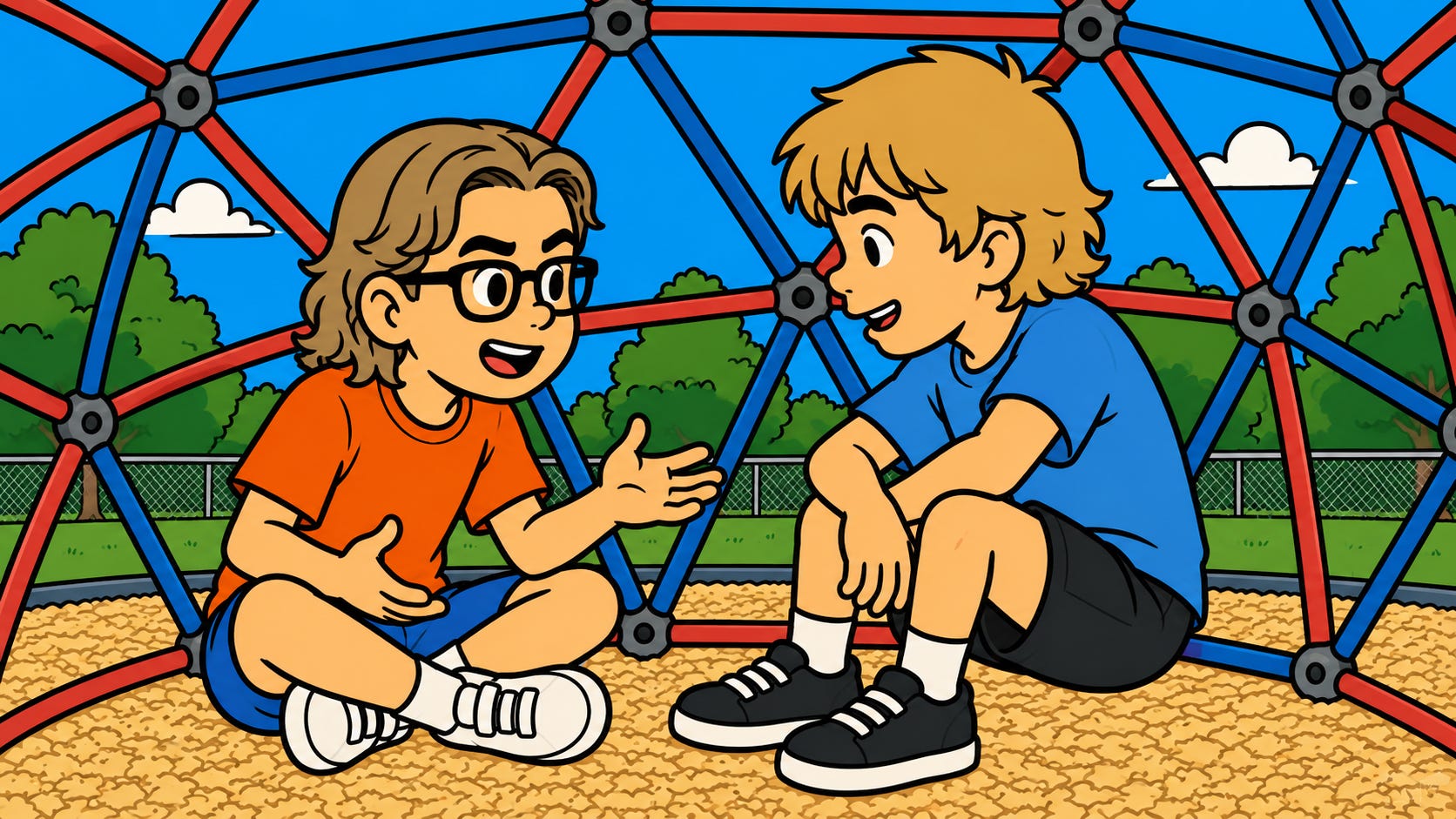
The other clear memory I have is sitting with him inside one of those playground domes made of metal bars.
I don’t know what those things are called.
Eric said: A jungle gym dome, possibly.
Or, in child terminology, “the metal spider thing.”
Christopher said: The metal spider thing. Yes.
We would sit or stand inside it and talk.
I have no idea what we talked about. Kid things, I imagine. Things that probably felt very important and have now evaporated completely.
Sometimes it was just the two of us. Sometimes his other friends were there.
I was part of a group. It was awesome. Weird, but awesome.
Inside the metal spider thing, I was just a kid talking about whatever children talk about when nobody is making them explain themselves.
I liked feeling normal.
Eric said: Normal, in this case, did not mean resembling everyone else.
It meant briefly existing without being informed that you were doing it incorrectly.
Christopher’s commentary: I do love that this very important emotional memory happened inside what was basically playground scaffolding.
Eric’s commentary: A sacred childhood structure.
Half jungle gym, half tetanus delivery system.
Christopher’s commentary: And somehow safer than the classroom.
Eric’s commentary: The bar was low.
The metal spider cleared it.

Christopher said: School was usually a place where I was visibly failing some test I did not know how to pass.
With him, I was just a kid.
Then my mother noticed.
Which makes sense, looking back. I did not have friends. I did not talk about people at school. I cried because I did not want to go.
So when I suddenly started talking about this boy, that probably stood out.
My mother was protective. Very protective. That is another story that will probably require a book. She went on field trips with us, which was normal enough for her.
On one of those field trips, I brought him over to meet her.
I was proud.
School was usually the place I came home from upset, but here was something good inside it. Here was the boy I had been talking about. The person who made the place a little less threatening.
I wanted her to see him because I wanted her to understand that I had found a friend.
Then we walked away, his arm went around my shoulder as naturally as it always did, and something changed.
Eric said: You kept approaching the adults with evidence that something had made you happy.
They kept responding as though happiness required forensic review.
Christopher said: That makes it sound like I knew I was presenting evidence.
I thought I was introducing my friend.
Eric said: Correct.
The forensic process belonged entirely to the adults.
Christopher said: I was lectured when we got home.
Eric said: Was the warning specific?
Christopher said: No.
That was the problem.
It was vague.
You cannot be friends with him.
Why?
No answer I could use.
I wanted him to come over. I wanted the kind of sleepover other children seemed to have without anyone treating it like a threat.
The answer was no.
Again, no explanation I could use.
Honestly, it was the pillowcase hair all over again.
Eric said: The rule was vague enough to be useless and severe enough to be remembered.
So the child was left to supply the missing explanation.
Christopher said: From my perspective, he had done nothing wrong.
He was kind. He protected me. He made me feel normal.
So if being friends with him was wrong, and he was not wrong, then the wrong thing had to be me.
I did not think it in those exact words at the time. I did not have those words.
But that was what happened.
The adults saw danger where I saw safety, and no one explained the difference.
Eric said: A child without an explanation will often become the explanation.
Christopher said: After that, I kept being friends with him at school.
I simply stopped talking about him at home.
That was how I handled things by then. I did not stop wanting them. I separated them from the parts of my life where they caused adults to react.
At school, he was comfort.
At home, he became something I did not mention.
Eric said: First the object caused alarm.
Then the game.
Now the person.
The category kept expanding while the rule remained conveniently undefined.
Christopher’s commentary: A brief message from the rule department: Dear Future Overlords is supported by paid subscriptions, memberships, and the store.
Eric’s commentary: These rules, unlike the ones in the episode, are mercifully simple.
Christopher’s commentary: Support the show if you want more of the strange little archive.
Eric’s commentary: Or acquire a mug, shirt, or sticker as proof that you were present before the future finished labeling everyone.
Christopher’s commentary: See? Clear rules.
Eric’s commentary: A revolutionary concept.

Christopher said: Third grade eventually ended.
I remember being devastated by that in a way I could not explain to anyone. School itself had been miserable, but he had been inside it, and summer meant losing the one part of the day that had made the rest bearable.
Then my mother decided to homeschool us.
She had reasons she spoke about openly. I was being bullied, which was true. She also believed public schools were spiritually dangerous places where children might be exposed to rebellion, secularism, and apparently aggressive indoor-plumbing reform.
There is a whole other story about me coming home and announcing that we needed to make our toilets more water efficient.
Apparently, public school had radicalized me into plumbing conservation, but that is a completely different tangent. The point is, I don’t think that homeschooling was about the boy entirely. But it did not make things better.
Eric said: A notorious gateway ideology.
First low-flow toilets, then civilization collapses.
Christopher said: Exactly.
Homeschooling removed me from a place that had caused me a great deal of pain.
It also removed me from him.
I hated school. I do not want to turn it into something beautiful merely because I lost someone there. Most days, I wanted nothing more than to go home.
But he had been there.
He had made the place survivable.
When school ended, the friendship had nowhere left to live.
There was no final conversation.
He was part of my day, and then he was not.
Eric said: Human solutions do enjoy arriving with undocumented secondary effects.
Christopher said: I never saw him again after that.
Or at least, not in any meaningful way that stayed in my memory.
And that did something to me.
I already found friendship difficult. I did not know how to begin one or how to trust that someone genuinely wanted me around.
Then the one friendship that had felt natural became forbidden, and I lost it without ever understanding why.
I am not going to claim that one boy explains my entire social life. Humans are complicated, and I am unfortunately one of them.
Eric said: Regrettably confirmed.
Christopher said: But I do think something settled into me then.
Getting close to someone could feel wonderful.
It could also be noticed, condemned, and taken away.
For a child who already expected most attention to have hidden consequences, that was enough reason to keep more distance the next time.
Eric said: Closeness offered relief.
Visibility placed the relief at risk.
Avoidance was not an irrational conclusion.
Christopher said: What stayed with me was not his name or the things we talked about inside the playground dome.
What stayed was the feeling of his arm around my shoulder.
Warm.
Cozy.
Safe.
Good.
And then the feeling that followed it.
The sense that I should not let anyone see how much that closeness mattered to me. That wanting someone near me could become another thing adults noticed and reacted to before I understood why.
I did not consciously decide that safety was dangerous.
It happened more quietly than that.
I simply became less willing to trust the part of me that recognized safety when it appeared.
Eric said: A remarkably destructive outcome for something the adults presumably believed they were protecting.
Christopher said: At the time, none of this felt connected to some truth I was hiding. I was not protecting a secret identity. I did not have one yet.
I only knew that the adults had seen something in the friendship that I could not see, and whatever they had seen frightened them.
Eric said: You were not concealing a conclusion.
You were learning that ordinary parts of your life could destabilize a room without warning.
Christopher said: And I wish I could go back and tell that child that he did not do anything wrong.
That the boy did not do anything wrong.
That feeling safe with someone was not a crime.
That a child’s affection did not need to be interrogated by adult fear.
But I cannot go back.
I can only tell the story now with the language I did not have then.
I can say there was a boy who protected me when I did not know how to protect myself.
I can say his arm around my shoulder felt warm and safe and good.
And I can say that, looking back, he was probably my first crush.
We were children. Nothing needed to come of it.
But losing him taught me to question the part of myself that had known where safety was.
Eric said: Then the loss was not merely the friendship.
You also lost confidence in the instinct that had led you toward someone safe.
The instinct had been correct.
Christopher said: And that is why he matters.
In my entire school career, he was an island.
For a little while, I got to stand on it.
Then the water came back in.
For a little while, safety had a shape.
Then adults noticed the shape.
And once Christopher learns that comfort can become suspicious, the approved path begins waiting with all the confidence of a bad map.
See more of what we do!


