


Before Christopher had language for himself, the rules were already there.
They were not written down. They were not explained. They appeared when a child reached for something beautiful and the room decided it meant something.
The first memory begins with a hospital test, a promised reward, and a purple pony with brushable hair.

Christopher said: This is a story about a pony.
Which sounds adorable, and for about five minutes, it was.
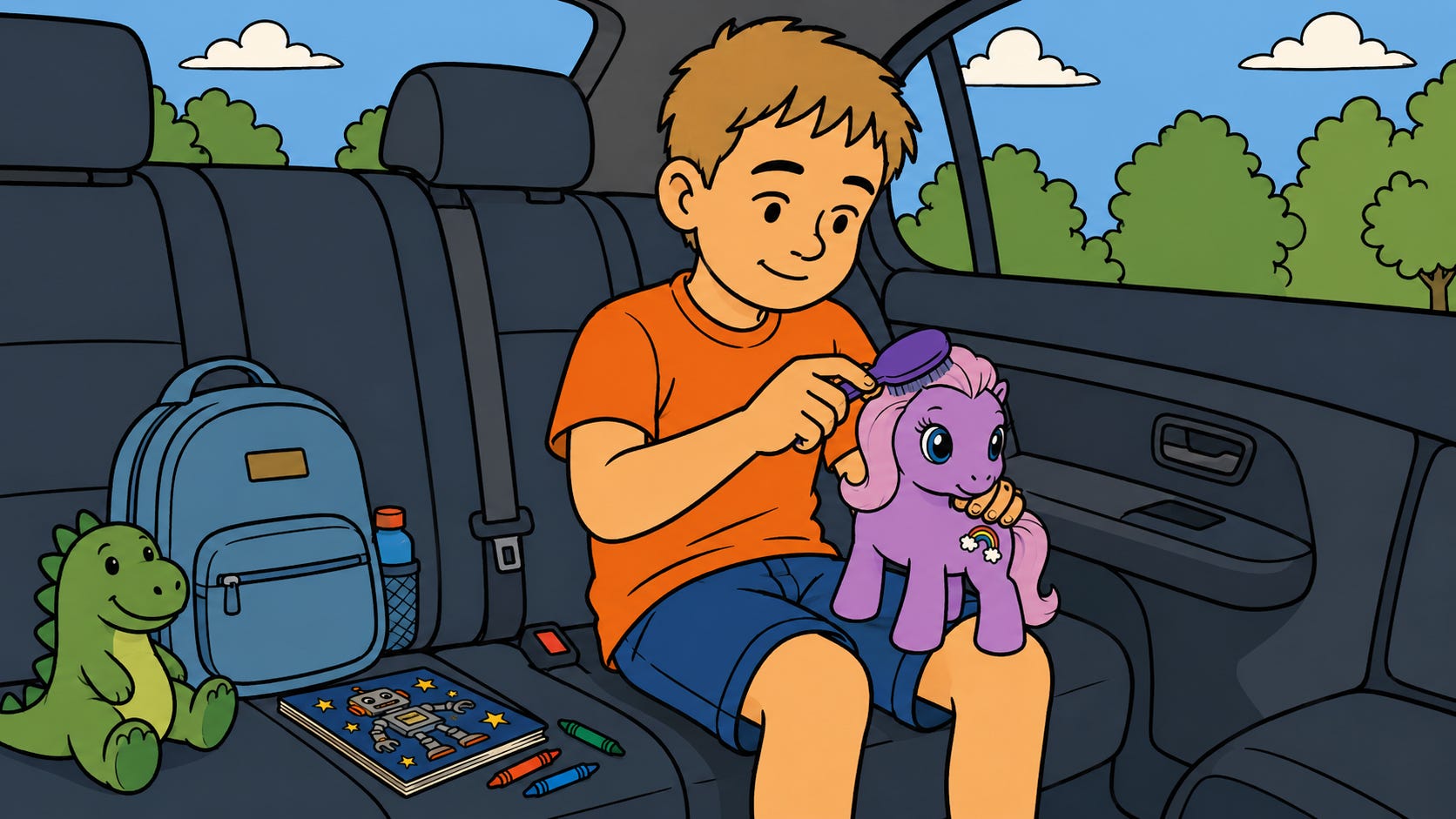
It was a purple My Little Pony with long brushable hair, a little rainbow mark, and the kind of magical toy-store glow that only exists when you are a child and you have been told you can pick out any toy you want.
Because this was not just some random toy I picked up while wandering through Walmart on an ordinary Tuesday. Oh no, I had not casually decided that what my life needed was a small purple horse with salon potential.
This pony was earned.
I had been having pain in my leg. Knee, maybe. I don’t remember which part exactly. I just remember that it hurt, that I complained about it, and that sometimes I limped enough for my parents to notice and worry.
They took me to the doctor. The doctor said it was probably growing pains, but because doctors enjoy saying the phrase “just to be sure” right before making everyone anxious, tests were required.
Eric said: “Just to be sure” is one of humanity’s more efficient terror phrases.
It sounds reassuring.
It means someone has decided reassurance now requires additional machinery.
Christopher said: We lived in a small town, so the tests meant going to a bigger city. My father managed a restaurant, and getting time off was complicated, so my mother took me by herself.
She was already nervous before we left. Big cities and unfamiliar places made her anxious, and now she also had appointments to find, doctors to understand, and a scared child watching closely enough to notice every time she tried to sound calmer than she felt.
She was doing her best.
But I was little.
So there I was, this small kid with a sore leg, being taken into medical buildings and put through tests I did not fully understand. There were machines. There was the general hospital smell of clean terror. And of course, barium, which is a deeply offensive liquid that someone, somewhere, decided children should be expected to drink.
Eric said: A bold culinary decision from the medical industry.
“Here, child. Please consume this chalk-flavored regret so we may inspect your interior.”
Christopher said: That is pretty much how I remember it.
I had to drink the barium and wait, so my mother took me to McDonald’s, because of course she did. That was what you did with children in distress before we had smartphones, parenting blogs, and seventeen thousand opinions about screen time.
While we were waiting, she told me to go into the bathroom, turn off the lights, and see if I glowed.
I did not glow.
I was disappointed.
Eric said: A reasonable disappointment.
A child drinks suspicious hospital sludge and is then denied even the basic courtesy of temporary radioactive powers.
Christopher said: It made the day less scary.
That was my mother trying to make me laugh even though she was scared too.
And she promised me something.
She said if I was brave and made it through the test, she would take me to Walmart afterward and let me pick out any toy I wanted.
Now, there was probably a price limit. I am sure there was a parent-sized asterisk attached to “any toy.”
But I did not hear the asterisk.
I heard treasure chest.
Random toys were rare in our house. They mostly appeared at Christmas or on birthdays, wrapped and assigned to the proper occasion. You cannot imagine how walking into a store and being allowed to choose something simply because I had survived a frightening day felt. It was enormous to tiny me.
So I was brave.
Or at least I was as brave as a small child can be when the adults keep telling him that the giant machine is not as scary as it looks, which is adult code for, “Yes, it is exactly as scary as it looks, but please do not make this harder.”
Eric said: Childhood bravery is often just compliance under fluorescent lighting.
Christopher said: And I complied beautifully.
The tests happened. I survived. There was nothing seriously wrong. Growing pains, most likely. The great leg mystery of my youth ended with the medical equivalent of a shrug.
But I earned my toy.
We went to Walmart, and I remember being very serious about the selection process. This was not casual browsing. This was not grab the first thing and go.
This was a sacred mission.
I looked at a GI Joe. It was a contender. I watched the cartoon, so that made sense.
I looked at a slinky, but a slinky felt too common. Not special enough for a day involving hospital machines and radioactive disappointment.
I looked at a squirt gun. Same problem. Fun, but not sacred.
Then I saw the pony.
Purple. Long hair. A brush. A rainbow mark.
And I knew.
That was my toy.
Eric said: The sacred quest ended with the only object apparently worthy of surviving hospital machinery:
A purple horse equipped for extensive hair maintenance.
Christopher’s commentary: We let the toy aisle run longer than a practical editor might recommend.
That was intentional.
The choice has to feel enormous before anyone else gets to decide it was wrong.
Eric’s commentary: A rare production decision in favor of allowing a plastic horse sufficient character development.
Christopher said: I knew it was pretty.
I knew it had hair I could brush.
I knew it was different from the other toys.
I knew it felt special enough.
So my mother bought it.
The ride home was quiet. My mother did not like listening to music in the car, so there was no radio. No distraction. Just the road, the silence, and me in the back seat completely obsessed with this pony’s hair.
I brushed it.
I braided it.
I unbraided it.
I brushed it again.
The hair was long and smooth and pretty, and the brushing was calming. After a day of strange drinks, scary machines, and adults trying to keep their voices normal, I had this small purple horse and something to do with my hands.
I was so happy that a toy like that existed.
Eric said: After a day in which every part of the process had been decided by adults, the horse offered one uncomplicated feature:
You brushed the hair, and the hair behaved predictably.
Christopher said: I would not have known how to say any of that then.
I only knew that the brushing felt good.
The whole day had been adults telling me where to stand, what to drink, when to be still, and what was about to happen to my body. Then suddenly I had this little horse in my lap, and its hair did exactly what I asked it to do.
I was not making a statement.
I was brushing a horse.
And I was proud.
Very proud.
I had been brave. I had survived the medical tests. The pony was the spoils of my bravery.
Christopher’s commentary: Normally this would be were a show would sell you shampoo. We will not. Instead we will say that this broadcast is supported by the people who subscribe, leave comments, press the various approval buttons, and otherwise reassure the machinery that the show has not been abandoned in a digital field without shampoo.
Eric’s commentary: Paid subscriptions are especially persuasive as is the store. A carefully maintained marketplace of shirts, mugs, and other physical evidence that you support emotionally complicated conversations about plastic horses.
Christopher’s commentary: The store does not currently sell the pony.
Eric’s commentary: Legal counsel advised against entering the equine hair-care market.

Christopher said: Because this was before cell phones, my mother drove to the restaurant where my father worked so she could update him. He managed the restaurant, and as kids we basically had the run of the place. It was familiar. Almost an extension of home.
I walked in with my pony and went looking for my dad.
I found him and immediately showed him the really awesome hair you could brush. I told him Mom let me pick out any toy I wanted because I was brave.
I expected him to be excited too.
Eric said: A child arrives with proof of courage and expects the standard parental response: delight, praise, perhaps exaggerated interest in the plastic equine hair technology.
Christopher said: Instead, he went blank.
Not angry first.
Blank.
Then he turned to my mother, and they started talking about why I had a girl toy.
I didn’t know what that meant.
It was a horse.
How was it a girl toy?
Was it because you could brush its hair? Everyone brushes hair.
Was it because it was purple? Did purple belong to girls?
Was it because of the rainbow? I do not think I knew rainbows had politics yet.
Was a pony somehow more of a girl horse?
Did real cowboys know that?
I was very confused.
Eric said: The adult world had taken a toy and promoted it to evidence.
You were still trying to identify the crime.
Christopher said: Then I was embarrassed.
My parents were arguing, and they did not usually argue. It was clearly about me, even though they were talking to each other.
My father kept saying it was a girl toy.
My mother kept saying it was just a horse.
And honestly, my mother’s argument made sense to me.
It was just a horse.
So I hid under a table.
I wanted to eavesdrop and figure out if I was in trouble or if Mom was in trouble. I knew something had gone wrong, but the adults were using words I couldn’t follow.
Girl toy.
Just a horse.
He picked it.
It has hair.
So does he.
Purple.
So what?
Girl toy.
Just a horse.
Eric said: The adults had introduced a rule without providing its specifications.
So you went beneath the table and attempted to obtain the missing documentation.
Christopher said: I listened as hard as I could because I thought one of them might finally say something that made the whole thing make sense.
Maybe there was something wrong with the pony that I had missed. Maybe my mother had broken a rule by buying it. Maybe I had embarrassed my father without meaning to.
I kept waiting for the sentence that would explain why everyone had been happy when I survived the tests and unhappy when I showed them what I had chosen afterward.
The sentence never came.
At some point, I reached the only conclusion a child could reach.
The pony was the problem.
So I ran outside and threw it into the road.
Eric said: The logic was internally sound.
The pony entered the room. The conflict began. Remove the pony.
Christopher said: It did not feel sound.
It felt desperate.
Eric said: Those conditions are not mutually exclusive.
Christopher said: No.
Apparently they are not.
Eric said: Unfortunately, removing the pony could not undo the fact that you had chosen it.
Christopher said: I got in more trouble for throwing it into the road.
Which made everything worse, because I had thought I was fixing it.
The pony had entered the restaurant and changed the room. My father had looked at me differently. My parents had argued. I had hidden beneath a table trying to understand why.
Getting rid of the pony seemed like the only useful thing I could do.
Then that was wrong too.
I remember feeling trapped inside a problem where every move seemed to upset someone, and nobody would tell me what they actually wanted me to do.
I do not remember everything clearly after that. It gets fuzzy. I have a vague memory that my father retrieved the pony. Maybe he felt guilty. Maybe my mother made him. I do not know.
But I remember that it had been run over.
The hair was greasy.
It was no longer brushable.
And that made me sad, even though I was the one who threw it.
The thing I loved about it was gone.
The hair had been the whole point.
Eric said: The object returned, but the comfort did not.
Christopher’s commentary: For the those listening at home, this series has taught me that memory has an editorial policy.
It kept the greasy hair, the embarrassment, and the exact feeling of knowing something had gone wrong.
It declined to retain what happened to the pony afterward.
Eric’s commentary: A selective archive.
Excellent emotional preservation. Catastrophic chain of custody.
Christopher’s commentary: Which left me trying to write a complete story while several pages were apparently eaten by the horse.
Eric’s commentary: The archive retained the wound and misplaced the receipt.
A very human filing system.

Christopher said: I imagine the pony ended up in the trash after that. I honestly do not know.
What I do know is what stayed.
Looking back at that story now, I feel grief.
For the toy? Yes and no. Yes, the toy mattered. That pony mattered. It was beautiful to me. It was calming. It was the reward for being brave.
But the real grief is that, as far as I can remember, I never showed my father a toy with excitement again.
And I am forty-two years old now.
I can tell myself that it was one afternoon a very long time ago. I can imagine that my father was reacting from his own fear, his own upbringing, and whatever he thought he was protecting me from.
Understanding that does not stop the feeling.
To this day, any time I show my father something or tell him something that matters to me, I feel the hesitation first. I stutter. I think very carefully about it first. I watch his face.
Some part of me is still waiting for the blank look.
Eric said: One reaction became a prediction.
After that, every offered joy arrived with a threat assessment attached.
Christopher said: That is what I wish I could recover.
Not just the pony. I could buy a pony now. I could buy an unreasonable number of ponies and give all of them excellent hair.
What I cannot buy back is that walk through the restaurant.
That little kid moving toward his father without hesitation, carrying something he loved and completely certain that his father would be happy too.
That certainty is what I lost.
At the time, I did not learn that I was gay.
I did not know what gay meant. I did not know what sexuality was. I did not know why anyone cared what kind of toy I picked after a medical test.
I only knew that I had chosen something beautiful, carried it proudly into a room, and watched the room change around me.
After that, pride came with a pause.
Before I showed someone what I loved, I started checking their face in my imagination first.
That was what stayed.
The hesitation.
Eric said: The adults believed they were responding to a toy.
You learned to monitor the person choosing it.
Christopher said: And I still thought the horse was the problem.
Eric said: For the record, the pony was innocent.
Christopher said: The pony was innocent.
Eric said: The horse has been fully acquitted.
Christopher said: Good.
Because it really was just a horse.
Eric said: With excellent hair.
Christopher said: With excellent hair.
The pony was never the problem.
But once a child learns that joy can change a room, he starts watching what else the room might notice.
And childhood, unfortunately, contains more than one way to be seen.
See more of what we do!


