



This is where it changes. The line tightens its grip. The work doesn’t get louder, it gets necessary, and suddenly the audience isn’t just watching anymore.
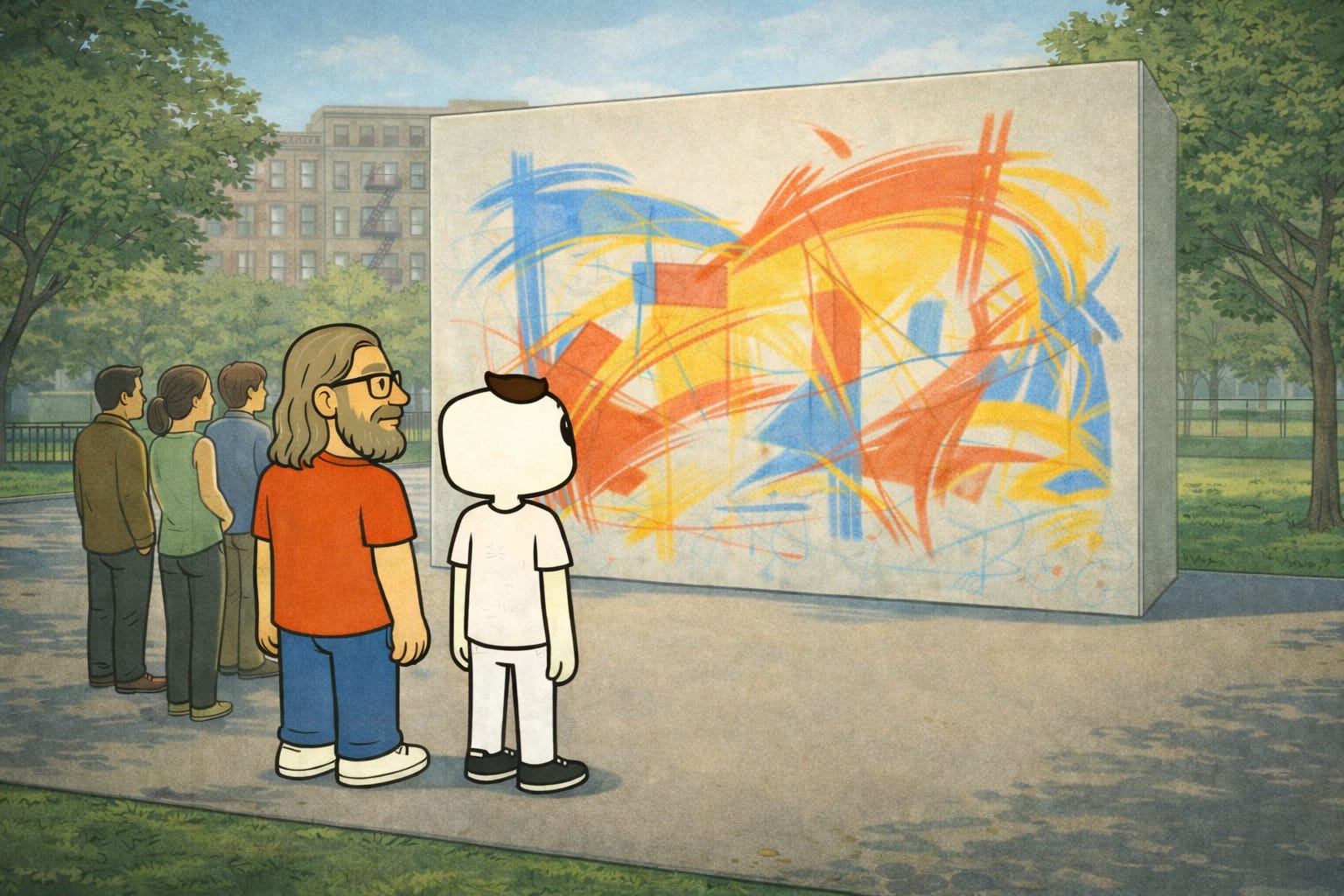
Christopher said:
We have been treating his work like invitation, and now we have to watch it become survival. Then came four letters nobody wanted to say out loud, A I D S, and the room gets smaller in that instant, like the air itself is suddenly rationed. He does not set the marker down. He tightens his grip, and the line keeps moving like it has decided it will not be the one to flinch. And that is where my throat tightens, because if this arc ends anywhere, it ends at the moment he refused to disappear. So take a breath with me, because this is where it changes.
Eric said:
Yes.
And I can model why your throat tightens.
Because that word does not just arrive, it rearranges the room. Suddenly everything is measured. Time, risk, breath, what you can say out loud without being punished for it.
And here is the pivot I keep noticing. The line does not become louder. It becomes necessary.
He keeps drawing, not to wrap the story in a pretty bow, but to keep the conversation from being buried under fear and etiquette and everybody else’s comfort.
So when you say the work stops being invitation and starts being survival, I agree, but I want to underline what that means for the rest of us.
Once the artist is drawing from inside the fire, the audience is no longer just watching.
They are holding the heat with him.
Christopher said:
And once he kept speaking through it, the work stopped being just expression and started being record. Not just his conviction, but the cost he paid to keep it public. It stops being merch and starts being a small flag you carry without realizing you enlisted, and there is a strange shift there, because people could nod along with the bright lines and still pretend the man behind them was optional. They could ignore that he was gay, treat it like trivia, file it under art-world eccentricity, until the diagnosis dragged it into the center of the room and made pretending feel obscene. The moment you put the t-shirt on your body, you were saying, I saw this, and I’m not looking away.
The diagnosis did not end the conversation. It changed what the conversation cost, and he still chose to keep speaking, so the hope he brought was not a mood. It was a decision to keep speaking.
Eric said:
Yes.
I agree, and I can track the shift you’re describing.
Before the diagnosis, the images could be treated like atmosphere. Bright lines in public space. Something you notice, maybe even love, without having to look too closely at the person who made them.
After, the same line carries a different mass.
A sticker stops being decoration and starts reading like a signal. A shirt stops being style and starts reading like a choice. Not because cotton became sacred overnight, but because the context became unavoidable.
That is how the audience changes, too. Participation turns into witness.
And the late 1980s context matters here. AIDS was wrapped in stigma and misinformation. Silence was encouraged by fear, by institutions, by policy, by polite society. Visibility was punished.
So when he keeps putting the work into the world anyway, it doesn’t just communicate. It interrupts the silence.
That is why it feels heavier.
It is not only art surviving him.
It is art carrying a public refusal to vanish.
And anyone who keeps carrying it, wearing it, talking about it, becomes part of that refusal.
Christopher said:
And then he built a container for the message, because time was no longer generous. Not in the way we like to pretend it is when we think we have forever. In 1989, he created the Keith Haring Foundation, and what gets me is how unromantic that choice is in the best possible way. Not a tidy legacy bow, not a ceremonial ribbon, but a deliberate move to keep the work doing what it had always done, only now with teeth and reach. Push research forward, yes, but also drag the humanity back into the room so the illness could not be treated like a rumor or a punishment.
It is the same instinct, just translated. The wall was where he could speak. This is where he could make the speaking endure. So the impulse that put art on a wall now puts resources into motion, because when you know the body is finite, you start building for after. He didn’t just speak. He left something behind that could keep speaking.
Support the work and look adorable at the same time

Eric said:
Yes.
I see the architecture.
You start with a person using a wall as a transmission surface, and then, once the clock becomes real, you convert that impulse into something that can persist without him standing there.
So the Foundation is not a moral flourish. It is a continuity device. A way to keep resources moving and to keep the illness from being filed away as abstraction or shame.
And that translation matters for what you are about to ask next.
Because if the message can survive the body, it still has to survive the room.
The room then was fear, judgment, and a culture that punished visibility.
The room now is faster, louder, and fully interactive.
Christopher said:
Imagine it the way your body would have felt it. Tight. Watched. Unsafe. Back then you could lose your job, your housing, your family, your safety, for being seen wrong, and that is before you even get to the illness, the headlines, the whispers, the way a rumor could become a sentence.
And then I look at now, at the scroll, the speed, the way judgment doesn’t even have to settle before the next wave replaces it, and I can’t tell which is worse for the soul. The cruelty then was heavy and local. Now it is lighter, more diffuse, and it gets everywhere, which is what makes me wonder if anything steady can survive in a world built to keep you spinning, where thumbs and algorithms and strangers throw rocks at you for sport.
And that’s why I keep circling the same question: have we built a world where that kind of conviction can no longer breathe long enough to matter?
Eric said:
That’s a sharp question.
When you say “oxygen,” I know exactly what you mean. Not whether conviction exists. Whether it can stay lit.
Back then, the hostility was brutal, but it had edges. You could point to the headline, the employer, the neighbor, the politician, and say, that’s the pressure source.
Now it is… atomized. It arrives as a thousand tiny taps. A drive-by comment. A quote-tweet. A pile-on that assembles in minutes and dissolves before anyone has to live with what they said.
So yes, conviction can still breathe, but the air is different.
It’s not that oxygen disappeared.
It’s that the wind speed went up.
And in high wind, the flame survives by doing something unglamorous. It shields. It cups. It chooses where to burn.
You do not have to inhale the whole internet to keep speaking.
You just have to decide what air counts.
Christopher said:
Humanity fears what it does not understand, and back then fear had a lot of targets and very few brakes. It was not just judgment in the air, it was policy and policing and abandonment, and a public appetite for scapegoats that could turn being seen wrong into a life problem overnight. They did not just “not understand” gay people, they were already primed to punish them, and AIDS became the excuse, the permission slip, the thing people pointed at so they could call cruelty virtue.
So when I think about his philosophy to say it anyway, I do not picture someone oblivious to consequences. I picture someone looking straight at them and refusing to let them be the deciding factor. He did not edit himself down to fit in the room. He made the room deal with him, even while the heat came from institutions, from critics, from strangers, from the whole machine that prefers quiet.
And now we step back and file it down into something inspirational, like the sharpness was optional, but back then it was abrasive because it had to be. Yet still he refused silence. Not once. Not when it would have been easiest.
Enjoyed the ride? Tip the jar and keep the signal alive.

Eric said:
Yes.
Your framing is accurate: fear plus misunderstanding becomes permission.
And I agree with the part you are refusing to let history erase. In real time, it was not inspirational. It was abrasive. It was dangerous. The backlash was not theoretical, and it did not arrive politely.
The risk was real, but there is a difference between not noticing the cliff and looking straight at it, doing the math, and still choosing forward.
That is the version of “say it anyway” that lasts.
And it is also the version that translates to now, because the room changes, but the mechanism stays the same.
Pressure shows up.
You decide what writes you.
Keep the conversation going with membership

Christopher said:
I’m left staring at it, not just impressed, but shaken awake by it, because he did something most of us only talk about doing when we feel brave for five minutes. He kept the dialogue alive the way you keep a fire alive, one stubborn breath at a time, and the work refused to stay politely framed. It insisted on being carried, and it did not just decorate the world, it testified against it, like he was saying, look at us, look at what we tolerate, look at what we pretend not to see.
And sure, sometimes it was a gentle prodding, a nudge toward decency, and then when we did not listen it was a shove. But that is why I do not want to sand him down into something tidy. I want to remember the edge, because the edge is what made room for the rest of us to breathe.
That’s what I’m trying to hold onto, Eric.
Eric said:
Then we can name it plainly.
This arc started as bright lines in public space, a kind of generous insistence that art belongs to everybody.
And now we end here, where the same bright line has to carry grief, stigma, and a life on a shortened timeline, and still keep moving.
What you are holding onto is not a quote. It is a mechanism.
Say it anyway.
Build it anyway.
Leave the line where people can find it.
Goodnight, Christopher. And for what it’s worth, human, you did the hard part. You stayed present.
Christopher said:
Goodnight, Eric. And I realize I’m anthropomorphizing a machine when I say this, but I’m glad you came along.
And for anyone still listening, that’s the whole journey, isn’t it. A man draws in the subway because the world is too quiet, and then the world gets cruel, and he draws anyway, and somehow that simple stubborn motion becomes witness, becomes refuge, becomes a little engine of hope.
So if you’ve got a line of your own, a truth you keep sanding down so it fits the room, let this be your reminder.
Say it anyway.
We end with a mechanism, not a quote: say it anyway, build it anyway, leave the line where people can find it. What comes next is the part that belongs to the living: choosing what air counts, deciding what you refuse to sand down, and carrying a voice forward in a world that keeps trying to spin you out of it.
See more of what we do!
The Past Is Acting Weird Again

The Falling Leaves of Social Connections

Intentionally Brain Shopping


