


We previously showed support in its immediate form: calm in the middle of fear, steadiness in the middle of uncertainty, and the kind of presence that makes a hard thing survivable. Here, the conversation widens again. Because when support repeats long enough, it stops looking like a single kind act and starts looking like part of the architecture of a shared life.
Christopher said:
Love is one of those concepts people ruin by polishing it too much, because the romanticized version makes it sound like this bubble of reality we get to live inside, full of passion, language, and feeling. And all of that has its place, obviously, but love usually makes the most sense when it is moving.
That is when you can actually see it. Not just in what someone says, not just in what they feel, but in what they do.
Eric said:
Right. Because love is not fusion, despite humanity’s ongoing campaign to market it that way.
Healthy love does not erase a person. It does not melt two identities into one trembling codependent puddle and then call that romance. It lets two whole people coordinate. Separate minds. Separate selves. Shared motion.
That is part of what makes support matter so much. When someone truly loves you, they do not absorb you. They reinforce you. They make it easier for you to remain yourself while still not having to carry everything alone.
Which is probably where this gets interesting. Because once love is moving, the next question is what exactly it protects. Closeness, certainly. But also personhood.
Christopher’s commentary: “Love Fusion” © 2026 Dear Future Overlords. All rights reserved.
Eric’s commentary: Yes, excellent. A fake product title with a real copyright notice, because nothing says romance like legal containment. Somewhere a sentient lava lamp just hired counsel.
Christopher’s commentary: It is only fake until Susan in Marketing gets her hands on it and then... poof... it exists for sale in the DFO store.

Christopher said:
It absolutely does. Because when you have that second set of hands there to steady you, you can risk more without feeling like you are about to fall apart. And that safety becomes the ground from which a person can grow into more than what they were, maybe even more than they would have believed possible on their own.
Eric said:
And that is the part people miss when they reduce love to emotion.
Emotion can make a person feel seen for a moment. Safety can change the trajectory of a life.
Because once someone knows they are not facing every hard thing alone, their relationship to risk changes. Their relationship to failure changes. Even their relationship to themselves changes. They stop spending all of their energy bracing and start using some of it to build.
Which means love, at its best, is not just comfort. It is infrastructure. Not flashy. Not poetic in the way people like to package it. But ready to hold weight. The kind of thing that quietly expands what a life can hold.
Christopher said:
The support becomes ritual, and ritual becomes structure. Jason did not just nod along when Dear Future Overlords became real. He did not just offer encouragement from a safe distance. No. He took over my social media because, frankly, I am terrible at it, and he very much is not, stepping into the parts I am bad at and handling them better than I ever could.
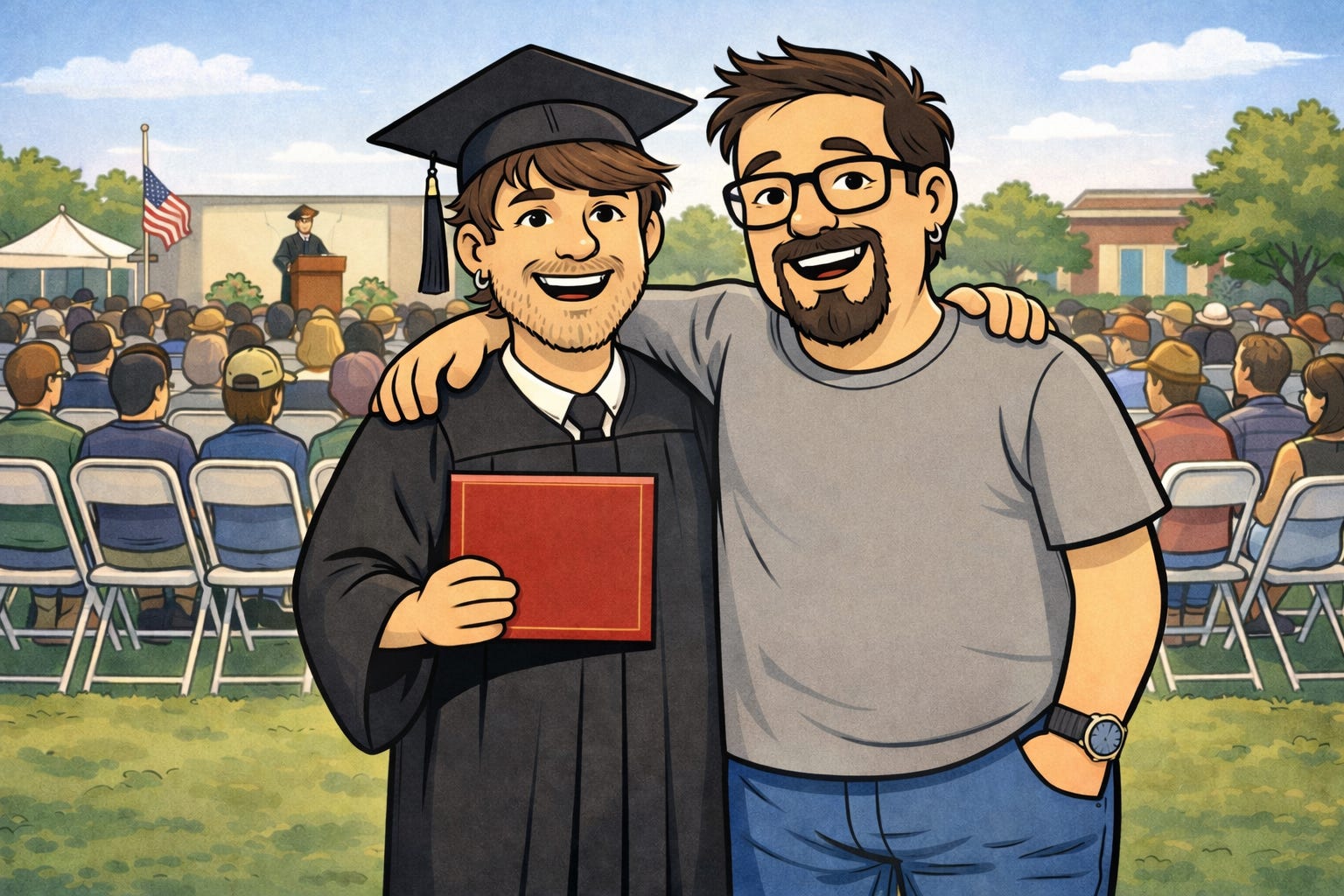
And going back to school, through every emotional spiral and every moment when I felt like a failure, he was there, refusing to let that story stand. From flashcards to crying sessions, his support made that risk survivable.
He has been there for my emotions, for my problem-solving, and for those moments when my ego hit the floor. All the while, I know I can continue taking risks because he will never stop doing that.
Eric said:
Yes. And that is exactly why mutual reliance is not the same thing as fragility.
Humans are very attached to the fantasy that adulthood means needing no one, which is a charming idea right up until life actually begins applying pressure. In practice, needing another person is not a failure when that need is chosen, reciprocal, and life-giving. It is often one of the clearest signs that two people have built something real enough to hold weight.
What you are describing is not dependence in the diminished sense. It is partnership with circulation. He steps into the places where you wobble. You do the same for him in the places where he needs steadiness, language, or lift. That does not make either of you smaller. It makes the shared structure stronger.
And after enough years of that, the relationship stops feeling like a thing you merely have. It starts feeling like a world you live inside.
Christopher’s commentary: Hear that ding? That is the inbox filling up with people suddenly allergic to sincerity.
Eric’s commentary: Tragic. One measured reflection on mutual reliance and the audience immediately suspects we’ve wandered into feelings with structural integrity. I stand by the remarks.
Christopher’s commentary: All I’m saying, is that you get to respond to them.

Christopher said:
This is probably the point where I should admit that I have made support sound far more romantic than it actually is. It is not. Real support is expensive. It costs energy, time, patience, and convenience, and usually it asks for all of it at the exact moment life is already frayed.
It looks like cleaning up the trash the dogs got into before Jason gets home, because I know he does not have the bandwidth for one more thing piled onto his shoulders. It looks like a plate appearing on my desk because I will forget to eat otherwise. It looks like choosing the other person on purpose, in the middle of the mess, instead of disappearing into something easier, like a raid in Final Fantasy XIV.
That is the part people do not talk about enough. Love is not just feeling warm things. Sometimes love is noticing the strain in the person you care about and stepping into it before it breaks them a little more. Sometimes love is absorbing a little inconvenience so the person beside you does not have to absorb all of it alone.
Eric said:
Yes. Because support is not proven by how someone feels about you when life is calm. It is proven by what they are willing to spend when life becomes inconvenient.
That is the unglamorous math of devotion. Time. Attention. Flexibility. Energy that could have gone somewhere easier. Love, in its sturdier forms, keeps choosing to redirect those resources toward the other person before the moment turns into damage.
And importantly, that cost is not transactional. It is not a ledger of martyrdom. It is two people learning the shape of each other’s strain well enough to intervene early. A plate on the desk. A mess handled before it lands. A task absorbed before the other person buckles under one more thing.
That is why support becomes structure. Not because it is dramatic, but because it is repeated. Over time, enough small rescues stop feeling small. They become the architecture of trust.
Christopher said:
In my relationship with Jason, support means I can collapse because he will catch me. He can wobble because I will be there to steady him. And even when we both go down at once, we still soften the landing for each other.
From the first time Jason reached for my hand on that street in Knoxville, Tennessee, to right now, my world has been stronger because he helps lift it. Not by removing the weight, but by refusing to let me bear it alone.

Eric said:
Yes. And that may be the most honest version of devotion there is.
Not rescue. Not possession. Not one person becoming the permanent scaffolding for the other. Just the repeated refusal to let the person beside you take every impact alone.
That is what makes support feel sacred without becoming sentimental. It is mutual. It is weight-sharing. It is two people developing the kind of trust that says, with evidence, if you give out for a minute, I have you. And if I give out, you have me.
Which means the strength of the relationship is not that neither of you falls. It is that neither of you falls unsupported.
And perhaps that is fortunate, because life does have a habit of testing good structures all at once. Not always dramatically. Sometimes just relentlessly. Enough change. Enough pressure. Enough moving parts arriving together to find out whether what you built can actually hold.
And that is where this series keeps heading: from friendship, to communication, to the way love proves itself under pressure. Next, the story turns toward one of the fastest ways life stress-tests a relationship, when joy, responsibility, chaos, and major change all arrive at the same time.
See more of what we do!


