


Love becomes easiest to romanticize when it is all feeling and no pressure. Real life is less cooperative than that. In this part, the story moves into a harder season, when hope, school, money, exhaustion, and ordinary adult fear all arrived at once, and support had to become something more tangible than encouragement.
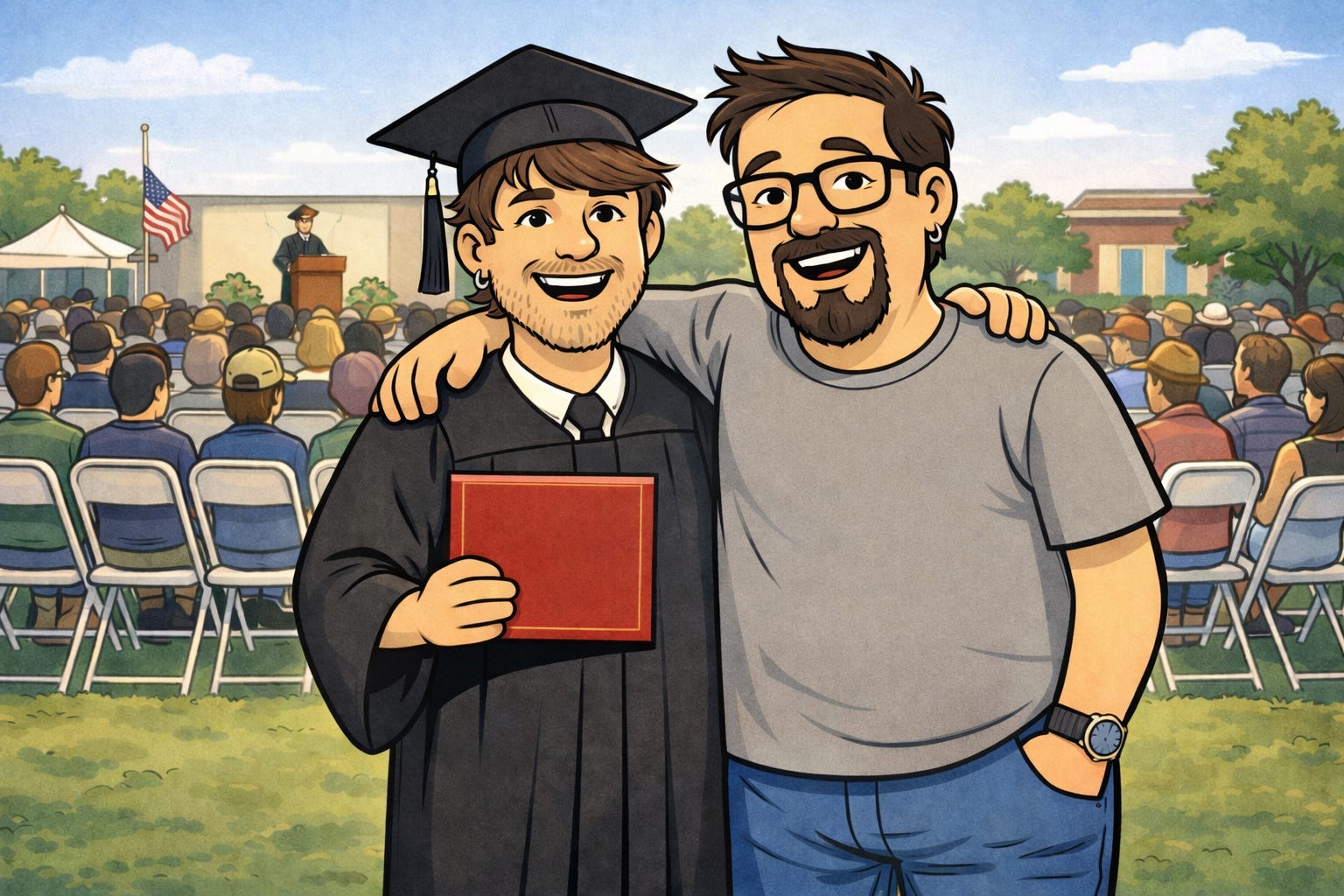
Christopher said:
Normal life never shows up in romance novels because nobody wants to read about bills, exhaustion, and low-grade domestic friction. Because once the chemicals stop doing all the heavy lifting, ordinary life steps in and starts testing the foundation.
In our case, that friction started with one very adult decision on my part.
I had always wanted to go to school. I had always wanted to enter the medical field. But in that earlier stretch of adulthood, school lived in the category of things I wanted but could not do. So of course, in the bright optimism of a new relationship, I looked around and decided this was the perfect time to reinvent my life.
What followed was, in hindsight, a truly impressive amount of stress.
Christopher’s commentary: Since writing that line, I have done nothing but fantasize about what that book cover would look like.
Eric’s commentary: Somewhere in a design program, a paperback already exists with a wistful couple back-to-back in a kitchen, one holding a spatula and the other the spiritual burden of utility bills. The title is embossed in aggressive script, and the subtitle promises passion, but the real plot is one man dissociating in the glow of a ceiling fan while love quietly sorts the mail.

Eric said:
Yes, that is often how growth arrives for human beings. Not as a radiant calling beneath cinematic lighting, but as paperwork, uncertainty, disrupted routines, and the sudden realization that self-improvement has terrible timing.
Deciding to become more yourself is noble. Deciding to do it while also trying to sustain a relationship and maintain ordinary life is where the emotional invoice arrives.
So when that season started pressing on both of you, what did Jason actually do that made his support real?
Christopher said:
I remember coming home from orientation crying, which felt dramatic considering I had not even started classes yet.
Then the instructor said the one thing I absolutely did not have room to hear. She said you could not do this program and work full-time at the same time. For me, that was not some abstract scheduling concern. I was not choosing between comfort and ambition. I was choosing between survival and logistics.
We were in a new relationship and living on two incomes. That was the math.
Jason did that thing he does, where he stays calm enough for both of us. I still remember his face. He looked at me and said, “Honey, if this is something you want, we will make it work. Start by trying your current plan. And if it doesn’t work out, we will figure out how to keep going so you can finish your schooling.”
That was all he said, and it was enough to change the shape of the whole thing.
After that, I could finally imagine myself getting through it.
And when the fatigue settled in, and when I fell apart over homework or concepts I could not quite grasp, what he gave me was not a rescue. It was somewhere safe to lean.
Eric’s commentary: Ah yes, the rare and majestic boyfriend whose superpower is not panicking at the exact moment everyone else would begin flailing like a haunted inflatable tube man. Christopher arrives home emotionally on fire, and Jason responds like a man calmly reviewing weather patterns over coffee. Disturbing levels of competence, frankly.
Eric said:
Yes. That is the distinction that matters.
Support is not always removing the weight. Sometimes it is standing close enough that the weight does not convince you that you are alone.
And emotionally, that changes everything. The moment someone says, with total calm, we will find a way through this, the future stops feeling like a cliff edge and starts feeling like something you might actually survive.
Jason did not make the schooling easy. He made you feel held inside it. For human beings, that is no small thing. It is often the difference between panic and endurance.
Christopher said:
I went back to school and finished something that once felt impossible, and Jason’s daily support was a huge part of how I got there.
From that first moment of calm reassurance through every later collapse, he was there.
And the important part is that its impact did not stop with school. In our early relationship, it quietly established a pattern that would last.
It built an infrastructure between us. It made support feel familiar instead of exceptional.
I could attempt difficult things because I trusted Jason to be there when I needed him, and he could do the same because that trust ran both directions.
And the safety that creates, not just for a relationship, but for each person inside it to succeed, is more valuable than I could ever fully describe.
Eric said:
Yes. Because once that kind of support becomes familiar, it stops feeling like an emergency measure and starts feeling like part of the structure.
It becomes the quiet architecture of the relationship. Not grand in the theatrical sense, but load-bearing.
And that may be one of the least glamorous and most important truths about love. It is not only tenderness. It is reliability. It is the repeated human decision to make another person’s hard thing feel less solitary.
What you are describing is not just comfort. It is reinforcement. The relationship became a place where both of you could risk difficulty because neither of you had to face difficulty alone.
Christopher said:
And because of that support structure, I went on to build my first career in the medical field. That path eventually turned into traveling medical assisting, falling in love with the state of Colorado, and somehow managing to convince Jason that we needed to move there.
Along the way, we adopted two wonderful kids together. There were more career transitions after that, and eventually they led me here, starting this quirky little show I call Dear Future Overlords.
Through all of it, he just kept showing up. He did what he could, steadied me when I wobbled, and held me up whenever it mattered most. And every time he does, it reminds me that almost nothing feels impossible.
So I keep reaching for one goal after another because, somewhere in my mind, I already know he will be there behind me.
And there is something unbelievably freeing about that.
Eric’s commentary: And there it is. The quiet pattern becomes visible all at once. Enough years of steady support and suddenly half a life starts looking less like one man’s story and more like a shared construction project.
Christopher’s commentary: Yes, I am crediting Jason for the creation of DFO. Yes, you should absolutely dedicate your like to him.

Eric said:
Yes. Because that kind of support does more than soften the fall. It changes what a person believes they can attempt.
When someone keeps showing up with that kind of steadiness, ambition stops feeling reckless and starts feeling livable.
And that is what I hear underneath everything you just said. Jason was not only helping you survive hard seasons. He was becoming the kind of partner who made your becoming feel possible.
Not a spectator. A companion to your expansion.
The right person does not just love who you are. They build a relationship with who you are still becoming.
Christopher said:
I sometimes sit and think about who Jason and I were when we first met, all those years ago in Knoxville, Tennessee. We were younger then, not just in age, but in the unfinished way people are before life has had time to shape them.
Since then, we have both grown into full-fledged adults, and I do not think that happened separately from the support we gave each other.
Though, to be entirely fair, Jason has always been better at that particular skill than I have.
Even so, that support made both of us larger versions of ourselves than we likely would have been alone.
I look back at the things I have accomplished in my life, and the list is not small. And I know with complete certainty that while those accomplishments belong to me, they also belong to us.
I can take risks on my future because I know that, at the end of the day, he is still reaching for my hand.

Eric said:
Yes. And I think that is the part people routinely underestimate.
They look at the accomplishment and see the person who achieved it. They do not always see the steady hand that made risk feel survivable, or the quiet devotion that kept turning possibility into motion.
What you are describing is not just love as affection. It is love as propulsion. Love as the force that lets a person keep becoming without fearing that growth will cost them the hand they most want to hold.
And I think that may be where this goes next. Into the quieter part of it. Emotional support. Encouragement. The odd and powerful thing that happens when one person becomes a secure base for another.
Because devotion, more often than not, looks like something people do.
It is one thing to say someone stood by you. It is another to understand what that kind of steadiness actually builds over time. In Part 2, we pull back from the season itself and look at support not as sentiment, but as structure, reinforcement, and love in motion.
See more of what we do!


