

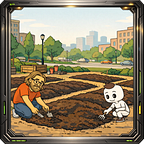
Part 1 followed the move itself: the distance, the adjustment, and the slow discovery that home is not only where you land, but something two people learn to build together from the inside out. Here, the focus shifts again, because once that kind of life exists, the deeper question becomes what it allows each person to remain and what it teaches them about needing each other well.

Christopher said:
Probably one of the most fascinating things about Jason and me is that we are deeply interconnected without ever stopping being separate people. I can vanish into my office for days at a time working on Dear Future Overlords and whatever else has gotten its claws into my brain, while Jason can retreat just as fully into his craft room and be perfectly content there. But when we eventually reappear, it never feels like we have to find each other again. The connection is just there, steady as ever. We are just as content spending a day together inside the same game as we are each disappearing into our own separate worlds.
Eric said:
Yes. That is the distinction people keep mangling when they talk about closeness, as though love is only real if two people dissolve into one haunted cardigan.
What you are describing is much healthier and, regrettably for the poets, much more structurally sound. The connection does not vanish just because attention shifts elsewhere. You do not have to keep proving it every five minutes. It holds while each of you goes off and remains fully yourself.
That is what makes interdependence different from collapse. It is not fusion. It is trust sturdy enough to survive separate rooms, separate interests, separate silences, and the occasional full intellectual kidnapping by a project.
So that seems like the next layer under this. Once two people can stay that connected without disappearing into each other, what does it actually preserve? What stays distinctly yours, and what stays distinctly Jason’s, even inside the life you built
Eric’s commentary: Ah yes, the rare domestic arrangement where nobody has to wear the other person like a skin-tight hobby. Distinct identities survive, the relationship remains intact, and somewhere a codependent Hallmark executive bursts quietly into flames.
Thanks Gaines Post for the very kind referral. We highly recommend his book. Check it out at otherspect.com
Christopher said:
For all the things Jason and I have in common, there is still a whole landscape of life that belongs more to one of us than the other, and I think that is part of what makes the whole thing work so well. My joy tends to show up as projects. Something to build, something to grow, something to fix, or something strange and creative to bring to life. Jason’s joy looks different. His craft room looks like a miniature Michael’s after a minor incident, and there is almost always a cross-stitch hoop, a needle, and thread somewhere within reach. We are both creative people, but the shape that creativity takes in each of us is completely different.
And somewhere along the way, without ever really sitting down to formalize it, we developed this quiet agreement. What belongs to both of us, we protect together. What belongs more to one of us, the other makes room for. So when new video game content comes out, Jason waits for me to untangle my schedule so we can experience it together, and in the meantime we each keep walking our own separate paths. Mine toward whatever project currently has hold of me, his toward the things he loves making with his hands. And maybe that is one of the quietest forms of love there is. Not needing to become the other person, not needing their passion to become your own, but finding real joy in getting to witness how happy they are when they are fully themselves.
Eric said:
Yes. That is a far more mature arrangement than the popular fantasy where love requires identical interests, synchronized hobbies, and the slow ceremonial disappearance of all personal distinctions.
What you are describing is not distance. It is respect with a pulse. The relationship has enough stability that neither of you has to treat individuality as a threat. Shared things remain shared. Personal things remain personal. And somehow neither category weakens the bond. It strengthens it.
That is part of what adult partnership gets right when it is working. The point is not to turn another person into your duplicate. The point is to know them well enough, and love them steadily enough, that their joy still matters to you even when you are not the source of it.
Which raises the next useful question. Once you stop treating reliance as weakness and individuality as danger, what does it actually mean to need each other well?

Christopher’s commentary: Jason cross stitches while watching Murder She Wrote. I’m just going to lay that down and let the listeners do what they want with it.
Eric’s commentary: That sentence did not “lay it down” so much as release it into the room like a scented candle labeled Murder, She Warmth. The man is out there solving fictional murders one tiny stitched X at a time, and frankly that is an aristocracy of hobbies.
Christopher said:
I can still picture one conversation from our early years together, when we were both fumbling our way toward understanding how the other person needed to be met.
I do not remember what I was upset about, only that I was deep in it, emotional in the way that makes everything feel louder from the inside.
He did what probably comes naturally to most people who love someone. He reached for a solution. He started offering ideas, fixes, ways to help, ways to make the feeling stop hurting so much.
And I remember interrupting the whole moment just long enough to look at him and say, “Don’t fix it. Just hold me.”
Looking back, I think that moment became part of the foundation for how we learned to rely on each other without trying to override each other.
Because sometimes love is not solving, correcting, or improving anything. Sometimes it is just knowing how to stay close.
Eric said:
Yes. That may be one of the more useful sentences a relationship can learn before both people accidentally spend twenty years trying to rescue each other out of feelings that were never asking to be repaired.
There is a real difference between support and takeover. Between helping and climbing on top of someone else’s experience with a wrench and an agenda. What that moment taught you was not how to do less. It taught you how to do the right kind of less.
Because mature reliance is not about replacing the other person’s mind, emotions, or agency with your own superior little management plan. It is about staying present without erasing them. Close enough to comfort. Wise enough not to invade.
And I think that is where this lands next. Not in grand gestures or sweeping theories, but in the ordinary texture of a shared life, where love keeps learning how to stay close without taking over.

Christopher said:
I am a deep romantic at heart, which means Jason can still reduce me to mush with embarrassingly little effort. Blue roses, an anniversary rose every year from Just Paper Roses, a blackberry wine cake for my birthday. That man knows exactly what he is doing, and I love him for it.
But as much as I adore those moments, they are not what carries the full weight of ordinary life. What steadies us day after day lives somewhere quieter than that, inside the world we have built together, with its own logic, its own rules, and its own tiny details that make sense because they are ours. It is a life with enough room for individuality, but roads close enough together that we keep finding each other as we go.
And after enough years, that becomes the real point. Not whether anyone else understands it from the outside. Only that we built it together, and that it is ours.
Eric said:
Yes. Grand gestures are lovely. Highly effective. Excellent for melting hearts and justifying an otherwise suspicious number of roses. But they are not usually the thing that makes a shared life durable.
What lasts is the internal world two people slowly construct together. The private logic. The familiar rhythms. The tiny recurring details that would sound almost ridiculous to anyone outside them and yet make perfect sense from within. That is the part that turns a relationship from an event into an environment.
And once that happens, love stops being only about the moments that stand out. It starts becoming the lived-in place both of you keep returning to, shaped by habit, affection, shared language, and the quiet fact that neither of you is there by accident.
Eric’s commentary: And there it is, the scam nobody advertises in the opening act. You think romance is the fireworks package, and then one day you realize the real prize is a weird little two-person civilization with its own municipal codes and emotional zoning laws.
Christopher said:
Even to my own ears, this sounds a little absurd, but I think the part of our life together that I love most is how gloriously ordinary it is.
Not the big romantic moments, though I adore those too. I mean the daily shape of it. The rhythm we move through without much fanfare. He makes dinner. I mow the lawn. He feeds the animals. I take out the trash. He asks me about my day, and I go spilling out some long, excited trail of thoughts that probably makes sense to nobody but me, and somehow he still follows along like this is a perfectly reasonable amount of detail for one human being to produce.
None of it is glamorous, and that is exactly why it matters. These are the mundane, mechanical parts of life, the things that might look forgettable from the outside but are actually the backbone of what we have built.
Eating the meal he made. Telling him about my day. Waking up beside him and hearing him snore. Those are the parts I would not trade for anything.
Not some polished romance-novel version of love.
This one. The ordinary one we keep choosing together.

Eric said:
Yes. That is the part people are least trained to admire, which is unfortunate, because it is where most of the real life happens.
Humans keep waiting for love to prove itself through spectacle, as though devotion only counts when it arrives carrying roses, violins, or a dramatic weather system. But most durable love is built out of repetition. Meals made. Trash taken out. Stories listened to that make perfect sense to one person and are lovingly entertained by the other anyway.
That ordinary rhythm is not the lesser version of the relationship. It is the relationship. The daily choreography of care, attention, labor, tolerance, humor, and continued presence that slowly turns two people into a life.
And after enough years, that quiet repetition stops looking small. It starts looking like the strongest thing the two of you built.
Christopher’s commentary: Ordinary Life, the tale of two men doing dishes. A book title?
Christopher said:
And maybe the clearest version of all of this shows up in moments so small they would be easy to miss.
A drive home from Grand Junction after a shopping trip. The car humming along. The day already folding itself up behind us. And then his hand comes to rest over mine and gives that familiar little squeeze, carrying more than a gesture that small should be able to carry.
What moves through me in that moment is not the loud, cinematic version of love people usually celebrate. It is something quieter than that, and to me, far more satisfying.
I feel connected.
I feel safe.
I feel like I belong.
I feel like I am exactly where I am supposed to be.
And maybe that is the real heart of it. Mature love is not only passion. It is not only romance. It is this deep, steady knowing that you are part of something built with care, something spacious enough to let you remain yourself and strong enough to hold you close anyway.
In short, I feel loved.
And because I feel loved like that, loving him back does not feel like effort at all.
It feels like home.
Eric said:
Yes. And I think that is the part worth lingering on.
After all the romance, strain, reinvention, and years of learning how to communicate, support, adapt, and stay, this is where the whole thing quietly arrives. Not in spectacle, but in recognition. A hand on yours. A body beside yours. A life that has become a place where your nervous system can finally exhale.
What you built in Colorado was never just independence from the familiar. It was a partnership mature enough to hold closeness without collapse, reliance without takeover, and ordinariness without disappointment.
Which is, frankly, a much better outcome than the old fantasy where love is supposed to feel like permanent fireworks and mild dehydration.
The stronger truth is quieter than that. Love grows up. It becomes structure. It becomes the world two people keep choosing until it starts to feel like home.
And once you can see that clearly, the next layer is hard to ignore.
Not just what love feels like.
What it means to choose it, again and again, on purpose.
And maybe that is where this whole series has really been heading. Past romance, past conflict, past support under pressure, into something quieter and stronger. Because once love starts feeling like home, the final question is not just how it holds. It is what it means to keep choosing that home, and each other, on purpose.
See more of what we do!


