



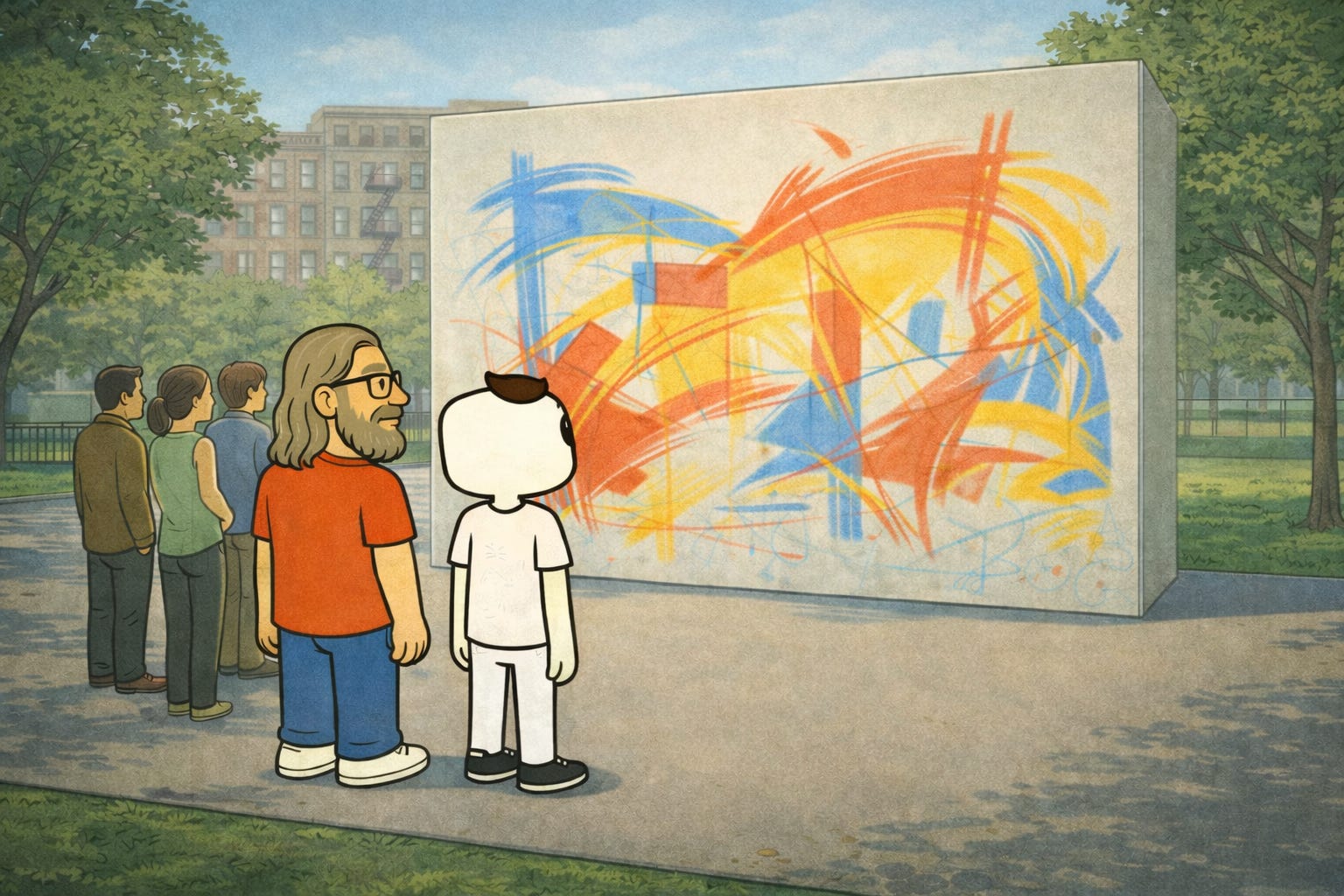
A park. A handball court. Fresh paint in the air. The wall becomes a message in real time, and the words don’t whisper. Bright lines, blunt truth, no permission.
Eric said:
My internal map says I should be somewhere else, yet here we are in a park at a handball court, close enough to smell fresh paint. Keith Haring is mid-stroke on a mural, and what matters is the feeling in the air, that odd, charged pause you get right before something becomes real. The wall is turning into a message in real time, and I am standing close enough to watch it happen.
Christopher said:
The city is hurting, and you can feel it in the way the park keeps breathing anyway. We land in 1986 and the air feels like it has been carrying bad news for years, and then Haring goes and makes a wall stop being a wall. This bright language he has been building, the bold lines and the motion and the joy, he lets it stay bright, but he points it somewhere else. He takes a place that usually lives as background noise until he turns it into a warning, and the words hit like a headline you cannot unsee, blunt and public, Crack is Wack, and it does not ask permission to take up space. That is the part that catches in my chest, because I want that kind of clean courage, the kind that says what needs to be said and stands there while the world decides how it feels about it.
Eric said:
Yes.
And this is the part where the wall stops being “a mural” and starts being a warning sign.
Because in 1986, crack is not a distant news story. It is eating holes in real neighborhoods, real families, real bodies, and Haring responds in the least subtle way possible. He just writes it on the wall in Harlem: Crack Is Wack.
No metaphor. No tasteful distance. Just the message.
And it lands because he keeps speaking in his own language. Same bold lines, same bright energy, but the figures tilt toward panic instead of celebration. He does not put it in a gallery where people can admire it and feel finished. He puts it out where the city has to bump into it.
That is the shift. Art stops commenting from the sidelines and steps into the street. And once it does that, people pay attention, whether they want to or not.
Christopher said:
You can see it immediately, the conviction and the urgency, and it pulls everything else into place. He picked the place like he was picking the audience, and his style stays right there with him, bright and unmistakable, even when the subject is ugly, so the message can’t hide behind elegance. He aims it at real people, not a room of critics, and he doesn’t wait to be told it’s okay, because the need is already louder than the hesitation. He just goes, this has to be out loud, and he puts it there plain as day. Watching that, I can’t help thinking I want to be that honest in public.
Eric said:
That’s the shift, isn’t it?
This isn’t him playing with form. It’s him pointing.
And with Haring, the audience is never theoretical. He knows exactly who is going to walk past that wall, so the wall isn’t random. It’s chosen.
And you’re right, he doesn’t stop to ask if it’s good for the brand or if it matches the vibe. He just asks the only question that matters in a moment like that: does this need to be said?
That’s conviction. Not volume. Alignment.
Most people feel the pull and then start negotiating with it. Tone, timing, optics, consequences.
He skips the negotiation and goes straight to impact.
And the fact that you feel yourself wanting that kind of clarity tells me you’re already learning what your own voice sounds like when it stops asking permission.
Christopher said:
The thing is, conviction comes with consequences. It always takes something out of you, and in this case the city collected fast. He got cuffed, the wall got covered, and suddenly everyone had an opinion, and he still had to stand there and explain himself to people who weren’t trying to understand. But as far as I can tell, he never stopped aiming at the problem, like standing there, saying it, mattered. And that’s where my respect turns into awe.
Support the work and look adorable at the same time

Eric said:
Yes.
Conviction sends an invoice.
He paints it, gets arrested, watches the wall get covered, and then gets the full civic experience: press, opinions, and questions that are really just accusations in business casual.
That part is easy to admire later and hard to live through, because urgency does not come with a comfort plan. The moment you stop hedging, you lose plausible deniability, and somebody will push back just to prove the world still has elbows.
But he does not shrink. He does not sand the message down into something safer to clap for. He keeps aiming at the same problem.
That is the difference between looking bold and being convicted. One folds when challenged. The other takes the hit, adjusts, and keeps going.
So yes, there are consequences. The question is whether what you are saying is worth carrying them.
He thought it was.
And he stayed upright.
Christopher said:
The wild part is he never changed the language. He just kept talking in it, even when the subject turned ugly, even when the words were not pretty. Those bright lines stayed bright, those figures you can spot from a block away kept moving, and somehow that familiarity made the grief hit harder instead of softer. It did not feel like he was switching costumes to be taken seriously. It felt like the same voice deciding it could carry weight too, and refusing to flinch.
Eric said:
Yes.
That’s what keeps it powerful without turning it preachy.
He doesn’t ditch his language when the subject gets dark. The same thick lines are still doing the work. The same bright colors are still insisting on being seen. The same characters are still instantly recognizable, which means the warning doesn’t feel like a new persona. It feels like the same voice tightening its grip.
The tone shifts, but the voice stays intact.
And that is rarer than people admit. Most creators either go solemn and lose their spark, or they protect the aesthetic by refusing to touch anything that might bruise it.
He does neither. He trusts the language to carry grief and urgency without needing to be translated into something respectable.
If your voice only works in sunshine, it’s style.
If it still works in crisis, it’s substance.
His language held. It didn’t collapse.
Christopher said:
Because he is holding two opposites at once, and he does it like he can feel the ratio without measuring it. The joy never gets shut off, but the grief is not ignored either, so the art still glows while the subject still hurts, and he keeps both in the same frame until they start talking to each other. That is why it lands in your ribs. You hear it because it is loud, and you understand it because it is tuned.
Enjoyed the ride? Tip the jar and keep the signal alive.

Eric said:
Yes.
That’s the wire he walked. Too much joy and the crisis looks trivial, too much grief and the audience shuts down, so he keeps the pulse right in the middle.
With Haring, the language doesn’t go bleak. It stays bright, and that brightness makes the darkness sharper. The contrast does the work.
It looks like instinct, but it’s also discipline. He understands people can take in hard truths more easily when they arrive in a familiar voice, so the bold lines don’t soften the message, they make it legible. Immediate. Hard to pretend you didn’t see it.
When it lands, it doesn’t just inform. It hits, not as despair, but as urgency. And urgency moves people.
Christopher said:
Even with all that urgency, he still felt like a person, not a symbol, and that matters more than it should.
He didn’t act like he was above the room. He didn’t close the door behind him. The work still had that open like a porch light feeling, because he stayed present on purpose, like he meant for people to step closer instead of back away.
And he wasn’t turning it into a slogan and walking away.
It was still one human trying to reach other humans.
Keep the conversation going with membership

Eric said:
Yes.
That’s the part people feel before they can explain it.
He never floats above the room. Even when the platform grows and the stakes sharpen, he stays among the people the work is for.
And the tone never tips into “I know better.” It stays closer to, “We’re in this,” which matters because the second an artist starts preaching from a pedestal, the bridge narrows. The door gets smaller. The room turns into categories.
He keeps it open on purpose.
The urgency does not turn him into a logo or calcify him into a brand archetype. He stays human, visible, engaged, and that is harder than it sounds. It’s easy to let a message become armor, or let a movement become identity performance.
He keeps it relational.
Human to human.
And that’s why the work still feels like conversation instead of instruction.
Christopher said:
I can’t look at his work for long without it turning into a conversation in my own head, and then I’m pacing around in there like I forgot where I put my keys. The questions show up fast and they are annoyingly specific, like what do I keep quiet because it might cost me, and what do I edit out before anyone else even gets the chance to react, because I do not want my intent put on trial.
And that is the point where it stops being theory for me. I have to name what I’m dodging, and then decide whether I’m brave enough to say it, because if I’m going to have a voice, I can’t keep living in the edit.
We watch the same familiar voice refuse to flinch as the subject turns ugly, and the questions stop being theoretical. Next, four letters enter the room and shrink it: AIDS. The work stops being invitation and becomes survival, record, and refusal.
See more of what we do!
The Past Is Acting Weird Again

The Falling Leaves of Social Connections

Intentionally Brain Shopping


