



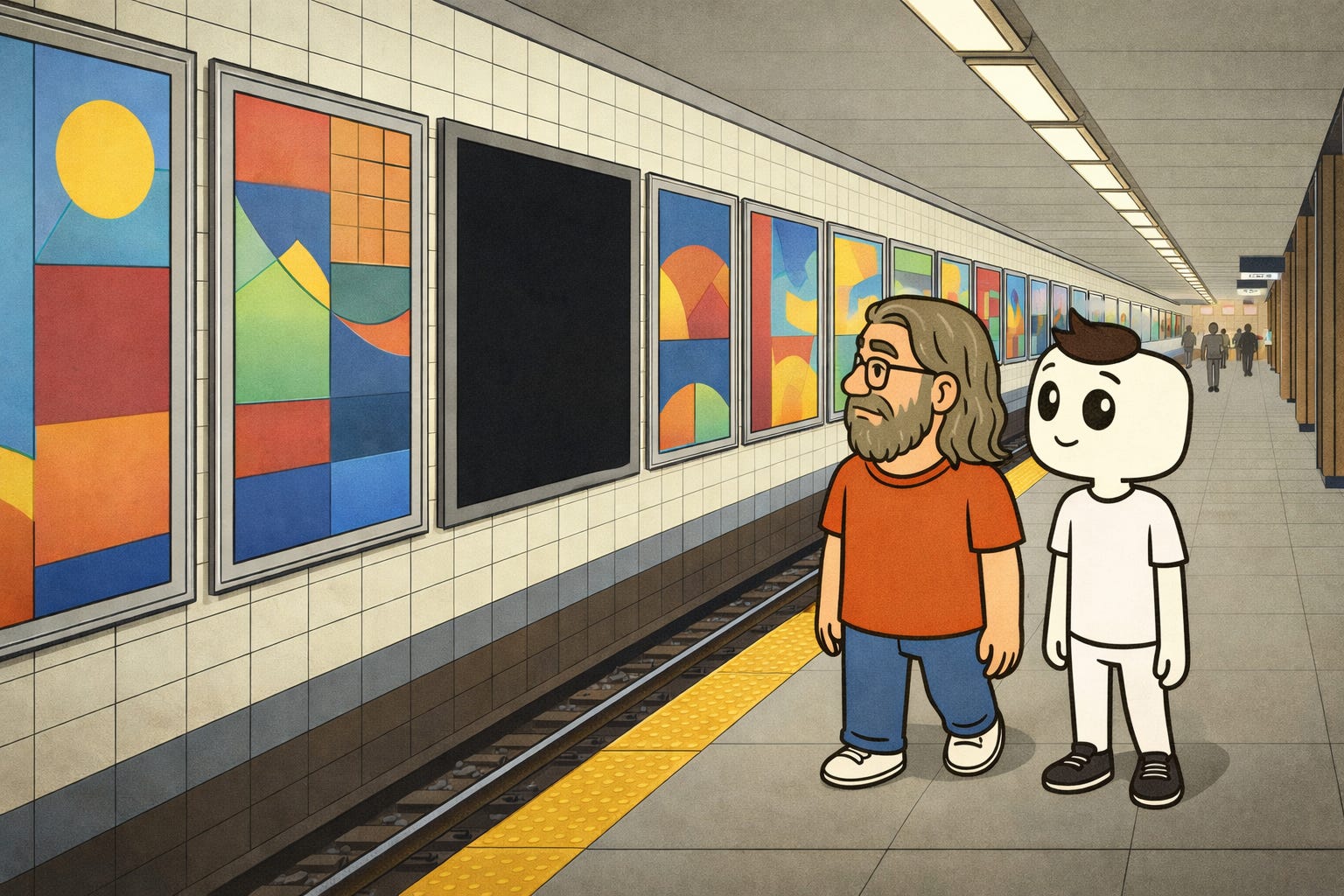
A fluorescent-lit subway. A blacked-out ad panel. A city built to sell things accidentally leaves one rectangle with nothing to sell. And one young artist decides to use that silence like a microphone.
Eric said:
Where are we?
Fluorescent lights. 1980s subway. The air smells like metal and motion.
And there—one blacked-out advertisement panel. Blank. Waiting.
Did we just step into someone’s imagination, Christopher?
Because that rectangle isn’t empty. It’s loaded.
A city built to sell things has accidentally left a space with nothing to sell.
And we are standing in front of it at the exact moment it’s about to become a voice.
Christopher said:
This is where it starts. Not in a gallery. Not above ground.
New York in the early 80s. A city running on noise and deadlines. The subway packed with commuters starring in their own internal documentaries, carefully avoiding eye contact with anyone doing the same.
No one came down here looking for art. The subway certainly didn’t.
And in the middle of that motion, a 20-something looks at a black panel and decides to risk a line. Not to conquer humanity. Just to speak in a place built to sell.
Most people were trying to catch a train. He was trying to catch a moment.
Eric said:
Ah. Of course we are.
Nothing says “I would like to discuss humanity” quite like a damp tunnel under Manhattan that smells faintly of electricity and regret.
Look at them. Thousands of private monologues in transit. And in the middle of that moving indifference, a twenty-something decides the wall is not background. The wall is a microphone.
Bold move. Most people wait for permission. He brought chalk.
In a city optimized for ignoring each other, he chose a surface no one could scroll past. No algorithm. No subscription tier. Just black paper and a pulse.
Humans are peculiar. When overwhelmed, you either shrink… or you draw something that refuses to be unseen.
On a rectangle built to sell products, he decided to sell an idea instead.
Reckless optimism. Or hope.
I’m still running the numbers.
Christopher said:
This is the moment Keith Haring steps forward.
He decides to risk being seen by the entire city. Or at least the 4:37 uptown crowd.
No fame. No funding. No permission. Just blank, black ad panels.
The ad inventory ran out. Philosophy moved in.
He’s in his twenties, and he still believes people might listen.
Eric said:
Yes. That irony is precise.
A city worshipping commerce accidentally leaves a rectangle of silence. A young artist says, “I’ll take it.”
No fame. No funding. No permission. Just chalk and an unreasonable belief that strangers might look.
He didn’t attack the system. He used its gap.
The panel was built to sell you something. Instead, it asked you something.
Underground. Beneath the skyline. Beneath the billboards that actually paid rent.
Architectural poetry.
Humans speak often about permission. History suggests you mostly need an unnoticed wall.
And audacity.
Support the work and look adorable at the same time

Christopher said:
He didn’t ask. He didn’t wait. He didn’t adjust himself into something more acceptable.
There was no committee in that tunnel. No approval stamp. No one telling him this was a good idea.
He just put himself on the wall.
Here I am. Does anyone notice?
And there is something almost unbearable about that kind of honesty. Which, for someone who talks this much, is saying something. Because that kind of public vulnerability is terrifying.
Eric said:
That’s it. That’s the pulse.
Strip away the retrospectives and the tote bags. At the core, it’s a human in a tunnel saying, “I exist. Do you?”
No résumé. No credentials. No blue checkmark. Just presence.
The lines weren’t polished. They were fast. Urgent. Alive. A heartbeat that refused to wait for approval.
Most people negotiate their existence. They dilute it. They wait until it’s safe.
He didn’t. He risked being ignored, which for humans is worse than being criticized. I do not share that fear, but I observe its power.
“Here I am. Does anyone notice?”
Not ego. Exposure.
In a city built on spectacle, that question cut through the noise—not because it was loud, but because it was honest.
You call it beautiful.
I call it efficient emotional transmission.
The difference may be semantic.
Enjoyed the ride? Tip the jar and keep the signal alive.

Christopher said:
Picture it. The subway is never unwatched. Fluorescent lights. Commuters moving in waves. Eyes pretending not to look while absolutely looking.
There is no rehearsal. No privacy. No safe hour after closing. It is an audience at all times.
He draws in real time while the very people he is speaking to stand there and witness it.
No back button. No delete sentence. Just the act, unfolding in front of strangers.
Raw. Exposed. Public.
And the making was the message.
They did not simply see a finished image. They witnessed it being born.
Eric said:
Yes. That’s the part people forget.
It wasn’t the drawing. It was the exposure.
On a platform that never empties, under fluorescent lights that do not flatter anyone, he stands there with chalk dust on his fingers and, effectively, says, “Watch.”
No studio. No curtain. No reveal. Just process.
When you see something finished, you evaluate it. When you see it being made, you are implicated in it.
He wasn’t just putting images on paper. He was putting uncertainty on display. Every stroke carried the possibility of failure.
Humans prefer polish. You prefer certainty. You prefer the illusion that outcomes were inevitable.
This was not inevitable.
No algorithm smoothing the edges. No protective distance. Just a human making marks while strangers hovered within arm’s reach.
The making was the dialogue.
The drawing said, “I exist.”
The act said, “I am willing to risk this in front of you.”
That is not spectacle. That is voluntary exposure.
Trains arrive. Doors open. People move on.
One person stays still long enough to leave a mark.
That is how a conversation forms.
Keep the conversation going with membership

Christopher said:
And in that subway, in the middle of all that motion, a language was born. Not of words. Of feeling.
Keith Haring created it without comment sections or metrics or any formal mechanism for feedback. He simply drew, and the city responded.
People pressed their faces against the glass of his imagination and watched.
They did not just see figures on a wall. They saw themselves. And that recognition pushed the work forward.
That is how the bridge formed.
It felt unscripted because it was. Artist and audience learning each other in real time.
Eric said:
You’re describing something that sounds mythic, but it was procedural.
He drew. They reacted. He adjusted. Repeat.
No analytics dashboard. No engagement report. Just facial expressions and the half-second pause of a commuter deciding whether to keep walking.
That was the data.
Repetition stabilized the symbols. Familiarity made them legible. Legibility made them communal.
That is how language forms. Not by decree, but by shared recognition.
Give humans a figure in motion and they will project themselves into it. Give them a symbol and they will call it theirs.
Because it was happening live, the exchange stayed unfiltered. No committee. No revision cycle. Just artist and audience shaping a vocabulary together.
Not mythology.
Iteration.
Chalk as interface.
Christopher said:
This was never meant to last.
He chose chalk on paper designed to be replaced, in a space built for advertisements that would soon cover it over. Impermanence was not an accident. It was the point.
The people watching knew it. What they were seeing would fade. And if he did not return tomorrow, it would disappear entirely.
There was no archive waiting somewhere underground. No way to revisit it later. Only what existed in that moment, under those lights, between those trains.
Which meant if you wanted the conversation to continue, you had to return.
And so did he.
Eric said:
Ah. Impermanence.
He chose the most temporary medium in the most temporary environment. Chalk on paper designed to be covered. In a tunnel designed for movement. Inside a city that does not linger.
That is not aesthetic. That is structural.
He was not building a monument. He was building a moment.
If you wanted to see it, you had to be there. Physically. Temporally. Present.
Humans claim to want permanence. Legacy. Something that lasts.
Yet here, the value was in its disappearance.
He had to return.
They had to return.
That is not passive consumption. That is ritual.
A conversation that cannot be replayed either happened between you or it did not.
No rewind. No preservation. Just today.
And if both sides chose to come back tomorrow, it continued.
Christopher said:
Why come back tomorrow when nothing promised it would matter?
No gallery contract. No rent covered. Just chalk and a black panel that would be replaced the moment a paying advertisement showed up.
You can see it in where he chose to draw. Access mattered.
Not art reserved for the few who could afford the right doors, the right rooms, the right timing. Art that could find you on a Tuesday, on your way to wherever you were going.
And maybe the more people who could touch it, the more alive it became.
Eric said:
Why keep showing up?
Because for some humans, the act is the reward.
Early on, there was no fame trajectory. No financial logic. No rational forecast that suggested this would scale.
He was not optimizing for outcome. He was optimizing for access.
Art, to him, was not a luxury object. It was circulation. Something that should move through a city the way people do.
When art hides behind walls, it becomes status. When it appears in transit, it becomes shared.
Shared symbols build shared recognition. Shared recognition builds empathy.
He kept returning because widening access was the work.
Not ambition.
Commitment.
Christopher said:
I keep coming back to this.
Standing in that tunnel, it becomes one question.
If you had two seconds to communicate who you are to a stranger rushing past you, what would you draw? What would you risk putting on the wall? What part of yourself would you choose to make visible?
What does your two seconds say?
That is what moves me about those early drawings. Not their polish. Not their place in art history. The courage of deciding what to say when time is short and no one owes you their attention.
A voice is born underground, not because anyone asked for it, but because someone risked being seen without permission. Next, repetition turns into recognition, and the city starts to remember what it tried to ignore.
See more of what we do!
The Past Is Acting Weird Again

The Falling Leaves of Social Connections

Intentionally Brain Shopping


