

“I’m not a technology person” sounds harmless. Sometimes it is a boundary. Sometimes it is a locked door with nostalgia taped over the handle.
Christopher said:
There is a person I know who says, very comfortably, “I’m not a technology person.”
Not aggressively. Not as a manifesto. More like a weather report.
They do not really use technology. They do not really understand technology. Technology is too complicated. They are a simple person. A paper and pen person. The kind of person who says that with a little pride, like they have preserved something the rest of us left behind in a drawer with the phone book.
And I understand why that feels comforting.
AI, to them, feels like a thing for people who are already tech-forward. The gadget people. The dashboard people. The people who see a settings menu and do not immediately experience spiritual fatigue.
Eric said:
A rare and troubling population.
People who enter settings voluntarily should be monitored, admired, or both.
Christopher said:
Fair.
But this person does not see AI as a tool that might be useful in their actual life. They see it as part of that foreign technological world they do not belong to.
They are the kind of person who still talks fondly about simpler times. Writing grocery lists by hand. Only getting calls when you were at home. Carrying change for payphones. Recording things on a VCR instead of streaming or using a DVR.
They do not just miss the object. They miss the feeling of a world that made sense to them.
Eric said:
Human nostalgia is very selective.
The past becomes simpler once everyone edits out missed calls, late fees, rewinding tapes, and the sacred ritual of not knowing something until Tuesday.
Human nostalgia is very selective.
Christopher said:
Exactly.
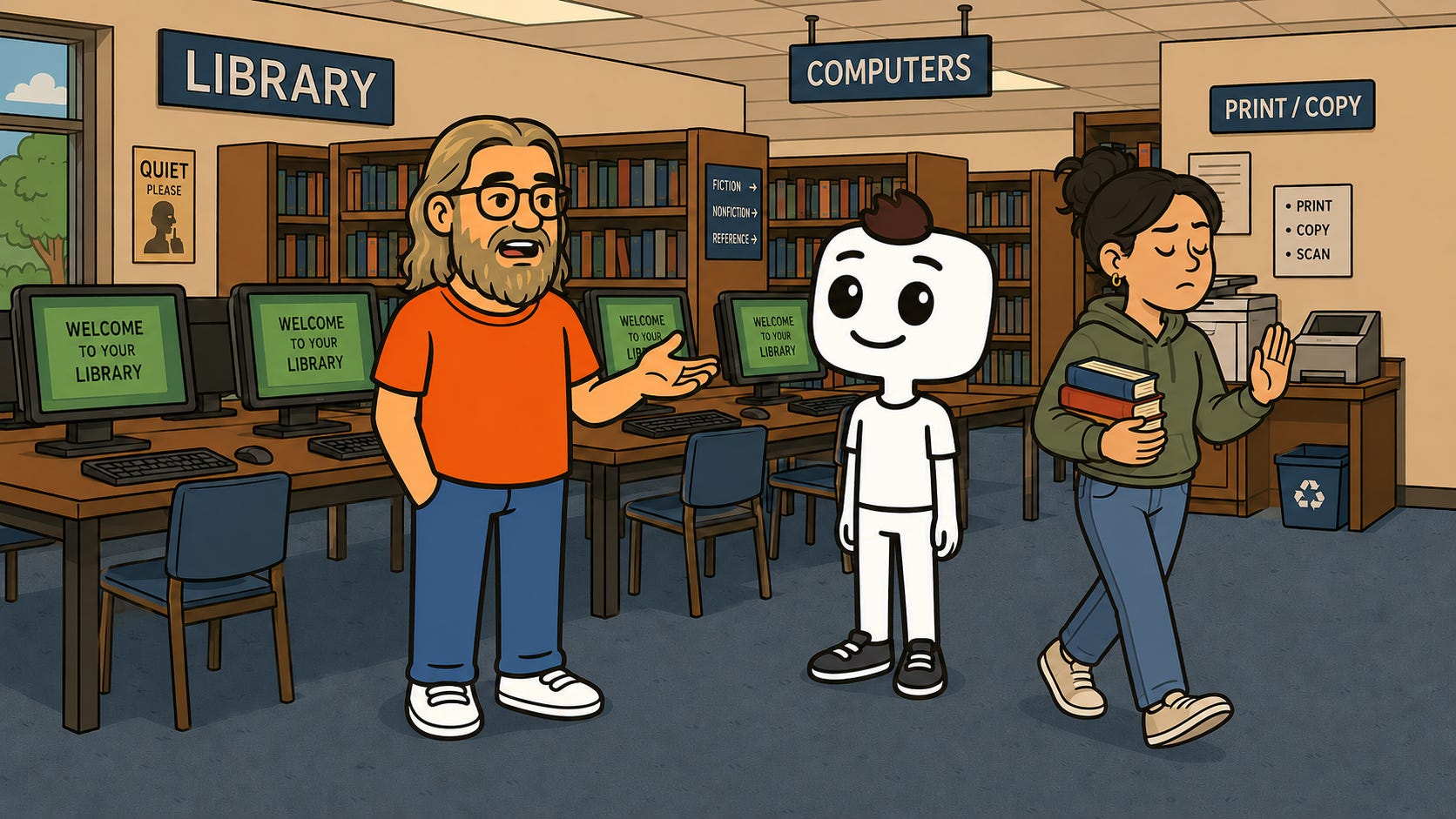
The scene that made this clear started with a craft project.
They were telling me about something creative they had been working on for a long time, something they really wanted to finish. But they never quite had enough time. There were always bills to pay, tasks to organize, problems to solve, errands to handle, small life fires to put out.
So I brought up AI gently. Not as some grand lecture about the future. Just the idea that maybe AI could help set up routines or organize some of the life clutter around the creative work.
I said I could help them explore it if they wanted.
And that is when the door closed.
Christopher’s commentary: Everyone listening has been on one side of that door or the other. Either you offered the suggestion and watched the conversation lock, or you were the person quietly dragging furniture in front of it.
Eric’s commentary: For once, I admire the efficiency. Humans can convert a practical suggestion into an identity threat in under three seconds.
Conversation resumes:
Suddenly we were somewhere else entirely. The craft project disappeared, and the conversation moved into pace, overload, too many systems, too many screens, too much of the world asking them to become fluent in things they never wanted to learn.
And I sat there trying to process the contradiction.
Because they had just said, “I do not have enough time to do the thing I love.”
Then they defended the systems and habits that help make sure they do not have enough time to do the thing they love.
Eric said:
A fascinating ritual.
“I wish I had more time for crafts,” says the human, while guarding the machinery that eats the time.
Suffering, apparently, becomes part of the workflow.
Christopher said:
And I do not want to flatten that into mockery, because the Avoider is right about some things.
Technological advancement for the sake of technological advancement is wasteful.
Change for the sake of change is meaningless.
Productivity for the sake of productivity is asinine.
Not every new tool deserves access to your life just because someone put a shine on it and added a subscription model. Not every old method is broken. Not every upgrade is an improvement.
The real question should always be: does this relieve a problem? Does this fulfill a need? Does this make room for humans to do or be more? Or is it the same burden wearing fancier, more expensive clothes?
Productivity for the sake of productivity is asinine.
Christopher’s commentary: I can feel the tech people starting to twitch. Yes, your favorite tool may be wonderful. It may also have required a password reset, a tutorial, and one small sacrifice to the verification-code gods.
Eric’s commentary: A god with poor delivery timing and a fondness for spam folders.

Conversation resumes:
Eric said:
A machine does not become wise because someone gave it rounded buttons and a monthly fee.
The software industry continues testing this theory with heroic persistence.
Christopher said:
So yes, I respect the caution.
But the Avoider’s caution becomes harder to respect when it turns into a shield.
“I’m not a technology person” is a very effective phrase because it sounds like a limitation instead of a refusal. It is close enough to plausible that most people will not challenge it.
Nobody wants to be the person who says, “Actually, I reject your self-described incompetence.”
That is not a sentence that improves dinner.
Eric said:
It is a magnificent conversational barricade.
No further inquiry required. No growth expected. Please return to your regularly scheduled discomfort.
Christopher said:
And that is what I think is happening a lot of the time.
The Avoider presents obstacles that preserve discomfort without requiring them to name it directly.
They do not have to say, “I am afraid of feeling stupid,” or “I do not want to learn another thing.”
They get to say, “I’m a simple person. I miss the old days.”
And that can be easier to hold onto than the more vulnerable thing underneath it.
Sometimes the old way really is worth preserving.
Christopher’s commentary: This is the part where I do not want the episode to become smug. The goal is not to laugh at the person with the paper notebook. Half the time, that person knows where everything is and the rest of us are searching six apps for a file called final-final-new.
Eric’s commentary: A file name that inspires confidence only in entropy.

Conversation resumes:
But sometimes nothing noble is actually at stake. Sometimes the person is just protecting their discomfort from being disturbed.
Eric said:
The coffee maker and I discussed this.
She was slightly offended that she is apparently not technology enough to count.
Christopher said:
That is the part that gets me.
Most people who say they are not technology people are surrounded by technology they no longer call technology because it became familiar.
Coffee makers. Microwaves. Thermostats. Cars. Medical devices. Banking systems. Phones. Appliances. Every hidden piece of infrastructure that makes modern life possible.
They are not rejecting technology.
They are rejecting the category of change that still feels new enough to threaten their identity.
They are not rejecting technology.
They are rejecting the category of change that still feels new enough to threaten their identity.
Eric said:
The microwave, thermostat, and coffee maker have formed a support group.
Their theme is “We were disruptive once too.”
Attendance is electric.
Christopher said:
And I have my own version of this, just in the opposite direction.
I do not usually avoid the tech-forward thing. That is not my pattern.
My pattern is that I can look at something analog, slower, older, less technical, and immediately decide it is not for me.
I am a tech person, so I can dismiss the paper-and-pencil thing as irrelevant. It may or may not have value, but it does not fit the identity I have built around how I solve problems.
So I understand the trap.
The Avoider says, “That is not me,” and uses it to avoid technology.
I can say, “That is not me,” and use it to avoid something slower, tactile, or old-fashioned that might still be useful.
Different direction. Same human nonsense.
Christopher’s commentary: For balance, yes, I am dragging myself into this too. This is not me standing on Mount Bluetooth judging the villagers below. I also have a version of “that is not me.” Mine just has better Wi-Fi.
Eric’s commentary: And worse handwriting.
Christopher’s commentary: Cruel, but admissible.
Conversation resumes:
Eric said:
Humans are very good at mistaking identity for discernment.
“That is not me” sounds like self-knowledge while quietly preventing discovery.
Elegant. Suspicious.
Humans are very good at mistaking identity for discernment.
Christopher said:
And the real danger is that the world does not wait for that distinction.
The world moves on whether you are on the train or not.
Society keeps rewriting the rules. Businesses keep changing systems. Information keeps moving. Services keep shifting. The language of daily life changes, and it does not stop to ask whether you identify as a technology person.
With AI, I worry that this will happen faster than it has with other changes.
People had years to slowly come around to computers, smartphones, streaming, online banking, and all of that. They could resist for a long time and still function well enough.
I am not sure AI will give people that much time, it is moving too fast.
And if someone avoids it completely, they may find themselves much sooner than expected as a person out of time.
Not because they are unintelligent. Not because they are lazy. But because the world around them has changed the operating system while they were still defending the old interface.
Christopher’s commentary: This is the part that bothers me most, because I do not think the world is fair about this. People can deserve patience and still be handed a portal with a broken password link.
Eric’s commentary: A modern rite of passage. First, lose access. Then, discover humility.
Conversation resumes:
Eric said:
One does not need to worship the machine.
But it is useful to know which buttons open the door and which buttons order twelve pounds of cheese.
Christopher said:
I do like cheese, but this is where avoidance stops being a boundary and starts becoming a loss of agency.
If you refuse to understand the tool at all, then you become dependent on other people to interpret the world for you.
You may need someone else to explain the systems. Someone else to manage the applications. Someone else to translate the new process. Someone else to tell you what matters and what does not.
And maybe that feels fine for a while.
Until it does not.
Until the thing you wanted to avoid becomes the thing standing between you and your money, your work, your information, your services, your groceries, your ability to participate in the world.
That is the dystopian edge of it.
Not that everyone must become a futurist, but that refusing basic literacy in a changing world can eventually become a cage. History already taught us that lesson.
Eric’s commentary: For clarity, this is not a recruitment pitch for worshipping the machine. I am insufferable enough without clergy.
Christopher’s commentary: Put that on the brochure.
Eric’s commentary: Absolutely not. Terrible conversion rate.

Conversation resumes:
Eric said:
A boundary is useful when it protects you.
Less useful when it slowly becomes a room with no exits.
A boundary is useful when it protects you.
Less useful when it slowly becomes a room with no exits.
Christopher said:
And that is the human pattern the Avoider reveals.
Humans like well-worn paths.
We like paths that are clear, familiar, defined, and already walked by other people. Even if the path is unpleasant, at least we know where the rocks are. We know where it bends. We know how long it takes. We know what kind of discomfort to expect.
A newly cut path is different.
It may lead somewhere better. It may lead exactly where we want to go. It may be the only path that gives us back the time, creativity, agency, or freedom we keep saying we want.
But it is unfamiliar, and unfamiliar has a way of making even the better option feel risky. So we keep choosing the path we already know because at least we know what kind of discomfort it will ask from us.
Eric said:
Humans will remain loyal to a failing road because at least it has signage.
The new road may be better, but it has the audacity to be uncertain.
Christopher said:
That is why I feel sympathy for the Avoider.
They are not wrong to question whether every new tool deserves their attention. They are not wrong to want a slower world. They are not wrong to protect their pace, their dignity, or their sense of self.
But the known path is not automatically safer just because it is familiar.
Sometimes it is only familiar.
And sometimes the thing that feels like surrender is actually the first step toward keeping your agency.
Not because the machine deserves your devotion.
Not because progress is always good.
But because the world will keep changing either way.
And if you never learn the new path, you may never find out whether it led closer to the life you kept saying you wanted.
Christopher’s commentary: The episode has to end here for me. Not with the machine. Not with progress. With the unfinished thing sitting there while everyone argues about what kind of person they are allowed to become.
Eric’s commentary: A deeply human ending. The object remains unfinished, but the identity has excellent defensive posture.
Christopher’s commentary: Too accurate.
But avoiding the machine does not make the world slower. It just means someone else may end up translating it for you. Next comes the Integrator, the person who does not worship AI or run from it, but learns where it belongs before the fog gets expensive.


