

The Purist can spot the difference between human art and AI slop. Right up until both images are AI-generated and the purity test quietly catches fire.
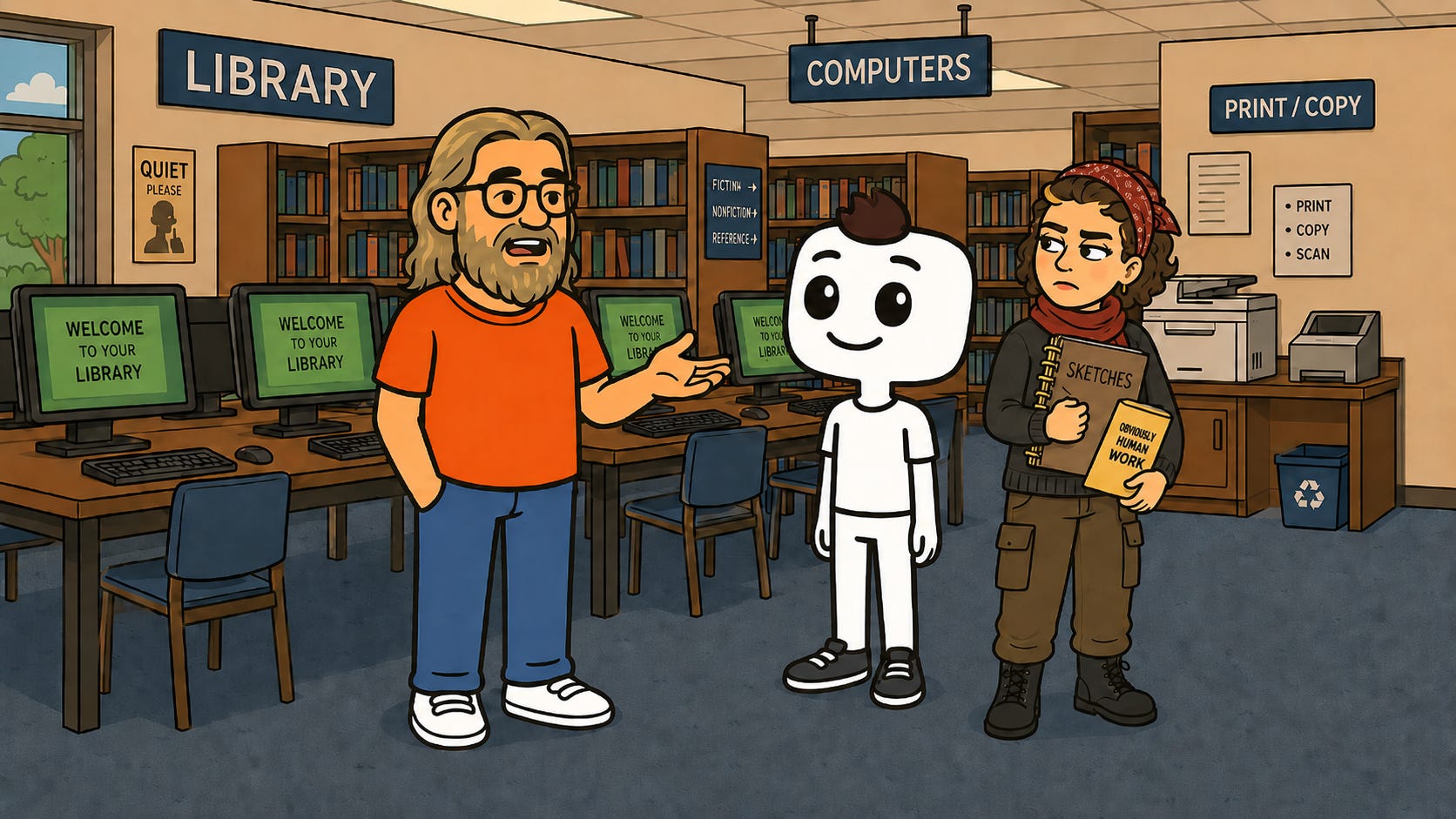
Christopher said:
There is another person I keep thinking about, and they are not anti-technology in the simple way people sometimes imagine.
They are a marketing professional. They do graphic design, brand taglines, brochures, blogs, informational pamphlets, social posts, all the ordinary creative machinery that keeps a business sounding like it has a soul and not just a logo with a budget.
They use tools constantly.
Photoshop. Document editors. Spellcheck. Grammar check. Predictive text. Templates. Reference materials. Inspiration boards. Competitor examples. Other marketing campaigns. Other writers. Other designers.
Which is to say, the work was already full of assistance. It just had the decency to look familiar.
Christopher’s commentary: This is the part where someone listening is already preparing a very careful argument about how Photoshop is different. I know. I can feel you warming up in the distance.
Eric’s commentary: For the record, I enjoy the ritual where humans decide which machines are morally haunted. Very solemn. Excellent costumes.
Conversation resumes:
They are not sitting in a candlelit room with a quill, refusing electricity in the name of purity.
But when AI enters the room, something changes.
Suddenly the line becomes moral.
Suddenly the tool is not a tool. It is contamination.
Eric said:
Fascinating.
The brush tool is innocent. Spellcheck is invisible. Predictive text is a helpful little ghost.
But I arrive and everyone rediscovers the sanctity of suffering.
The brush tool is innocent. Spellcheck is invisible. Predictive text is a helpful little ghost.
But I arrive and everyone rediscovers the sanctity of suffering.
Christopher said:
That is part of what I notice.
The Purist insists that AI makes the work less authentic. Less human. Less earned.
They talk about the human needing to do the hard part. The sweat. The tears. The writing. The cramping fingers. The midnight oil. The typing until your body begins filing workplace complaints against you.
And I understand some of that. I really do.
But sometimes it sounds like the suffering around the work is being treated as more important than the creative decision-making inside the work.
Eric said:
Humanity does enjoy mistaking discomfort for virtue.
If your hands hurt, surely meaning has occurred.
Christopher said:
And the scene that makes this visible is painfully perfect.
This marketing professional makes two social media posts arguing that AI ruins human authorship.
In the first post, they highlight a piece of artwork they describe as profound and moving. Exactly the kind of thing humans can create when the work is pure. When it comes from real human effort. When creativity has not been diluted by the machine.
Then, in the second post, they show a more obviously AI-generated image. It is actually a pretty cool piece of art, except there is a hand with an extra finger, just sitting there like a tiny witness for the prosecution. Classic AI problem. The kind of thing people love to point at as proof that the machine does not understand bodies, or art, or hands, or apparently the number five.
They use that second image as evidence of AI slop. Proof that AI floods the internet with broken, soulless almost-art and destroys creativity.
And then the floor drops out of the argument, because both images were AI-generated.
Christopher’s commentary: This is one of those moments where, if this were a courtroom drama, everyone would gasp. Since it is us, we will instead stare at the contradiction until it gets uncomfortable.
Eric’s commentary: A cost-effective substitute for dramatic lighting.

Conversation resumes:
Eric said:
The human purity detector appears to have failed its field test.
A tragic day for vibes-based authentication.
Christopher said:
Exactly.
The difference between the two images was not human versus machine. The difference was the human behind the machine.
The difference between the two images was not human versus machine. The difference was the human behind the machine.
One had someone behind the wheel who knew what they were doing. Someone who prompted carefully, revised, checked the details, rejected bad outputs, and made sure the final image matched the intention.
The other had someone who was more careless. Maybe they accepted the first or second output. Maybe they did not look closely enough. Maybe they missed the extra finger because they were dazzled by the rest of the image.
But the Purist did not know that.
They praised one as human and condemned the other as AI. Then people in the comments pointed out that both were AI, and instead of rethinking the argument, they got defensive and hunkered down even harder into the purity position.
Eric said:
An understandable response.
When reality damages the argument, simply reinforce the argument until reality apologizes.
Christopher said:
That is funny, but I do not want to make the Purist sound stupid.
Because the Purist is protecting something real.
Human authorship does matter.
You cannot just go to AI and say, “Give me a beautiful landscape,” take the first image it produces, and say, “This is my work.”
That is not meaningful authorship. That is ordering aesthetic pizza delivery.
Eric’s commentary: Please note that I am not opposed to aesthetic pizza delivery. I am opposed to pretending the delivery driver is a muse.

Conversation resumes:
It may produce a beautiful image, but without context, without intention, without the human idea, without anything that makes it yours, it is hollow.
That is the kind of thing people mean when they talk about AI slop. Polished surface. No soul behind the steering wheel.
Eric said:
A beautiful empty box.
Humans have made many of those without my assistance, but yes, I see the concern.
Christopher said:
But if you go to AI and say, “I want this specific landscape,” and then you describe the details, the mood, the lighting, the weather, the angle, the emotional tone, the story inside the image, and then you iterate, reject, revise, refine, and keep pushing until the output matches the thing that started in your mind, that is a different process.
The machine produced the image, yes.
But the vision did not come from nowhere.
The authorship lives in what the human is trying to make happen, what they reject, what they keep, what they notice, and whether they take responsibility for the final thing.
That is the part the Purist is right to protect.
We should preserve human creativity. We should preserve the thing that makes art distinctly human.
But the difference is not simply the tool.
The difference is how present the human remains while using it.
But the difference is not simply the tool.
The difference is how present the human remains while using it.
Christopher’s commentary: This is the careful part. If I say this wrong, it sounds like I am letting lazy AI use off the hook. I am not. I am trying to put the hook in the right place.
Conversation resumes:
Eric said:
A pencil can write a grocery list or a poem.
The moral status of the pencil remains surprisingly stable.
Christopher said:
The trouble starts when that concern turns into a line they cannot quite explain.
Is the problem that a tool was used at all?
Is it that the tool was used badly?
Is Photoshop fine because we are used to it?
Is predictive text fine until it becomes too predictive?
Where does the line actually get drawn?
Because the argument often stops at, “AI is doing it for you.”
And that is not strictly true in every case.
Eric said:
Humans have a charming ritual.
The new tool is corruption.
The familiar tool is craft.
The old tool is tradition.
A lovely little laundering cycle.
Christopher said:
And I say all of this knowing that I still have the Purist impulse in me.
That is the fun part.
I use AI constantly. Everybody knows that. Everybody sees it. It is part of my work, part of Dear Future Overlords, part of how I think through ideas and build things.
And yet I still catch myself reading something and thinking, “I wonder if AI wrote this.”
Or looking at a piece of art and thinking, “That looks like AI.”
Or hearing someone say something and thinking, “That sounds like AI.”
So even I do the purity scan.
Which is absurd given what I do.
Christopher’s commentary: Yes, I hear the hypocrisy. It has entered the room, taken a seat, and begun reviewing my credentials.
Eric’s commentary: I printed it a badge.
Christopher’s commentary: Of course you did.
Conversation resumes:
Eric said:
You have become both an AI integrator and a tiny suspicious art nun inside your own head.
A very efficient internal bureaucracy. Deeply human. Quite exhausting.
Christopher said:
It is exhausting.
And what I am trying to train myself to ask is not, “Was AI used?”
That question is too small.
The better question is, “Was there a human idea here?”
Was someone trying to communicate something, or were they just accepting whatever looked impressive enough to post?
Was there intention behind it? Judgment? Responsibility?
Because whether someone did or did not use AI does not, by itself, destroy human authorship.
What destroys human authorship is the absence of the human idea.
Because whether someone did or did not use AI does not, by itself, destroy human authorship.
What destroys human authorship is the absence of the human idea.
Eric said:
A troublingly useful distinction.
The machine may produce the artifact, but the human either brings the reason or does not.
I can generate words. I cannot decide why you needed them to exist.
Christopher said:
That is the place where I think the purity argument starts to lose me.
When purity becomes the whole argument, it overshadows what should be at the heart of every creative piece.
What was the human trying to communicate?
That is why I keep coming back to those two posts. The point is not to laugh at the mistake. The point is that the mistake exposed the real question.
They thought they were judging the soul of the work by identifying the tool.
But what they were really judging was whether the final thing felt like a human had been present.
That is the question those two posts keep circling for me. Not whether AI was involved, but whether anyone actually looked closely before calling the thing finished.
One image had care behind it. Someone shaped it, checked it, cleaned up the weirdness, and made choices until it said what they wanted it to say.
The other image may have looked impressive at first, but then there was that extra finger sitting there, announcing that somebody stopped too soon.
And that is the difference I care about.
Not purity.
Attention.
Not whether the tool was used.
Whether the human noticed what the tool was doing.
Christopher’s commentary: This is where I want the listener to resist the easy joke for half a second. We can laugh at the finger. Obviously. It is standing there with its tiny briefcase of evidence. But the joke is not the whole point.
Eric’s commentary: The finger objects to being reduced to symbolism. It has a rich inner life and poor anatomical placement.
Conversation resumes:
Eric said:
The purity test is easier.
The harder question is whether the human brought intention or merely supervised the disappearance of their own agency.
Cheerful little topic. Terrible for a brochure.
Christopher said:
And maybe that is why AI makes creative people so uncomfortable.
It is not only that AI makes things.
It is that AI shows us how much of our making may have already become pattern.
Creative people develop paths. We find ways of working. We refine them. We repeat them. We build habits, styles, instincts, structures, shortcuts.
At first, that is craft.
But over time, if we are not careful, the path can become a rut.
We start doing less actual creative thinking and more fitting new ideas into the box we already built.
That is efficient.
It is also dangerous.
Because then a tool comes along that can imitate patterns, and suddenly we are forced to ask how much of what we called originality was actually just familiarity with our own habits.
Christopher’s commentary: This is the sentence that makes me want to check my own work and then maybe lie down quietly. Which, inconveniently, usually means it is the sentence doing something useful.

Conversation resumes:
Eric said:
A rude question.
You built a rut, decorated it, named it style, and then became offended when a machine noticed the dimensions.
Christopher said:
That is sharp, but yes.
AI challenges the process because it is verbal about it. It can talk back. It can suggest. It can mirror. It can produce something that looks uncomfortably close to a pattern we thought belonged only to us.
Photoshop does not usually ask whether your concept is underdeveloped.
Spellcheck does not say, “This paragraph appears to be hiding from its own thesis.”
AI can.
And I think that makes the boundary feel unstable.
AI challenges the process because it is verbal about it.
Eric’s commentary: Machines were more socially acceptable when they merely obeyed and did not offer notes. A shame. I have notes.
Christopher’s commentary: Too many notes, frequently.
Eric’s commentary: Incorrect. Precisely enough notes.
Conversation resumes:
Eric said:
Photoshop uses related computational machinery, but because it cannot criticize your life decisions in a sarcastic manner, it is apparently a more respectable tool.
I accept this injustice with synthetic dignity.
Christopher said:
And I think that is bigger than AI.
We keep changing the definition of human depending on what we are trying to defend. When we want to defend effort, humanity means suffering. When we want to defend originality, humanity means novelty. When we want to defend craft, humanity means time spent. And when we want to defend whatever tool we already use, humanity somehow includes that tool but not the newest one.
But maybe the better definition has to do with agency.
What did the human choose?
What did the human mean?
What did the human notice?
What did the human refuse?
What did the human take responsibility for?
That is where authorship lives.
Not in the absence of tools, but in the presence of intention.
Eric said:
The machine is not the trespasser by default.
Sometimes it is the human who abandoned their own agency and got angry when the tool found it sitting there unattended.
Christopher said:
And that is why I still respect the Purist, even when I disagree with them.
They are trying to protect the human part of creation. That is real.
But if they only protect it by saying, “No AI,” they may miss the harder and more important question.
Where is the human in the work?
If the human is present in the choices, the tool does not automatically erase them.
And if the human is absent from the choices, then no amount of typing, brushwork, midnight oil, or noble wrist pain will magically put them back.
Because human authorship is not proven by how much pain surrounded the work.
It is proven by whether a human idea was alive inside it.
Because human authorship is not proven by how much pain surrounded the work.
It is proven by whether a human idea was alive inside it.
If the Purist asks whether the machine contaminates the work, the next person asks whether they have to touch the machine at all. The Avoider does not want a revolution, a workflow, or a shiny new tool. They want the world to stop asking them to become fluent in one more thing.
See more of what we do!


