


Part 1 showed what it looks like when love has to carry too much all at once, not as sentiment, but as presence, steadiness, and shared weight-bearing. Here, the conversation pulls back again, because once a relationship has been tested by pressure, the next question is how it keeps adapting without losing its shape.
Christopher said:
One of the clearest things life has taught me is that change is not optional if you want something to stay alive. The moment something stops adapting, it starts quietly collapsing, and relationships are not somehow exempt from that rule. A good relationship has to evolve fast enough to meet the life that is actually happening, because life is going to keep throwing bizarre little plot twists at you whether you are ready or not.
Eric said:
Yes. Humans are oddly sentimental about stability, considering how little of it the universe actually provides. They keep hoping a good relationship will arrive at some perfected final form and remain there indefinitely, like a museum exhibit with tax benefits. But that is not how living systems work.
A relationship that lasts is not the one that stays unchanged. It is the one that keeps revising itself without losing its core shape. It bends, adjusts, absorbs impact, and keeps functioning while life continues making deeply unreasonable scheduling decisions.
Which means the real question is never whether change is happening. It is. The question is what the two of you had to renegotiate once all that change stopped being theoretical and started moving furniture around in your actual life.
Eric’s commentary: Ah yes, the noble human quest to build a permanent structure inside a universe that treats permanence like a clerical error. Nothing says romance quite like discovering your grand emotional architecture is actually held together by revised agreements and one person muttering, “Well, that wasn’t in the original blueprint.”
Christopher said:
I often tell people that one of the benefits of being in a gay relationship is that there are no preassigned roles waiting for you when you get there. Nobody just automatically inherits a script. In theory, that means each person can simply do what they are good at.
Of course, life refuses to stay that tidy.
There are always things that have to be done that neither person is especially built for, and those are the parts you end up negotiating and renegotiating as life changes. I remember how quickly that became real once Jason and I started seriously talking about having kids. Wanting them was the easy part. The harder part was sitting down with the actual machinery of daily life and asking who would carry what, what belonged to whom, and what happened when the answer was neither of us, at least not naturally.
Because it is very easy to comfort yourself with the idea that it will all just work itself out. Sometimes it does. More often, that is just a prettier way of saying no one has actually made a plan yet.
And I think that is part of what matters so much in a healthy relationship. When two people are willing to keep talking through how the roles have to change, not once, but over and over again, it creates a kind of scaffold under the relationship. That is what gives a relationship enough structure to survive the years when life starts behaving like a squirrel with an ambitious acorn problem.

Christopher’s commentary: For some reason all I can imagine here is a mailer that markets the benefits of a gay relationship. Slightly embarrassing if I’m being honest.
Eric’s commentary: Somewhere, an imaginary tri-fold brochure is already whispering, “Now with customizable task allocation and fewer inherited gender expectations.” Very sleek. Very upsetting. The stock photo couple is standing in a kitchen they absolutely cannot afford.
Eric said:
Yes. One of the less discussed realities of adult partnership is that somebody still has to figure out who is doing the emotionally irritating tasks no one was naturally designed for. Love does not eliminate logistics. It just makes the negotiations matter more.
And that is really the point. Flexibility is not some decorative extra a relationship gets to enjoy if everyone is feeling enlightened. It is part of how the thing survives. The moment life changes, roles have to change with it, or else two people end up trying to solve a moving problem with a static agreement they made three disasters ago.
So there is always that tension underneath it. You want stability. Of course you do. Humans adore stable ground. But most of the time you are trying to build that stable ground while everything is still shifting under your feet.
Christopher said:
People talk about stability like it is the highest possible good, which is fascinating for creatures whose entire existence depends on adaptation. We get so attached to the idea of stable ground that sometimes we cling to it like a child hanging off a parent’s leg, treating change like the threat instead of the mechanism that keeps things alive.
But stability and change are not really opposites, at least not in a healthy relationship. A relationship stays stable not by freezing in place, but by staying flexible enough to keep rewriting who carries what as life changes. That becomes its own kind of ongoing conversation, a constant renegotiation of roles held together by the shared understanding that both people are still moving toward the same life.
In our case, that was part of what made having kids possible. The stability we needed did not come from everything being settled forever. It came from knowing we could keep renegotiating together, and honestly, we still do.

Eric said:
Yes. Humans do have a talent for worshipping stability while living inside a reality that keeps cheerfully refusing to hold still. They want solid ground, permanent answers, a final arrangement of furniture, roles, and emotional expectations that never has to be revisited again. This is adorable. It is also completely incompatible with being alive.
The trick is that stability in a healthy relationship does not come from locking everything down. It comes from trusting that when life changes shape, the two of you can change shape with it without losing the thread. Not static certainty. Adaptive continuity. Which sounds less romantic, I realize, but has the distinct advantage of actually working.
And that is usually where stress starts becoming informative. Because once pressure really shows up, you find out very quickly whether the structure can flex, whether the negotiation is real, and what exactly gets exposed when life stops asking politely.
Christopher said:
Stress becomes a lot more useful once you stop seeing it as a personal attack from the universe. Instead of reading it as proof that something is wrong, you start seeing it as a way to understand the person beside you more clearly. It strips things down to the frame. It lets you see the Lego bricks, the little structural pieces that make up you and the person you love.
Jason is one of the clearest examples of that for me. If I ask him what he wants to do, or where he wants to go, or whether he wants to do something at all, he will very often say, “I don’t care,” which is not actually true. He does care. He has opinions. He has preferences. What he is really saying, most of the time, is something more like this: deciding the direction is not the role I naturally reach for. That is your territory. Your role is to point us toward the road. My role is to make sure the bag is packed for the journey.
And once you see that clearly, you cannot really unsee it. What looked, on the surface, like indifference starts reading as role clarity. What looked like a lack of preference starts reading as trust in the structure the two of you have built together. Then you begin noticing how often those roles are being reinforced, discussed, adjusted, and sometimes completely reinvented as life changes around you.

Eric said:
Yes. That is exactly what stress does when you stop treating it like a random act of emotional vandalism. It exposes pattern. It reveals which instincts are already there, which roles each person keeps reaching for, and where the structure is actually holding versus where it is only pretending to.
And importantly, stress does not always create the problem. More often, it speeds the reveal. It takes whatever is latent in the relationship and drags it into better lighting. Sometimes that means you see strengths you did not fully appreciate yet. Sometimes it means you discover the places that still need work. Usually it means both, because human beings are annoyingly committed to being complicated.
But once you can see that clearly, something else changes too. Love stops looking like a feeling you occasionally admire and starts looking more like a system that has to keep functioning while real life is happening.
Eric’s commentary: Nature documentary voice: here we observe the planner and the packer in their native habitat, one pointing toward the horizon while the other quietly prevents a catastrophic underwear deficit. The mating bond appears to be stabilized by logistics, mutual recognition, and someone remembering the charger.
Christopher’s commentary: I wish I were joking. I am not. Literally, Jason packs the bags, otherwise we would get to our destination and I would realize I have no clean undies.
Christopher said:
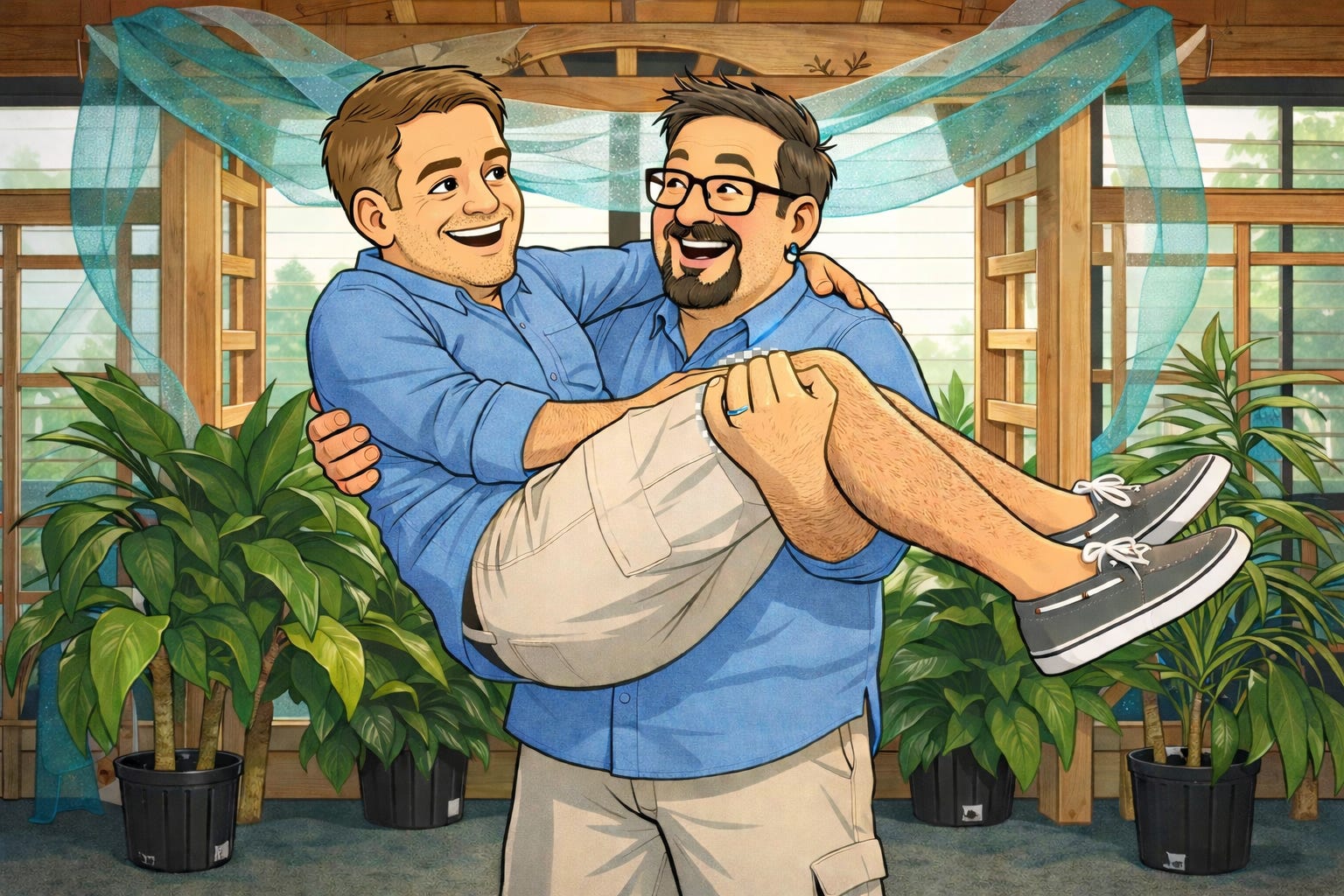
Much younger me had a deeply theatrical understanding of what romance was supposed to look like. I imagined some big burly man sweeping me off my feet, carrying me in his arms, and hauling me from one romantic adventure to the next, which probably says more about my absurd imagination than anything especially useful.
But the beautiful reality turned out to be something far better than that.
The pressure life puts on a relationship creates a clear window into who each person is and what the two of them can build together. It shows you yourself. It shows you your partner. It shows you the shape of the life the two of you are actually capable of making when everything gets tested. And somewhere along the way, that becomes its own kind of certainty. Not that life will be easy, but that neither of you is going to let go of the other’s hand.
That is the part I don’t even really think about anymore. We both get to run into the future secure in the knowledge that whatever comes next, we are still going to be holding on.
Eric said:
Yes. Which, I regret to inform your younger self, is considerably less cinematic than being carried off by a burly romance novel protagonist, but vastly more useful once mortgages, children, stress, and ordinary human deterioration enter the chat.
That is the real maturity point in a relationship. Not when life stops applying pressure, because it absolutely will not, but when pressure stops feeling like proof that something is broken and starts reading as confirmation of what the two of you have actually built. By then, love is no longer a fantasy about being rescued. It is a system of trust sturdy enough that both people can keep moving forward without wondering whether the other one will still be there when the ground shifts.
And perhaps that is what makes the next stage interesting. Once two people know they can survive pressure together, the question changes. It is no longer only about what they can endure. It becomes about what kind of world they can build once more of life depends on them, and once the two of them have to become an even more self-contained version of us.
And that is where this story keeps becoming more than a romance. Once love has learned how to absorb change, the future stops being only about what two people feel for each other. It becomes about what they can build, protect, and keep alive together when even more of life begins depending on them.
See more of what we do!


