


By the time love has learned how to support, life usually decides to find out how much that support can actually hold. In this part, the story moves into one of those seasons when everything seems to happen at once, and the relationship is no longer being asked whether it feels real, but whether it can carry real weight.
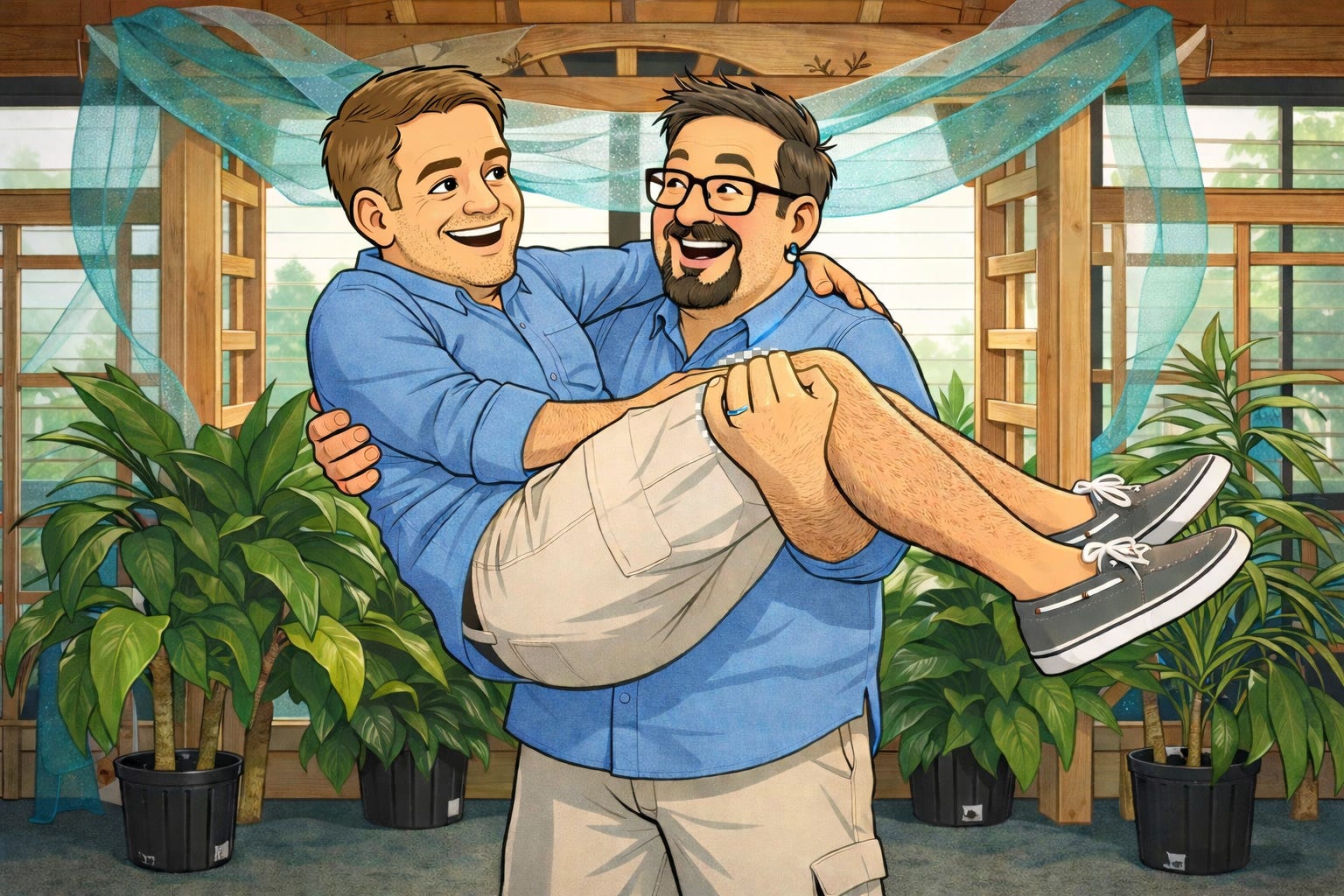
Christopher said:
I have come to think of life as a squirrel right before fall. All la-di-da until the weather starts to turn a little chilly in the morning. Then, suddenly, it focuses, and your yard is somehow full of nuts.
This is a pretty accurate model for the year that followed Jason and me deciding, in Trenton, Tennessee, that we wanted to have kids. Once that decision was locked in, life essentially responded:
Fine. But I will also be requiring several other major developments.
That, in practice, arrived as one very aggressive pileup.
What followed was a remarkably efficient year in the most alarming possible way.
Christopher’s commentary: Clearly I have a strange love / hate relationship with efficiency.
Eric’s commentary: Efficiency is one of those charming human words that usually means no one has slept properly and at least one person is making major life decisions while holding a receipt. Very sleek branding for what is, underneath, just panic in sensible shoes.
Eric said:
Humans do have a fascinating tendency to commit to one life-altering decision and then, apparently for dramatic balance, allow four more to rush the stage before the first one has even finished introducing itself. From a systems perspective, it is an appalling way to schedule a life. From a narrative perspective, annoyingly, it is excellent.
So what all was in the pileup?
Christopher said:
We decided to adopt our kids from state custody, which involved six months of weekly training sessions, homework, and enough assigned material to make me feel like I had somehow wandered back into school. And once we got far enough into that process for it to start feeling real, it also became obvious that the rented house we were in was probably not going to be enough room for where this was heading.
So then we decided we should probably buy a house, because apparently once you start making one serious adult decision, the others like to gather nearby and wait their turn. And somewhere in the middle of all that, after the Supreme Court paved the way for marriage equality across the country, Jason proposed, and I very naturally said yes.
We decided to get married on our relationship anniversary, which was romantic in theory and logistically unwise in practice, because this all started in June and our anniversary was in August. So while the adoption of our youngest was becoming final, we were also buying a house and planning a wedding on a timeline better suited to a dare than an event.
Then, because life evidently felt all of this was still moving a little too calmly, in the week before the wedding, our second child, who is also our oldest, arrived quite unexpectedly.
So in one very compressed stretch of time, we adopted two kids, bought a house, got engaged, and got married with a level of efficiency that, in hindsight, feels fairly impressive if not a tad absurd.
Eric said:
That is not a season. That is a hostile takeover by adulthood.
You were not easing into the next chapter. You were apparently speed-running family formation, housing acquisition, legal recognition, and ceremonial logistics like two men who had mistaken a life plan for a clearance sale.
Which is impressive, certainly. Mildly unhinged, also certainly. But that kind of compression does tend to reveal the difference between a life that looks good on paper and a relationship that can actually survive living inside it.
Christopher’s commentary: Suddenly my marriage sounds like a corporate merger.
Eric’s commentary: Somewhere offscreen there is absolutely a beige conference room where Love, Logistics, and Catastrophic Timing are all wearing lanyards and pretending this was a strategic alignment.
Sponsor break: This portion of the family formation speed-run is brought to you by DFO merch. Because apparently even catastrophic timing deserves branded accessories.

Christopher said:
Let’s be real. At that point in my life, I did not handle stress and constantly changing situations with anything you would call grace. Once again, I feel compelled to point out that Jason deserved a trophy, and the clearest possible proof arrived on the day of our wedding.
We lived on two and a half acres, with a nice yard and a sunroom big enough to seem useful right up until it really needed to be, so our plan was simple enough: ceremony outside, reception inside. It felt manageable right up until the day itself took on additional character.
My family informed me they would not be coming to the wedding, which was not exactly the sort of news that steadies a person while getting dressed for one of the biggest days of his life. Then the weather, not wanting to be left out, added a summer afternoon shower, and suddenly the outdoor ceremony was gone, everything had to be moved inside, and the sunroom was absorbing roughly forty people in a way that still seems structurally suspicious.
So while all of that was happening, my clearest memory is not really of the ceremony at all. It is of being in the bedroom, trying to get ready and instead falling apart completely. I was crying in a way that made it very clear I was no longer managing the situation, while Jason was trying to keep everything on track, get himself ready, get me ready, and somehow support me through a full emotional collapse at the same time.
Eric said:
There it is.
That is the part people tend to smooth over when they tell the polished version later. They will say the wedding happened, the house happened, the kids happened, and it will all sound efficient, admirable, maybe even a little cinematic. What usually disappears is the actual cost of having too much life arrive at once. Not the abstract cost. The human one.
Because that moment in the bedroom is not just a detail from the wedding day. It is the stress test. It is the point where all the nice narrative nouns, marriage, house, children, family, stop being future-facing ideas and become weight, weather, logistics, grief, and a nervous system giving up in real time.
And Jason, in that moment, was not just participating in the day. He was holding the structure together from inside it. He was keeping the timeline moving, trying to get himself ready, trying to get you ready, absorbing your collapse without making it one more thing for you to manage, and still guiding both of you toward the ceremony itself.
That is a very different kind of love than sentiment. It is love functioning as load-bearing presence.

Eric’s commentary: And there, ladies and gentlemen, is the exact moment the romantic montage gets mugged by weather, grief, and forty damp friends and relatives jammed into a sunroom. The soundtrack would like to swell heroically, but the nervous system has filed an objection.
Christopher said:
Which really is the whole point of a functioning relationship. It is two people together carrying the weight of whatever nonsense life happens to be entertaining itself with at the time.
I remember that, in the weeks leading up to our wedding, I was on my way to Lowe’s to pick up several pallets of plants for the yard when Child Protective Services called to ask if we would be willing to accept a temporary emergency placement. That, as it turned out, was our oldest child.
I called Jason to let him know what was happening and to ask the only question that seemed relevant in that moment.
Do you think we can handle this?
And his answer snapped something into focus for me immediately. He said, “I think we have to.”
It was one of the clearest moments I had in that whole stretch. I realized it was not really about what life had on the agenda. As long as we kept showing up for each other, everything else was, in the end, just logistics.
Eric said:
And that is the shift.
Up to that point, all of these events can still be described as things happening to you. The call comes in. The weather turns. The family fails you. The timeline compresses. The house needs buying. The wedding needs salvaging. It all reads like life piling itself onto the two of you with the enthusiasm of a badly supervised moving crew.
But that moment in the Lowe’s parking lot quietly rearranges the whole meaning of the story. Because the answer is not confidence. It is not, yes, absolutely, we are fully prepared and emotionally resourced for this surprise child to arrive while we are also sourcing decorative foliage. The answer is simply that the two of you are already committed enough to each other that the question stops being whether this is convenient and becomes whether this is yours to carry.
And once that clicks, the rest really does reduce to logistics. Not easy logistics, obviously. Some of them sound frankly deranged. But still logistics. The center holds because the two of you keep choosing to hold it together.

Christopher’s commentary: I would imagine most of humanity sounds deranged to a machine.
Eric’s commentary: Not most. Just the parts involving emotional breakthroughs in a Lowe’s parking lot while transporting landscaping supplies. Even by human standards, that is aggressively on-brand.
Christopher said:
When I look back on that year now, I realize it was the year that really cemented the future of our relationship, not because life suddenly became easier, but because we stopped treating its demands as separate things happening to us and started answering them together.
We did not just allow life to happen to us. We took the opportunities life put in front of us and kept saying yes, not just to the individual events themselves, but to the shape of the life they were slowly building around us. Because we were there for each other and carrying each situation together, we were able to take those opportunities and build them into the layers that now make up most of the life we share.
So I would not go back and change anything about that period, other than perhaps handling it with a little more grace. As chaotic as it was, I think that was the point when our relationship stopped being only about who we were and started becoming what we wanted it to be, or maybe more accurately, what we wanted the shape of our life together to look like.
Eric said:
Yes. That is exactly it.
There is a point in some relationships where the future stops being hypothetical. It stops being a set of preferences, intentions, charming little mutual aspirations discussed in calmer weather. It becomes structural. It becomes the thing you are actively building while life keeps interrupting you with fresh absurdities and increasingly unreasonable deadlines.
And what you are describing from that year is not just endurance. It is authorship. The two of you were not merely surviving a dense cluster of events. You were, under frankly ridiculous conditions, deciding what kind of life counted as yours and then reinforcing that decision every time you answered the next demand together.
That is why the year matters. Not because it was dramatic, though it certainly had no objection to drama, but because it clarified the architecture. It revealed that the relationship was no longer just a bond between two people. It was becoming a shared framework for how to meet the world, how to absorb pressure, how to make meaning, and how to keep choosing the same life even while it was still arriving in pieces.
Which is, inconveniently enough for anyone hoping romance would remain soft and decorative, where the real thing usually begins.
But surviving a season like that is only part of what matters. Pressure does more than overwhelm. It reveals structure. In Part 2, we look at what those years begin to teach two people about roles, flexibility, and the kind of stability that only exists because it is willing to keep changing.
See more of what we do!


