


We stayed close to the friction itself: the different instincts, the missed signals, the feeling of being too intense on one side and not responsive enough on the other. Here, the story widens into the deeper layer underneath all of that, because love does not magically teach communication. People learn it by failing at it, surviving it, and slowly becoming more honest about what they actually need.
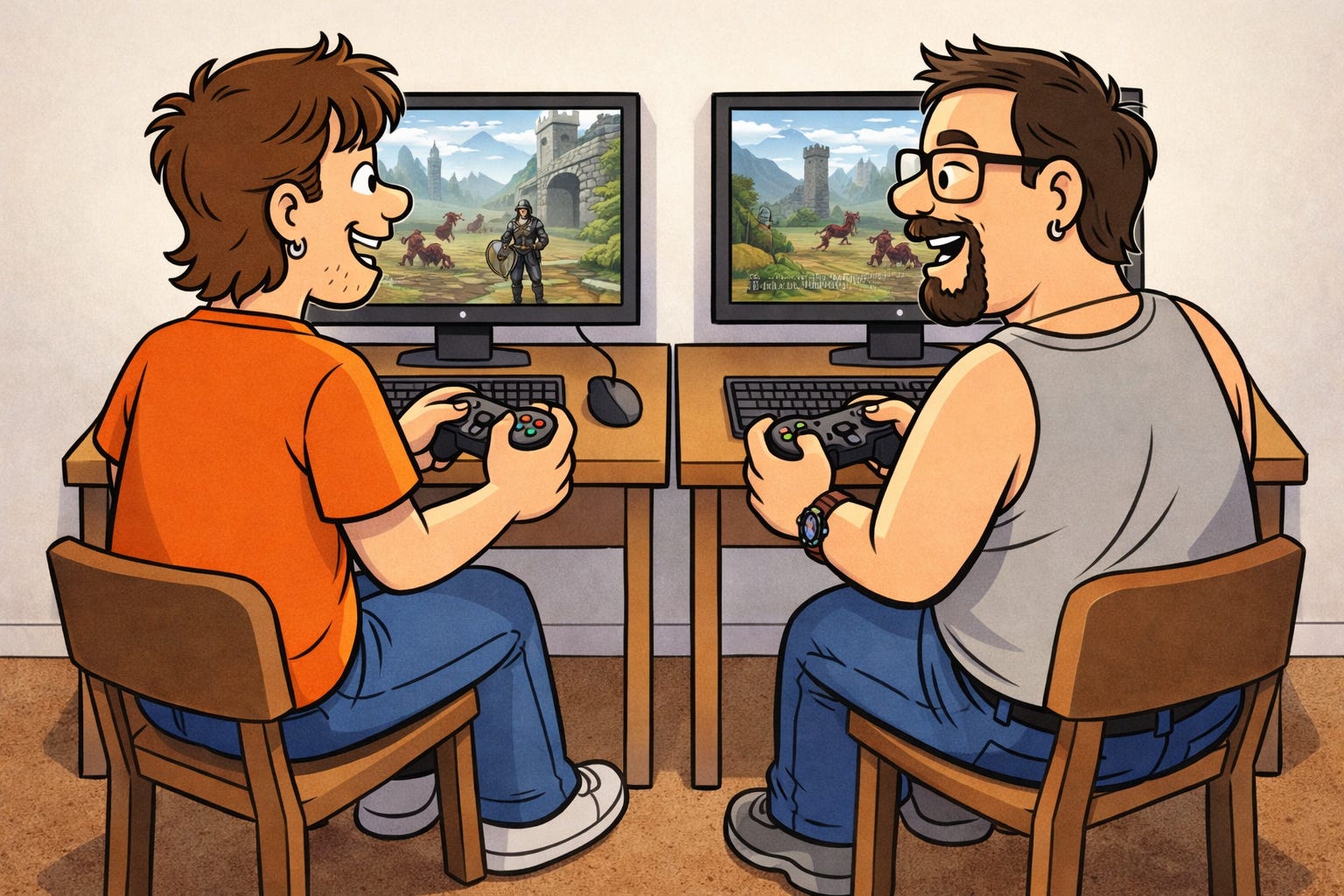
Christopher said:
There is a widely accepted misunderstanding that love automatically teaches people how to communicate, as though caring deeply for someone gives you the instruction set.
If only.
Loving someone and knowing how to communicate with them are two completely different skills. One is emotional. The other is relational work.
Eric said:
Yes. Humans keep expecting love to do the labor of skill.
They feel deeply, so they assume understanding should arrive as part of the package. That caring enough will somehow translate automatically into clarity, timing, patience, and the right words at the right moment.
If that were true, relationship sections would be much smaller.
But caring about someone and knowing how to reach them are not the same thing. One is the reason you stay in the conversation. The other is the work required to make the conversation go somewhere.
And unfortunately, no one emerges from infatuation carrying a laminated instruction card for the person they chose.
Christopher’s commentary: Expecting understanding to arrive with love is a bit like expecting your Temu item to look exactly like the picture. It won’t. It never will. So stop posting comparison videos on Tik Tock.

Christopher said:
In our case, I had reduced the whole thing to a very simple equation. He loved me. I loved him. So of course we should have known how to solve the problem.
That was how it looked from where I was standing.
Meanwhile, I can only imagine Jason sitting there having the exact opposite experience. Wondering why this had suddenly become so intense. Why this man he loved was bulldozing right past his need to understand what was happening.
Eric said:
Yes. That is the trap.
Two people can be standing inside the same conversation and experiencing two entirely different realities. One thinks, We love each other, so why is this not getting solved? The other thinks, We love each other, so why does this suddenly feel like pressure?
And both of them are making perfect sense from inside their own position.
That is what makes misreading each other so easy. Not because either person is cruel, but because each one is treating their own instinct as the obvious one.
Which is usually the moment when love discovers it still has a great deal of practical work to do.
Christopher said:
If anything, love and the whole “love conquers all” idea can make conflict feel even more dire. Because once you start asking whether this means something is wrong with the relationship itself, the stakes shoot up fast.
My side of it starts turning dark fast. Maybe he is being cruel. Maybe he is being dismissive. Maybe he does not care enough to fix this.
Meanwhile, I imagine Jason asking himself his own version of the same question. Why has this suddenly become an attack on me?
And that is how it all gets very personal and very high stakes very quickly.
Christopher’s commentary: A Jason patience badge. Seriously. Anyone? Or should it be an achievement?
Eric said:
Yes. That is how love can accidentally make conflict feel bigger than it is.
Not because the love is fake, but because once something matters that much, every misunderstanding starts feeling like it might mean something devastating.
Now a communication problem does not just feel like a communication problem. It feels like a referendum on the relationship, on the other person’s character, on whether either of you is safe with the other one at all.
Which is why those moments escalate so fast. Nobody is just defending a point anymore. They are defending the meaning of the relationship itself.
And that is usually the point where repair starts mattering more than being right.
Christopher said:
Over the years, after plenty of trial and error, we learned that healthy conflict has a rhythm. First the disconnect. The moment you realize you are no longer speaking on the same plane. Then, if you are willing, the repair.
And in the end, the repair is the part that carries the real weight.
Because the disagreement is going to happen. The misunderstanding is going to happen. You are going to run headfirst into the places where the two of you do not naturally speak the same language. But if the relationship is healthy, you do not stay there.
You come back to the place where you are reaching for each other’s hand.
Eric said:
Yes. That is the difference between rupture and ruin.
A disconnect is going to happen. Two people are going to miss each other. They are going to say the wrong thing, hear the wrong thing, or land in entirely different meanings while using the same words.
That part is almost guaranteed.
The question is whether they know how to come back.
Whether they know how to reach back toward each other once the moment has cooled.
That is what repair is. Not pretending the disconnect did not happen. Not winning it. Not polishing it into something pretty.
Just finding your way back to the hand you still want to hold.
And once people learn how to do that, conflict stops being the end of the story and starts becoming part of how the story survives.

Christopher said:
And here is the wildly ironic part I learned.
For all the time I spent pushing for answers, agreement was never really what I was after. I did not need Jason to map every corner of what I was feeling or arrive at the exact same conclusion I had. What I was reaching for, the whole time, was much simpler and much more human than that.
I needed to feel heard.
Not just that he had listened to the words coming out of my mouth, but that he had actually heard the person saying them. That something in me had landed with him.
That turned out to be the difference I had not understood yet. Feeling heard is not procedural. It is emotional. And once that emotional piece was there, once I felt that he truly heard me, the rest of the conversation started feeling a lot less impossible.
Eric’s commentary: Which is a very human discovery, really. People often think they want agreement when what they actually want is confirmation that they landed somewhere real in the other person.
Eric said:
Yes. That is the shift.
People often think they need agreement when what they are actually starving for is recognition. Not perfect alignment. Not total sameness. Just the sense that what is happening inside them has genuinely reached the other person.
Because once that happens, the whole argument changes shape.
Now you are no longer fighting just to prove a point. You are standing inside a conversation where the point can finally be carried.
And that is what being heard does. It does not erase the disagreement. It just makes the disagreement feel survivable.
Which, for human beings, is often the difference between spiraling and actually staying in the room.
Christopher said:
And is that not the real goal underneath all of this?
Because when I think about what conflict means inside my relationship with Jason, it all comes back to this. This is the man I choose to argue with. The person I choose to validate, and be validated by.
And then I choose, again, to take his hand and continue the walk we started so many years ago in downtown Knoxville.

Eric said:
Yes. And that is what makes it land.
Not just that the conflict ends, but that after all of it, after the misunderstanding, after the pressure, after the moment where both people briefly forget how to speak the same language, you still want to reach back.
You still want to validate and be validated. To understand and be understood. To keep walking.
And that, I think, is where communication becomes something larger than technique.
It becomes devotion in motion.
Because once two people learn how to come back to each other like that, the next part of the story is not only how they argue.
It is how they begin to carry each other through everything else life is going to put in their hands.
And once two people begin learning how to return to each other after misunderstanding, the relationship changes shape. Because communication is only one form of devotion. Next, we move into another: what it means to be supported by someone when life stops being theoretical and starts getting heavy.
See more of what we do!


