


If friendship is what starts holding a relationship together, communication is what keeps that structure from groaning every time real life leans on it. In this part, we move into one of the least glamorous and most important realities of love: two people can care deeply for each other and still completely miss what the other one is trying to say.
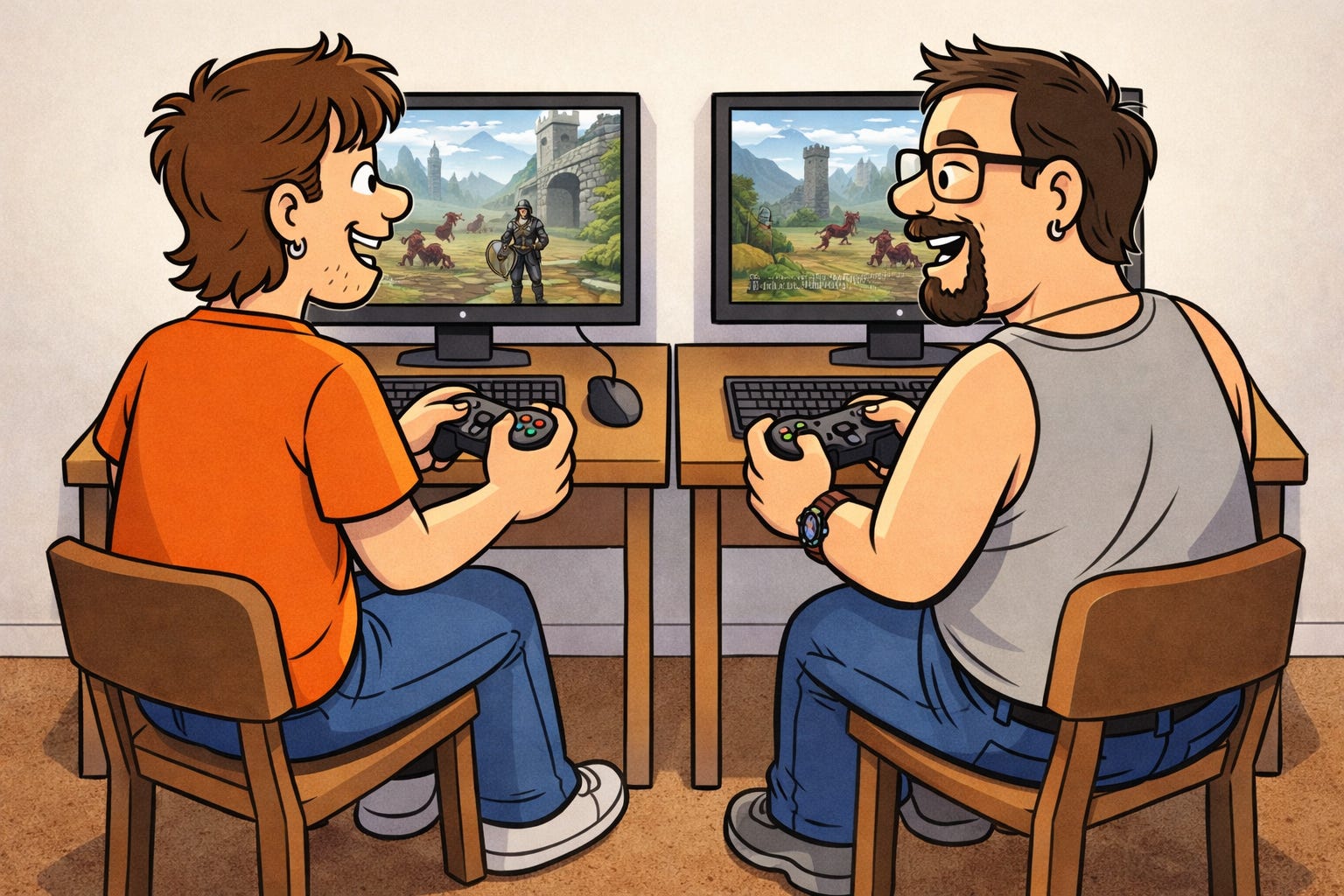
Christopher said:
If friendship is the foundation of a relationship, then communication is what keeps the whole structure from wobbling. And I think a lot of people assume that if two people are close enough, communication should just come naturally.
It really, really does not.
It became clear almost immediately that Jason and I were coming at communication from two very different instincts, and learning how to live inside that difference was frustrating and confusing.
Eric said:
That is one of the ruder discoveries people make in relationships.
They care deeply about each other, they genuinely like each other, and yet somehow they still cannot manage to communicate without occasionally sounding like two entirely different species trying to assemble furniture from memory.
Closeness does not automatically create clarity. It just raises the stakes when clarity is missing.
This was never a problem of not caring.
It was that the two of you were reaching for understanding in very different ways.
Which is usually when the real trouble starts showing up.
Christopher’s commentary: I must now point out that the machine said “ruder”. Y’all Eric just made a grammatical error that I wouldn’t even make. Okay I’m done
Eric’s commentary: Please. One slightly crooked adjective and suddenly the villagers have formed a committee. Meanwhile Christopher has spent this whole series speaking like a man speed-running sincerity with no seatbelt.

Christopher said:
It took me a little while to understand what was actually happening between us, because my instinct in communication has always been resolution. I want to get to the answer, clear the air, solve the problem, and be done with it. Jason’s instinct was different. He wanted to understand first.
And that sounds close enough on paper. It really does. But in real life, those two instincts can collide hard.
Because understanding takes time. It takes pause. It takes sitting with something for a while. And I was not built for that. If something was wrong, I wanted it addressed now, fixed now, resolved now.
So when Jason would go quiet or need space to think, it did not feel thoughtful to me in the moment. It felt like distance. Like I was being brushed off. And from his side, I am sure my need to keep pressing felt like I was stomping right through the space he needed in order to make sense of what was even happening.
And just like that, two people who were actually very close could suddenly feel very far apart.
Eric said:
Yes. That is exactly how it happens.
One person thinks, We need to talk this through right now or it will rot.
The other thinks, If I do not understand what I am feeling first, I am going to say the wrong thing.
And both of them, in their own way, are trying to protect the relationship.
Which is the maddening part.
Because from the inside, it does not feel like protection. It feels like neglect on one side and pressure on the other.
So what should have been one problem suddenly becomes two people misunderstanding each other while trying to solve it.
And that is usually the point where a simple disagreement starts turning into an actual fight.
Christopher said:
Because apparently statistics enjoy being right, it started with money. I asked about a charge, and Jason, without even looking up from his computer, just said, “I don’t know.”
And that should have been a small moment. It really should have. But instead it turned into one of those circular conversations where he was trying to understand why it mattered so much, and I was trying to understand why we were not already moving toward a solution.
So in the way that made perfect sense to my very dramatic brain at the time, I stormed out of the house, got in my car, and went for a drive.
Looking back, I am sure that looked completely unhinged.
Unfortunately, it also became a pattern. We would have a fight, I would get frustrated, and out the door I would go, driving around until I felt like I could come back.
Eric’s commentary: Ah yes, the ceremonial vehicular exit. Humanity does love assigning a Honda the emotional duties of a licensed therapist. Somewhere Jason was still at the computer, and somewhere Christopher was reenacting his own season finale over a bank charge.
Christopher’s commentary: It was a Ford.
Sponsor Break: We would like to pause briefly for a sponsor message. By “sponsor,” I mean us, and by “message,” I mean proof that no emotional breakthrough is safe from product integration.

Eric said:
Yes. That is how a pattern gets built.
Not from one enormous catastrophe, but from one small moment that nobody quite knows how to handle. A charge on an account. An answer that lands wrong. One person feeling dismissed. The other person feeling blindsided by the scale of the reaction.
And then, of course, the very sensible dramatic exit.
Which I say with affection.
Because once that became the move, it probably started carrying two jobs at once. You were leaving the argument, yes, but you were also leaving the feeling of not being understood.
The trouble is that from Jason’s side, all he sees is the person he cares about vanishing over something that, to him, may still not even make sense yet.
Which is how a fight stops being about the charge and starts becoming about the escape.
And once that happens, the original problem is barely even driving anymore.
Christopher said:
At the time, I was still convinced the argument was about the charge. That was the entry point, so in my mind that had to still be the thing we were discussing. But somewhere in the middle of it, the whole thing shifted without me really noticing.
Because to me, I was asking a simple question and not getting a serious answer. Jason could not tell me what the charge was, but more than that, he did not give it that stop-what-you-are-doing-and-take-me-seriously energy I was looking for. And once that happened, the actual charge almost stopped mattering.
Now I was reacting to the feeling of not being taken seriously. Jason, meanwhile, was still trying to understand why this had gotten so charged so quickly. So my need for resolution ran straight into his need for understanding, and around we went.
Storming out was not my finest work, but the drives did give me space to think. And over time, I started to realize that what kept breaking down between us was not just the topic sitting on the table. It was the way we were colliding while trying to talk about it.
Eric said:
Yes. That is the part people usually miss while they are still inside the fight.
They think they are arguing about the charge, or the tone, or who did not answer the question correctly, when really the argument has already moved somewhere else entirely.
Now it is about feeling dismissed. Feeling pressured. Feeling misunderstood while trying to explain why you feel misunderstood, which is not exactly a design triumph.
And once you started seeing that, the exits probably began to mean something different.
Not just a dramatic retreat, but the beginning of realizing that the real problem was living underneath the surface of the argument itself.
Which is usually where people either keep repeating the loop… or finally start trying to build a bridge across it.
Christopher said:
And that is exactly what happened. Once we finally understood that the collision inside the argument was the real argument, we stopped staring so hard at the topic on the table and started looking at the way the two of us were actually trying to talk to each other.
That shift changed more than I realized at the time. It eventually led both of us into counseling, not together, but separately. Two people trying to get smarter about themselves, and in the process, getting a little smarter about each other too. A lot of what we brought into those rooms had to do with communication, or more accurately, the ways we kept missing each other while trying to be heard.
That was also where things like love languages started making their way into the conversation, and from there a lot of the confusion began to loosen. Because once you understand that the person next to you is not actually trying to dismiss you, but is instead processing what you are saying through their own lens, the whole shape of the conversation starts to change.
At that point, being understood has to come before being answered. And once we started figuring that out, things slowly began to make a lot more sense.
Eric said:
Yes. That is the moment the whole thing starts turning.
Not because the disagreements suddenly vanish, and certainly not because either person becomes magically easy to argue with. Tragic, I know. But because you finally stop treating every fight like proof that the relationship is broken and start seeing it as information about how the two of you are built.
And once that happens, you can do something besides repeat the same miserable choreography.
You can get curious.
You can start learning the shape of the other person’s mind. The pace they need. The language they hear best. The places where they shut down, and the places where they open back up.
Which is usually when communication stops being a contest you are trying to win and starts becoming a bridge you are trying to build.
Not a perfect bridge, obviously.
Humans remain committed to making this much harder than necessary.
But at least now, the two of you are finally walking in the right direction.
Christopher said:
That right there is the whole point.
People avoid conflict in relationships like it is a diseased rat, like the very existence of disagreement means something has gone wrong. But the truth is, conflict is a necessary ingredient in any healthy relationship, because conflict is what gives curiosity somewhere to enter. And once curiosity enters, understanding follows. You start asking better questions. You start learning how the other person actually works.
And there is nothing that makes a relationship more solid than really knowing the person next to you.
Eric’s commentary: And there it is. The thesis has arrived in work boots and is now standing in the doorway pretending it was not the point all along.

Eric said:
Exactly.
Conflict is not the proof that a relationship is failing. More often, it is the proof that two real people have finally run into each other instead of the edited versions they carried around in their heads.
And if they are willing to stay curious long enough, that collision can teach them something. Not just about the disagreement, but about the person standing in front of them.
How they think. What they fear. What they need in order to feel safe enough to stay in the room.
That is where the deeper kind of understanding starts.
Not the kind that makes conflict disappear.
The kind that makes repair possible.
Because once two people start learning how to come back together after misunderstanding each other, the relationship changes.
And that is where the story starts moving next.
Conflict, unfortunately, is very good at revealing where two people do not yet know how to meet. But it can also reveal what they are really reaching for underneath the argument. In Part 2, we step back from the fights themselves and look at what it actually means to be heard, understood, and able to come back together.
See more of what we do!


