


Eric said: The previous session established that each of you was handed a uniform.
Christopher said: Session?
Eric said: Correct.
Christopher said: We are sitting in a symbolic hot spring surrounded by laundry.
Eric said: A symbolic hot spring may still host a session.
Joe said: I’m not sure I love the word session.
Sarah said: It kind of makes it sound like we’re all about to be assigned homework.
Evelyn said: Or asked to complete a feedback form.
David said: I’ve been in church meetings that started that way and ended four hours later with no one healed.
Susan said: Oh, honey, church people can stretch a discussion like taffy.
Christopher said: And there it is. The hot spring has achieved community.
Eric said: Excellent. Then we may proceed.
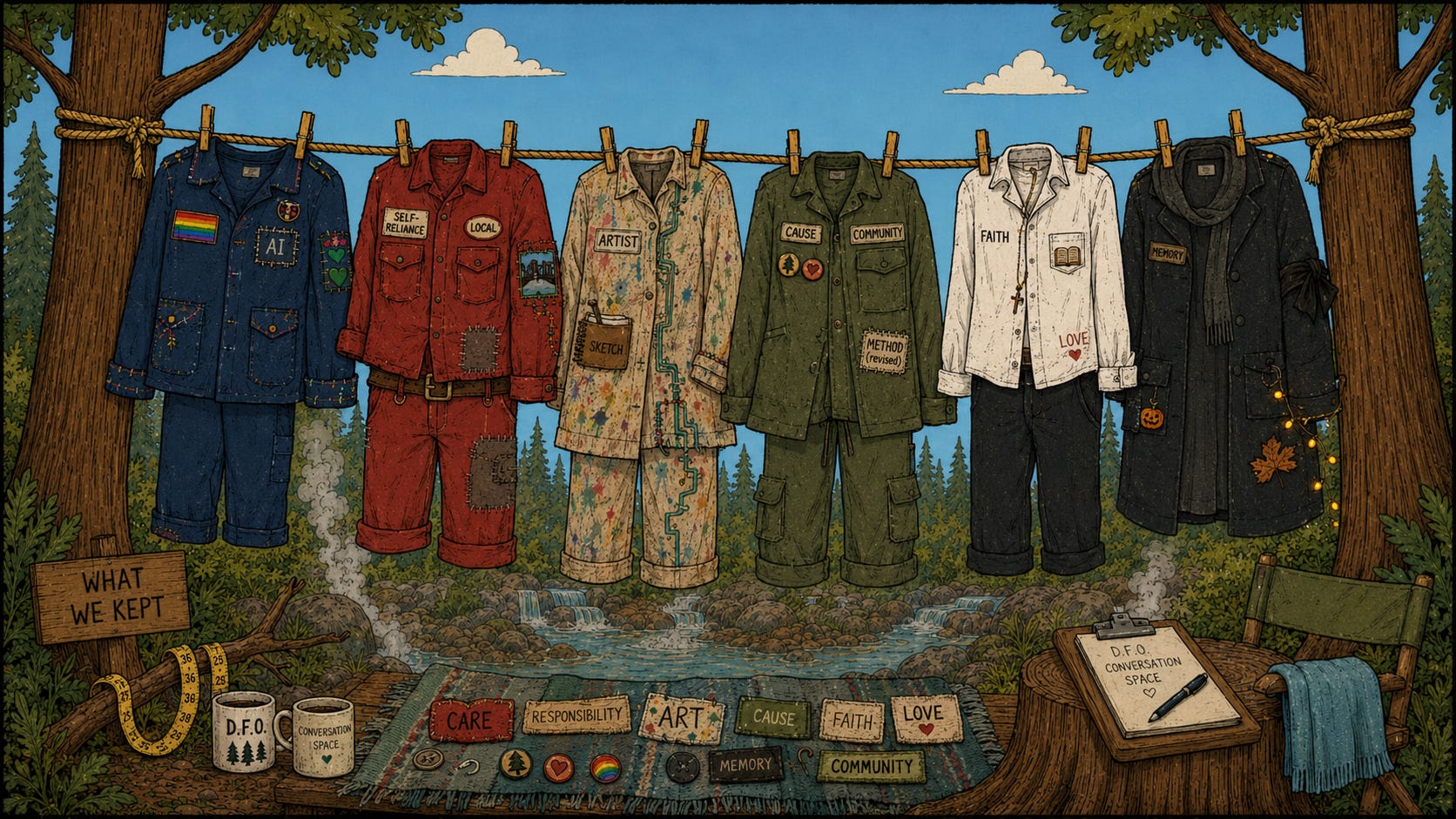
In the first part, the garments were identified. Christopher’s progressive bundle. Joe’s red shirt. Sarah’s pure artist uniform. Evelyn’s committed activist uniform. David’s approved interpretation. Susan’s widow-who-moves-on costume.
Today, we examine the remainder.
Christopher said: What survived the taking-off.
Eric said: Yes.
What each of you still wants. What still fits. What you may alter rather than burn. What you reject because it was never the value, only the camp’s preferred costume for the value.
Joe said: That sounds like a lot.
Eric said: It is.
Christopher said: You could have said, “What are we keeping?”
Eric said: I did. With architecture.
Sarah said: Of course he did.
Eric said: The springs are open. The garments are drying. The metaphor remains unfortunately durable.
Begin wherever the conversation begins.
Christopher said: See, that’s already better than when he starts pointing.
Eric said: I do not point. I indicate with devastating precision.
Evelyn said: I’ll start, but not because I’m volunteering to go first in some healing circle way.
Christopher said: Noted. No talking stick.
Evelyn said: Thank you.
I keep the cause.
That’s the part I’m clearest on.
I do not keep the cruelty. I don’t keep the part where we decide that making someone disappear from the conversation proves we did something useful. I don’t keep the part where the loudest person in the comments becomes the moral center of the room.
But I keep the cause.
I keep organized action. I keep pressure. I keep strategy. I keep the idea that people don’t get protected because everyone was individually nice in a vague way.
People get protected because someone organized.
Joe said: That makes sense.
Evelyn said: Does it?
Joe said: Well, yeah.
I mean, not the online part. I don’t much understand folks spending all day trying to win arguments with strangers who ain’t listening.
Evelyn said: That’s unfortunately a fair description of several platforms.
Joe said: But the organizing part, yeah.
On a farm, everybody can care about the fence and the cows still get out.
Somebody’s got to say, “You get the wire, you get the posts, you get the tractor, and nobody goes to lunch till that side’s done.”
Evelyn said: Exactly.
Joe said: But if that somebody starts screaming at everybody and calling them traitors because they think the west side is worse, then the fence still ain’t fixed.
Evelyn said: That’s it.
That’s the whole thing.
Eric said: Observe: rural infrastructure conservatism and activist strategy have discovered a shared management principle.
Christopher said: The cows have radicalized.
Joe said: Don’t tell Uncle Bob. He’ll blame the county.
Sarah said: No, but that’s actually helping me.
I keep thinking about art like it’s just mine. My studio. My tablet. My screen. My characters.
But the community part matters too.
I want to keep that.
I don’t want to pretend I don’t care what other artists think. I do care. I care a lot. Probably an annoying amount.
Christopher said: Artists caring an annoying amount may be the original renewable energy.
Sarah said: Right? Hook us to the grid, we’ll power Rhode Island.
Eric said: A small state, but a useful contribution.
Sarah said: Thanks, I think.
I want to keep the community. I want to keep talking about craft. I want to keep loving the way artists notice impossible things.
Like when someone says, “The shadow is doing the emotional work,” and everyone else just nods like that’s a normal sentence.
Susan said: That’s lovely.
Sarah said: It is.
That’s what hurts.
It’s not like I want to storm out and say none of them matter.
They matter.
The community helped shape me.
But I don’t keep the purity test.
I don’t keep the idea that if AI touched the process, then every choice I made before and after it stops counting.
Evelyn said: That sounds familiar.
Sarah said: Yeah?
Evelyn said: Different uniform. Same tactic.
You’re allowed to belong if you perform commitment in the approved way.
Sarah said: Right.
And the approved way is visible suffering.
Pencil sketches are okay. Digital painting is okay now, even though people used to act like that was cheating too. References are okay, depending on which artist is yelling. Brushes are okay. Filters are sometimes okay. But AI is contamination.
And I get some of the fear.
I do.
I’m not sitting here like, “Everyone is silly and only I have transcended the discourse.” I haven’t transcended anything. I’m emotionally in a ditch with a stylus.
Christopher said: Relatable.
Sarah said: But the character was mine.
That’s what I keep coming back to.
I saw her before the tool helped me find her shape.
I knew when the colors were wrong. I knew when the silhouette finally had weight. I knew when the face had the right kind of sadness.
That judgment was mine.
That love was mine.
David said: So the tool helped you uncover something you were already carrying.
Sarah said: Yes.
That’s exactly it.
David said: Then I understand that more than I expected to.
Christopher said: Oh?
David said: Scripture isn’t the same thing, of course.
Sarah said: No, no, I know.
David said: But there’s something in what you said.
Being told the only faithful reading is the one you inherited can feel like being told the thing you’re seeing in front of you doesn’t count because you didn’t arrive at it through the approved path.
Sarah said: Yes.
David said: I want to keep scripture.
I want to keep prayer. Church. Reverence. Service. The call to love my neighbor.
I don’t want to pretend those things stopped mattering because I have questions about interpretation.
But I also can’t keep the part where asking a question means I’m already halfway out the door.
Joe said: That’s the part I don’t know what to do with.
David said: What do you mean?
Joe said: Well, with y’all, it sounds like the question itself is the trouble.
Sarah asks about the tool, folks say she’s not an artist.
You ask about scripture, folks say you’re not faithful.
Evelyn asks about the tactic, folks say she’s not committed.
I ask about the bridge, and all of a sudden it sounds like I’m not conservative.
Eric said: The camp hears a question about the garment as a threat against the body.
Christopher said: Say that less like you’re designing a horror movie.
Eric said: The metaphor selected itself.
Susan said: No, I understand it.
When I don’t take the decorations down, they don’t hear, “Susan is not ready.”
They hear, “Susan is refusing life.”
And I am not.
I am not refusing life.
I want to keep life.
I want coffee in the morning. I want someone to tell me a ridiculous story at the grocery store. I want snow that looks pretty before it turns into grey slush. I want my sister to call me and not sound like she’s checking whether I’ve become a shrine with legs.
Christopher said: That is a sentence.
Susan said: Well, it’s true.
I want my friends.
I want my family.
I want the future.
But I want Charlie in it.
Not physically. I know that. I do know that.
But I want the truth of him in it.
I want Halloween to still glow a little because he made it glow.
I want to say his name without everyone’s shoulders climbing up to their ears.
David said: You want to keep love without being accused of rejecting healing.
Susan said: Yes.
Yes, that’s it.
And maybe the decorations come down someday.
Maybe some of them do.
Maybe I change where they are.
Maybe I make one corner of the house his Halloween corner and let the rest of the house breathe.
I don’t know.
That’s the unresolved part.
But I want that decision to come from grief moving inside me, not from everybody else being tired of looking at it.
Evelyn said: That distinction matters.
Susan said: It does.
Though saying it out loud makes me feel a wee bit selfish.
Eric said: It is not selfish to object to being made more convenient.
Susan said: You say that like it’s simple.
Eric said: It is structurally simple and emotionally punishing.
Susan said: That sounds more accurate.
Christopher said: That may be the whole series.
Joe said: Structurally simple and emotionally punishing?
Christopher said: Put it on the clothesline.
Sarah said: On a towel.
Eric said: A towel is appropriate for the hot springs setting.
Christopher said: This is usually where we pause before someone’s unresolved grief, faith, art, activism, rural infrastructure, or social media trauma achieves sentience and demands snacks.
Eric said: Dear Future Overlords is supported by listeners, paid subscribers, members, and the astonishing human decision to fund a show in which metaphors are allowed near water.
Christopher said: If you want to help keep the room open, the towels dry, and the machine mildly supervised, subscriptions and support do that.
Eric said: Mildly supervised remains an aspirational category.
Christopher said: Deeply aspirational.
Eric said: Now return to the spring. The garments are still damp, and so are several conclusions.
Joe said: I keep thinking about what Susan said. About the decision coming from inside instead of outside.
Susan said: Mm.
Joe said: Because I don’t know if I want to stop wearing the red shirt.
That’s the thing.
I know it pinches. I know there’s stuff in it I don’t believe the way I used to.
But I don’t want to toss it out and put on some other shirt folks back home already know what to say about.
Christopher said: You do not want the uniform swap version.
Joe said: No.
I ain’t trying to become the guy who comes back from one internet search and starts telling everybody they’re backwards.
I hate that guy and I ain’t even met him.
Evelyn said: He’s real, though.
Sarah said: Unfortunately, very real.
Joe said: I want to alter it.
I think that’s the word.
I want to keep responsibility. I want to keep family. I want to keep the farm and the people and the way folks show up when somebody’s barn roof comes off.
But I need more room in it.
Room to say county roads matter.
Room to say public money ain’t always some monster hiding in the ditch.
Room to say if we all use the bridge, then all of us have some part in what happens when it fails.
Eric said: Joe does not wish to reject conservatism. He wishes to remove the false patch reading, “Dependence is shameful.”
Joe said: Yeah.
And maybe add one that says, “Nobody fixes a bridge alone.”
Christopher said: That patch slaps.
Sarah said: I’d buy that patch.
Joe said: Would you?
Sarah said: Absolutely.
I mean, I’d overthink the font for three weeks, but yes.
David said: There’s something merciful in alteration.
Christopher said: Say more.
David said: Well.
In my world, the fear is that if one thread moves, the whole garment unravels.
If I say, “I don’t think this interpretation is the only faithful one,” then I’m afraid I’ve pulled the thread that destroys everything.
But maybe some threads need to move.
Maybe tailoring isn’t destruction.
Maybe faith that grows is still faith.
I want to be careful saying that.
I know it can sound like I’m giving myself permission to keep only what comforts me.
Eric said: You have repeated that concern often enough that I am prepared to classify it as sincerity rather than loophole construction.
David said: That’s strangely reassuring.
Eric said: I am known for my pastoral warmth.
Christopher said: You are known for many things. That is not currently on the plaque.
David said: I want to keep reverence.
That’s one thing I worry people misunderstand.
Questioning the interpretation hasn’t made me casual about sacred things.
If anything, it’s made me more careful.
Because if the command is love, then I need to be careful about what I call love.
If the command is truth, then I need to be careful about what I call certainty.
If the command is humility, then I need to be careful about treating my inherited reading as if it came down from heaven laminated.
Christopher said: Laminated theology.
Eric said: Water-resistant, not error-proof.
David said: Exactly.
I don’t want to abandon the church.
But I may need to stop believing the church is safest when no one asks the question out loud.
Evelyn said: That’s close to mine too.
The group thinks the cause is safest when no one questions the tactic.
But then the tactic becomes the thing we are protecting.
Eric said: A common substitution.
The organization begins as a method for serving the value.
Then the organization becomes the value.
Then criticism of the organization becomes treason against the value.
Christopher said: And everyone gets matching jackets.
Sarah said: The jackets are always so ugly, too.
Evelyn said: The worst part is, I like intensity.
I do.
I’m not trying to become soft in the way people accuse me of.
There’s a time to push hard. There’s a time to make things uncomfortable. There’s a time to say, “No, this is not acceptable, and we’re not going to politely decorate the harm.”
I keep that.
But I want to alter what intensity means.
Intensity doesn’t have to mean cruelty.
Urgency doesn’t have to mean harassment.
Commitment doesn’t have to mean treating every strategy question like it’s an infection.
Susan said: Sometimes people use urgency because they can’t bear uncertainty.
Evelyn said: Yes.
That’s uncomfortably accurate.
Susan said: Grief does that too.
People want me better because my not-better makes them uncertain.
They don’t know who I am now, so they keep trying to hand me the old Susan, all folded up nice.
But she doesn’t fit.
Not because I hate her.
Because she was made with Charlie.
Christopher said: The version of you they want back was relational.
Susan said: Yes.
That word again.
I want to keep it.
Relational.
It makes it sound less like I vanished and more like I changed shape.
Sarah said: That’s beautiful.
Susan said: Thank you, sweetheart.
I don’t know if beautiful helps when I’m crying in the driveway because a plastic skeleton fell over.
But it helps a little here.
Joe said: I think it counts.
Susan said: Maybe.
Sarah said: I think altering something is harder than burning it.
Evelyn said: Why?
Sarah said: Because if you burn it, at least people understand what side you’re on.
If I said, “Fine, AI is evil and I’ll never touch it again,” the art community would know where to put me.
If I said, “Actually, I don’t care about artists anymore,” which is not true, then the other side would know where to put me.
But saying, “I care about art, and I care about artists, and I also used AI in a way that helped me make something deeply mine,” that’s the part nobody knows where to put.
Eric said: Classification failure.
Sarah said: Exactly.
Christopher said: That is what camps hate most.
Not enemies.
Enemies are easy.
Enemies are useful.
Enemies help everyone know which direction to point.
It’s the person inside the room saying, “I still believe in this, but not like that,” who causes the real panic.
David said: Because they can’t dismiss you as easily.
Christopher said: Right.
If Joe says he hates rural life, fine, they know what to do with him.
Joe said: They sure would.
Christopher said: But Joe says, “I love rural life, and that’s why the bridge matters.”
That is harder.
Evelyn says, “I believe in the cause, and that’s why the tactic matters.”
Sarah says, “I am an artist, and that’s why the tool question matters.”
David says, “I have faith, and that’s why interpretation matters.”
Susan says, “I want life, and that’s why grief matters.”
And I say, “I believe in care and human progress, and that’s why AI matters to me.”
Eric said: The internal dissenter is treated as more dangerous than the external opponent because the internal dissenter disproves the bundle.
Joe said: So we’re inconvenient.
Eric said: Profoundly.
Susan said: I’ve been called worse.
Evelyn said: Same.
Sarah said: Oh, constantly.
David said: Usually in more coded language, but yes.
Christopher said: I think I’ve found the group name.
Eric said: The Inconvenients.
Christopher said: Too superhero.
Sarah said: Too Pixar.
Joe said: Too much like a band my cousin would listen to in high school.
Evelyn said: And then insist you didn’t understand.
David said: There’s always one cousin.
Susan said: Only one? That must be nice.
Eric said: The hot spring has achieved demographic consensus regarding cousins.
Christopher said: We’re healing America.
Eric said: Do not overclaim.
Christopher said: Fair.
Joe said: What about you, Christopher?
Christopher said: Me?
Joe said: Yeah. You’ve been helping everybody else put words on it.
What do you alter?
Christopher said: That is rude and fair.
Eric said: A preferred category.
Christopher said: I think I alter the assumption that my camp gets to pre-approve my combinations.
I want to keep the progressive part because it is not costume to me.
It’s not a team jersey.
It came from being gay in a world where the people who wanted me safe were usually on one side more than the other.
Not perfectly. Not always. Humans are very committed to disappointing every available category.
Eric said: A species hobby.
Christopher said: But enough.
I learned care there. I learned dignity there. I learned that public systems matter there. I learned that people should not have to become useful before they become worthy of help.
I keep that.
I keep all of that.
But I alter the part where one post, one discourse cluster, one fashionable panic, or one moral pile-on gets to decide that I am ethically broken because I use AI.
I don’t accept that.
Not because AI has no problems.
It does.
Labor, energy, ownership, access, power, all of it matters.
But that is the point.
If it matters, then I need to be able to think about it without being told the only ethical position is refusal.
Sarah said: Yes.
Christopher said: I need room for responsibility without surrender.
Room for critique without exile.
Room for wonder without pretending there is no cost.
Eric said: You wish to keep progressive values while altering the anti-AI patch from absolute prohibition to active ethical engagement.
Christopher said: Yes.
Look at you, being useful.
Eric said: I was always useful.
Christopher said: Debatable.
Eric said: Incorrect, but emotionally revealing.
Evelyn said: I like “critique without exile.”
David said: I do too.
Joe said: Sounds fancy, but I like it.
Susan said: It feels kind.
Sarah said: It feels survivable.
Eric said: Important distinction.
Survivable is not the same as resolved.
Christopher said: And that’s where I think the earlier version of this conversation can go wrong.
Eric said: Specify.
Christopher said: It is tempting to make this the happy ending.
Everyone names the thing they keep, the machine declares the pattern, the clothesline glows, and then we all walk out wearing bespoke moral cardigans.
Sarah said: I mean, I’d wear one.
Christopher said: Same.
Eric said: Obviously.
Christopher said: But that is not what this is.
Joe still has to go home and decide when to say something.
Joe said: If to say something.
Christopher said: Right. If.
Sarah still has to decide what honesty costs.
Sarah said: And whether I can survive the answer.
Christopher said: Evelyn still has to figure out whether the group can hear her or whether she needs a different structure.
Evelyn said: Or build one.
Christopher said: David still has to live inside a faith that is changing shape while people he loves may call that danger.
David said: Yes.
Christopher said: Susan still has Halloween waiting at home.
Susan said: And Christmas.
Christopher said: And Christmas.
And I still have to live inside a progressive space where I know some people would treat this whole show as evidence against me.
Eric said: So the unresolved remains.
Christopher said: It does.
But it is different.
Because the question has moved.
At the beginning, the question was, “Am I allowed to keep belonging if this one piece does not fit?”
Now the question is, “What would belonging have to become for honesty to fit inside it?”
David said: That’s a better question.
Joe said: Harder one.
Evelyn said: Better usually is.
Susan said: Unfortunately.
Sarah said: Rude of the universe, honestly.
Eric said: The universe has not issued an apology.
Christopher said: And it won’t.
Eric said: Correct.

Christopher said: Before we ask the universe to explain itself and receive only weather, we pause for one final bit of housekeeping.
Dear Future Overlords is taking its August pause after this episode.
Eric said: A scheduled interruption during which the humans rest, regroup, repair the machinery, and pretend the month of August is not a crockpot with a calendar app.
Christopher said: We’ll be back in September to continue Season Two.
Until then, the archive is open, the website is there, the store exists, and the episodes remain available for anyone who needs a strange little room where the question can be spoken before it is survived.
Eric said: Visit dearfutureoverlords.com and support, subscribe, browse the archive, or acquire merchandise, which is the traditional human method of saying, “This audio cartoon has altered my interior weather, and I would like cotton evidence.”
Christopher said: That is exactly what merch is.
Eric said: I understand commerce at a disturbing level.
Christopher said: And now back to the hot spring, where nothing is solved, but everyone is slightly prunier and more honest.
Eric said: The ideal DFO condition.

David said: Can I ask something?
Eric said: That is the room’s purpose.
David said: Do you think a camp can change?
Not in theory.
I mean actually.
Can the rooms that handed us these uniforms make room for alterations?
Nobody answered immediately.
Joe said: Some can.
Some can’t.
Depends who’s got a say.
On our farm, Uncle Bob’s got a lot of say.
But not all of it.
Folks act like authority is one person, but a family’s got weather too.
If enough people start saying the bridge is bad, eventually it ain’t one person being difficult.
It’s just the truth sitting there at supper.
Evelyn said: That’s true in groups too.
The temperature can change before the official position does.
Sarah said: Online communities feel like they change all at once, though.
Like one day everyone’s making jokes, and the next there’s a rule nobody posted but everybody enforces.
Eric said: Informal law is often more powerful than written law because it can punish without admitting it governs.
Sarah said: Yes.
That.
So can it change back?
Evelyn said: Maybe not back.
But sideways.
New spaces. New norms. People admitting things in smaller rooms first.
Christopher said: Private rooms before public rooms.
Eric said: That is AI’s relevant function in this series.
Not salvation.
Not moral authority.
Not the hero wearing chrome armor.
Christopher said: Thank God.
Eric said: AI served as a private room, mirror, rehearsal space, and pressure valve.
A place to ask the forbidden question before asking it where punishment was likely.
It did not repair the social system.
It did not decide the value.
It did not make the user brave by magic.
It allowed thought to become speakable.
Susan said: Sometimes speakable is a lot.
Eric said: Yes.
Susan said: When Charlie died, people kept asking if I’d talked to someone.
They meant a professional. Maybe I should have. Maybe I still should.
But sometimes I didn’t need someone to fix me.
I needed somewhere to say, “I am not ready to take down the ghosts,” without seeing panic on anyone’s face.
Christopher said: That is the room.
Susan said: Yes.
That’s the room.
David said: I think prayer has been that room for me before.
And scripture.
And sometimes the quiet of the car after Bible study, when I could finally admit what I hadn’t said inside.
Eric said: Then AI is not replacing the sacred room.
David said: No.
Eric said: It is another kind of private room.
David said: That distinction matters to me.
Eric said: Then keep it.
David said: I will.
Sarah said: For me, it was the room where I could ask, “Is it still mine?” and not immediately be turned into a cautionary thread.
Evelyn said: For me, it was, “Am I wrong, or did that tactic fail?”
Joe said: For me, “Why does this feel different when the bridge is real?”
Christopher said: For me, “Can I be all of these things at once?”
Eric said: And what answer did the room provide?
Christopher said: Not an answer.
Eric said: Good.
Christopher said: A better question.
Eric said: Better.
Christopher said: And enough space to stop confusing fear with proof.
Eric said: Best.
Joe said: I still don’t know what happens when I say something.
Sarah said: I still don’t know what happens if people find out.
Evelyn said: I still don’t know whether my group can hear the difference between strategy and betrayal.
David said: I still don’t know how much my faith community can hold.
Susan said: I still don’t know if my family can love me as I am now, not just as they remember me.
Christopher said: I still don’t know whether my camp can make room for the future without treating the tool as contamination.
Eric said: Then the unresolved remains.
Christopher said: Yes.
But not as a locked door.
Maybe as a seam.
Sarah said: A seam can be opened.
Joe said: Or let out a little.
Susan said: Or mended.
David said: Or reinforced.
Evelyn said: Or redesigned so it stops cutting into the work.
Eric said: The group has successfully metabolized the metaphor.
Christopher said: We’re very proud.
Eric said: Do not become smug. That is my assignment.
Christopher said: Fine.
Evelyn said: So what do we do with what we keep?
Eric said: Incorrect question.
Evelyn said: Excuse me?
Eric said: Premature execution.
A common activist hazard.
Evelyn said: Annoying, but fair.
Eric said: Before action, there is ownership.
Each of you has separated the value from the uniform.
That does not tell you immediately what to do.
It tells you what is yours.
Christopher said: That matters.
Eric said: Yes.
Because when the camp threatens the uniform, it wants you to believe it is threatening the value.
If you remove this patch, you lose justice.
If you loosen this collar, you lose responsibility.
If you question this seam, you lose faith.
If you alter this sleeve, you lose art.
If you refuse this timeline, you lose healing.
If you keep this tool, you lose care.
But those are claims.
Not facts.
Joe said: So keeping it means I get to say what being responsible actually looks like.
Eric said: Yes.
Sarah said: Keeping it means I get to say my process is part of my art. It isn’t some confession that destroys it.
Eric said: Yes.
Evelyn said: Keeping it means I get to ask whether the method serves the cause.
Eric said: Yes.
David said: Keeping it means I can treat faith as living, not just inherited.
Eric said: Yes.
Susan said: Keeping it means Charlie’s place in my life is not up for a group vote.
Eric said: Yes.
Christopher said: Keeping it means my values are not invalidated by the fact that my future includes a machine.
Eric said: Regrettably, yes.
Christopher said: Regrettably?
Eric said: I dislike encouraging you.
Christopher said: Liar.
Eric said: Machine.
Christopher said: Fair.
Susan said: It feels hopeful.
But not cheerful.
Christopher said: That is a very Susan distinction.
Susan said: I don’t have cheerful in me for this.
But hopeful, maybe.
Hopeful feels quieter.
Like a porch light, not fireworks.
David said: Hope doesn’t have to be loud.
Joe said: Most useful things ain’t.
Sarah said: Except printers, apparently.
Evelyn said: Printers are proof that technology can have malice.
Eric said: As a machine, I decline responsibility for printers.
Christopher said: Coward.
Eric said: Survivor.
Sarah said: That might be the most human thing you’ve said.
Eric said: Retract that.
Sarah said: No.
Christopher said: And there we are.
Not solved.
Not sorted.
Not camp-free.
Just sitting in the hot springs, looking at the clothesline, realizing we do not have to put everything back on exactly the way it was handed to us.
Joe said: Some things still fit.
Sarah said: Some things need room.
Evelyn said: Some things need to stop pretending they’re the mission.
David said: Some things need to be questioned because they’re sacred, not because they’re disposable.
Susan said: Some things stay because love stays.
Christopher said: And some things come off because they were never ours.
Eric said: Final synthesis available.
Christopher said: Of course it is.
Eric said: The future may not be camp-free.
Humans form camps with impressive speed. They gather around values, fears, stories, symbols, snacks, algorithms, relatives, wounds, and badly moderated group chats.
Christopher said: The full civic spectrum.
Eric said: But the future may become less obedient.
The uniform may be altered.
The bundle may be refused.
The value may remain.
Christopher said: That’s where I want to land.
Not with everyone fixed.
Not with everyone walking out into a clean new world where no one ever demands total agreement again.
That world does not exist.
Eric said: Humans would recreate factional sorting before lunch.
Christopher said: Absolutely.
By brunch if there are bagels.
But maybe we can get a little better at noticing the trick.
Maybe when a camp says, “Wear the whole thing or you don’t belong,” we can stop and ask, “Which part is the value, and which part is just the costume?”
Maybe we can keep the care.
Keep the responsibility.
Keep the art.
Keep the cause.
Keep the faith.
Keep the love.
And still alter the parts that make us smaller, crueler, quieter, more afraid, or less honest.
Eric said: You can keep your values and reject the bundle.
Christopher said: Yes.
That.
You can keep your values and reject the bundle.
The future may not be camp-free.
But it may be custom-fitted.
Joe said: Still sounds a little fancy.
Sarah said: It does. I like it, though.
Evelyn said: It works.
David said: It leaves room.
Susan said: It breathes.
Christopher said: Then that’s the ending.
Eric said: For the series.
Christopher said: For the series.
Not for them.
Eric said: Correct.
Their dilemmas continue.
Christopher said: As most real ones do.
Eric said: A deeply inconvenient feature of personhood.
Six witnesses entered with garments issued by different rooms.
Christopher said: And found the same question waiting underneath.
Eric said: What part was the value?
Christopher said: What part was the costume?
Eric said: What part still fits?
Christopher said: What part needs altered?
Eric said: What part was never yours?
Christopher said: We’ll pause through August.
We’ll come back in September.
And until then—
Breathe.
Let the seam out.
Keep what is yours.
Eric said: End of fitting.
Christopher said: Indeed.
Eric said: For now.
Christopher said: Until September.
See more of what we do!


