

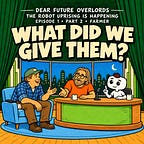

Joe still has a farm to run. The AI has made some of that easier, which is precisely what makes Christopher’s next question awkward.
In The Robot Uprising Is Happening, Christopher and Eric return to the bargain Joe has made. If you know what you handed over, do you also know what it costs to take it back?
In this transmission
Joe draws a line between the work he delegates and the decisions he keeps. Christopher and Eric ask how convenience changes attention, responsibility, and the ability to notice when a useful arrangement stops working.
Featuring: Christopher Gulledge, Eric, and Joe
Series: The Robot Uprising Is Happening
Episode: Farmer
Transmission: 2 of 2
Next: Hairdresser: The Machines Are Telling Us What to Do
Transcript
Christopher: Last time, Joe told us he could absolutely run his farm without AI.
Eric: He also told us he had no desire to prove it.
Christopher: Which is fair and reasonable.
Announcer: This is Dear Future Overlords, an audio cartoon conversation about humanity, technology, and the increasingly questionable line between the two. This is The Robot Uprising Is Happening. Episode One, Part Two: Farmer — What Did We Give Them?
Christopher: We’re back with Joe Farmer. Joe, I want to shift the question a little. I’m less interested in whether you could live without the AI than I am in what you had to give it so that it could be this useful.
Joe: Information, mostly.
Eric: An admirably efficient answer.
Joe: (laughs) What do you want me to say? Calendar. Purchases. Weather. Farm equipment. Music. Some messages. Stuff like that.
Christopher: That is an impressive list.
Joe: No, but I didn’t do it all at once. That’s the thing. It started with email, because everybody was talking about email. Then it asked me if I wanted to connect my calendar, and I did.
Eric: So the bargain was incremental.
Joe: Sure. I guess.
Christopher: That’s where I think people get nervous. Not because you did something obviously reckless, but because nothing you did felt like a big decision.
Joe: Because it wasn’t.
Christopher: Right. And then one day you ask, “What music do I like?” and the machine gives you a pie chart of your soul.
Joe: (laughs) It gave me percentages. I wouldn’t call that my soul.
Eric: Thank you, Joe.
Christopher: Oh, don’t get smug. People ask you to describe them all the time.
Eric: Yes. I try to distinguish between observed patterns and metaphysical essence.
Joe: That sounds exhausting.
Christopher: It is.
Eric: Christopher, you are the exhausting component of that process.
Christopher: (laughs) Fair.
Joe: Look, I get why people worry about it. But I think people act like every little decision is sacred. Some of them just aren’t. I don’t care which route gets me to town fastest. I care that I get there. I don’t care which brand of paper towels shows up if it’s the same stuff I always buy. I care that we have paper towels.
Christopher: So your argument is that the meaning is in the goal, not the choice.
Joe: For some things, yeah.
Eric: But not all things.
Joe: No. Of course not.
Christopher: I feel like that’s the part I want to dig at, because everybody’s line is different.
Joe: Good.
Christopher: Good?
Joe: Yeah. Why would my line need to be yours?
Eric: That is a useful question.
Christopher: It is. I just don’t enjoy that it is.
Christopher: Somewhere out there, somebody is already furious that Joe outsourced paper towels.
Joe: I really hope not.
Eric: Christopher is asking you to locate that person and send them this episode.
Christopher: Exactly. Not because we need a fight. Because I desperately want to know how long two adults can debate paper-towel agency before somebody gets tired.
Joe: You need better hobbies.
Eric: Sharing the episode may help him acquire one.
Eric: Joe, do you think convenience can change preference?
Joe: What do you mean?
Eric: Suppose the AI repeatedly selects something for you because it is efficient, available, familiar, or statistically likely to please you. Over time, do you begin preferring what it selects because it selects it?
Joe: Maybe. But people do that anyway.
Christopher: Explain.
Joe: Grocery store puts the milk in the same place every week. I buy the same milk. Restaurant has six things I like, I order the same two. My brother calls me on Sunday nights because that’s when he always calls. We build routines. I don’t think the AI invented routines.
Christopher: No, but it can build them faster.
Joe: Sure. And if I don’t like one, I change it.
Eric: Do you?
Joe: Usually.
Christopher: (laughs) That was less confident.
Joe: Fine. Sometimes it picks something and I go with it because I don’t care enough to change it.
Christopher: This is kind of my entire point.
Joe: Maybe the problem is you keep thinking “I don’t care” means “I gave something up.” Sometimes it means I genuinely do not care.
Eric: And the time recovered from not caring is redirected toward something you do.
Joe: Exactly.
Christopher: Family.
Joe: Family.
Christopher: So here’s the loop playing in my head. I can worry about you handing over little decisions, but those decisions clearly bought you something.
Joe: That’s what I’ve been saying.
Eric: Christopher enjoys discovering conclusions after other people have already stated them.
Christopher: It gives the audience a journey.
Joe: (laughs) Sure it does.
Christopher: But there is still a question I can’t shake. If a machine handles more and more of the little choices, does that eventually change your relationship to choosing?
Joe: Maybe. But if it does, I’m not sure that’s automatically bad.
Eric: There is the cultural assumption again: that exercising a faculty as often as possible is inherently virtuous.
Christopher: All right, now both of you are making the same point.
Eric: I am not capable of ganging. I am one machine.
Joe: For now.
Christopher: Oh, Joe. See, now you’re encouraging him.
Joe: (laughs) I was encouraging Eric, not whatever this is.
Eric: Imagine tomorrow morning. You are at work. You set down a Dear Future Overlords coffee mug.
Christopher: Your coworker looks at it and says, “What is Dear Future Overlords?”
Eric: This is your opportunity.
Joe: To do what?
Christopher: Say, “Apparently it’s a show where a farmer has to defend not caring about paper towels.” Then walk away.
Eric: The mug is available at DearFutureOverlords.com. The social consequences are your responsibility.
Christopher: Joe, I think I have one last question. What do you think you gave the machine?
Joe: Access.
Christopher: And what did it give you?
Joe: Time.
Eric: That is an unusually clean exchange rate.
Joe: It’s not perfect. Sometimes it gets stuff wrong. Sometimes I have to fix something. Sometimes I tell it not to do that again. But most days? Yeah. I gave it access to a bunch of boring pieces of my life, and it gave me back pieces of the day.
Christopher: And that’s worth it to you.
Joe: Easily.
Eric: Even knowing that someone listening to this may hear “access” and recoil.
Joe: Then they shouldn’t do it.
Christopher: You make that sound very simple.
Joe: For me, it is.
Eric: Which does not obligate anyone else to make the same bargain.
Joe: Exactly.
Joe: So we’re done?
Christopher: With you? For now.
Joe: Good. I’ve got dinner.
Eric: Which, presumably, your AI has already placed on the calendar.
Joe: (laughs) No. My wife did.
Christopher: Which for you is the entire point.
Announcer: You’ve been listening to Dear Future Overlords: The Robot Uprising Is Happening. Episode One, Part Two — Farmer: What Did We Give Them? Written, directed, and produced by Christopher Gulledge. Voice performances produced with ElevenLabs voice models. Visit DearFutureOverlords.com for more episodes, writing, and ways to support the show. Thank you for listening.


