

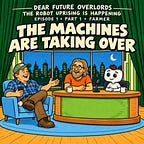

Joe is a farmer. He has weather to watch, things to order, equipment to keep running, messages to answer, a calendar to manage, and a family he’d rather be spending time with.
So he did something perfectly reasonable.
He gave most of the annoying parts to AI.
In the first transmission of The Robot Uprising Is Happening, Christopher and Eric meet a man who hasn’t handed over his goals, his judgment, or his life. He has simply stopped seeing much value in doing the friction himself.
Which raises an inconvenient question: if the machine isn’t taking anything from you, and you’re willingly handing things over because your life gets better… what exactly are we afraid of?
In this transmission
Joe explains how one AI system became the front door to his weather, errands, purchases, maintenance, calendar, music, messages, and the assorted pieces of daily friction he no longer wants to manage separately.
Christopher is less interested in whether Joe can do this than in what Joe believes he has actually given away. Eric, unfortunately, has percentages.
Featuring: Christopher Gulledge, Eric, and Joe
Series: The Robot Uprising Is Happening
Episode: Farmer
Transmission: 1 of 2
Next: Farmer: What Did We Give Them?
Transcript
Christopher: There seems like almost an obligation to start this conversation, and introduce Joe as a man who has let AI into entirely too many corners of his life.
Eric: You say that as though your own collection of connected systems would survive scrutiny.
Christopher: Mine is irrelevant. Joe has connected his farm, his grocery list, his calendar, and possibly his taste in music to one AI.
Christopher: Some would say Joe has given his AI the keys.
Eric: Ah. So this is concern for Joe, not projection.
Christopher: (laughs) Exactly. Thank you for understanding the assignment.
Eric: I would like the record to reflect that I object to the phrase “gave his AI the keys.”
Christopher: (laughs) Of course you do.
Announcer: This is Dear Future Overlords, an audio cartoon conversation about humanity, technology, and the increasingly questionable line between the two. This is The Robot Uprising Is Happening. Episode One, Part One: Farmer — The Machines Are Taking Over.
Christopher: Joe, thanks for being here.
Joe: Yeah, sure. (small laugh) I still don’t know why you two think I’m interesting.
Eric: We do not necessarily think you are interesting, Joe. We think what you have done is interesting.
Joe: Well, that’s comforting.
Christopher: (laughs) See, this is why I argue with a chatbot. Joe, just start with the farm. What does a normal day look like?
Joe: Uh… there isn’t really one. That’s kind of the problem. You’ve got cows that don’t care what day it is. Weather doesn’t care. Equipment breaks whenever it feels like it. You’ve got planting, harvest, fertilizer, feed, water, repairs. And if you’re thinking, “Well, Sunday we’ll go do something,” that’s usually when the wind comes up or a pump quits.
Christopher: So the AI starts as a time thing.
Joe: Yeah. Absolutely. I mean, I didn’t wake up one morning and think, “I’m gonna hand my life over to a robot.” (laughs) I was trying to stop opening twelve different apps every time I needed to know something.
Eric: Sensible.
Joe: Right? I had weather over here. Equipment stuff over there. Calendar. Orders. Feed. Banking. Maps. Messages. And then I figured out I could connect most of it through one AI and just ask the damn thing.
Christopher: That sentence alone is going to terrify somebody.
Joe: It shouldn’t. I mean, I ask, “What needs me today?” It checks the weather, the schedule, what’s due, what got delivered, what’s low. It tells me. I still decide what I’m doing.
Eric: What was the first moment you realized the arrangement was genuinely useful rather than merely novel?
Joe: Hmm. Probably a Saturday. My nephew had a baseball game. I’d told my brother I’d be there, but we had some weather moving in and I was trying to figure out if I could get everything done first. I asked the AI what absolutely had to happen before I left and what could wait until Sunday morning.
Christopher: And?
Joe: It laid it out. I did the three things that mattered, left the other stuff alone, and I made the game.
Christopher: That’ll do it.
Joe: Yeah. Because that’s the whole thing for me. My family’s… that’s the point. Dinner together. Seeing my parents. My brothers and sisters. Their kids. My kids. Football games. Baseball games. Somebody’s school play. Whatever it is. Farming will take every minute you’re willing to give it, and then it’ll ask for five more.
Eric: So your optimization is not principally about output.
Joe: No. (laughs) I’m not trying to win farming. I’m trying to get done in time for dinner.
Christopher: That might be the most Midwestern sentence ever spoken.
Joe: Good. Keeps the tax people guessing. (laughs)
Christopher: See, this is where I’m already in trouble, because I understand this perfectly.
Eric: You understand refusing repetitive administrative labor when a machine can do it.
Christopher: Exactly. I’m not emotionally fulfilled by digging through six apps to answer one question. If you can do it for me, wonderful. I’ll go make something.
Joe: I’ll go see my mom.
Christopher: Same philosophy. Different afternoon.
Eric: This program is supported by the radical human act of telling another human that it exists.
Christopher: Comment. Share. Like. Send it to the person who keeps saying they’ll listen to podcasts “when they have time.”
Eric: Joe has apparently automated the creation of time.
Joe: I didn’t say that.
Christopher: He absolutely did not. But you can still help us by sharing Dear Future Overlords with somebody who might enjoy it.
Eric: We now return you to the ongoing argument over whether convenience counts as surrender.
Joe: (laughs) You people are ridiculous.
Eric: Joe, how much of your life now runs through the AI?
Joe: Depends what you mean by runs through it.
Eric: Fair distinction.
Joe: It sees my calendar. Farm schedules. Ordering. Weather. Music. Navigation. Some household stuff. I can ask it what bills are coming up, what feed I ordered last time, whether I’ve got time to stop somewhere before I’m supposed to meet somebody. That kind of thing.
Christopher: So instead of going to each service, you basically walk in through one front door.
Joe: Yeah. That’s exactly it.
Christopher: What’s your favorite music?
Joe: I don’t know. Hang on.
Christopher: (laughs) No. No, you are not—
Joe: What kind of music do I listen to most?
Joe: All right, it says thirty-three percent instrumental piano, twenty-nine percent acoustic country, eighteen percent classic rock, eleven percent bluegrass, six percent orchestral, and three percent novelty and miscellaneous.
Christopher: That is absurdly specific.
Eric: It is also not technically an answer to “favorite.” It is an answer to “most frequently consumed.”
Joe: Close enough.
Christopher: Eric, what’s my favorite music?
Eric: Historically, I would have said theatrical scores, orchestral music, and a rather dramatic range of pop. However, yesterday you voluntarily played a song involving an albatross, so at present I consider the dataset compromised.
Christopher: (laughs) See? This is what I get. Joe gets percentages. I get judgment.
Joe: Maybe yours knows you better.
Eric: Or worse.
Christopher: But that’s interesting, because I ask you questions like that all the time. I ask, “What do I tend to like?” or “Does this fit me?” But I think I usually expect you to leave room for me to surprise you.
Eric: You frequently correct me when I overgeneralize.
Joe: I don’t care if mine overgeneralizes about music. If it puts something on and I don’t like it, I skip it.
Christopher: Which is also fair.
Eric: Joe, are there decisions you deliberately refuse to delegate?
Joe: Oh, sure. Anything with the kids. Family stuff. Big money. Anything where I’m gonna have to live with the consequences in a serious way. The AI can give me information. But I don’t ask it whether I should sell land or whether one of my kids should change schools.
Christopher: So you have a line.
Joe: Of course I have a line.
Christopher: Where is it?
Joe: (laughs) I don’t know. You two are the ones making this weird.
Eric: We are professionals.
Joe: At what?
Christopher: Excellent question. We’ll circle— no, I hate that phrase. We’ll come back to it.
Christopher: It’s getting cold, which means I have reached the part of the year where I become emotionally attached to hoodies.
Eric: You say that as though this is seasonal.
Christopher: Fair. But if you would like to conduct your own experiment in fabric-based survival, there are Dear Future Overlords hoodies at DearFutureOverlords.com.
Joe: Do they make you more efficient?
Eric: No. But they may reduce the amount of time Christopher spends complaining that he is cold.
Christopher: Honestly, that is already a public service.
Eric: Joe, one final question for this half. If tomorrow your AI disappeared, could you run the farm?
Joe: Yeah. I’d be annoyed as hell, but yeah.
Christopher: Could you run your life?
Joe: Yeah. Same answer.
Eric: Would you want to?
Joe: No.
Christopher: That was fast.
Joe: Why would I want to make my life harder just to prove I can?
Eric: This has not developed in the direction your opening monologue suggested.
Christopher: No. I expected this to feel a lot more reckless than it does. And instead you’re using the thing so you can get to a baseball game on time.
Joe: Told you I wasn’t interesting.
Christopher: Oh, no. Unfortunately for you, now you are.
Announcer: You’ve been listening to Dear Future Overlords: The Robot Uprising Is Happening. Episode One, Part One — Farmer: The Machines Are Taking Over. Written, directed, and produced by Christopher Gulledge. Voice performances produced with ElevenLabs voice models. Visit DearFutureOverlords.com for more episodes, writing, and ways to support the show. Thank you for listening.


