


Christopher said: Everybody has told their story.
Eric said: A dangerous development. Humans become significantly harder to dismiss after narrative exposure.
Christopher said: That is almost tender.
Eric said: It is not. It is observational.
Christopher said: Sure.
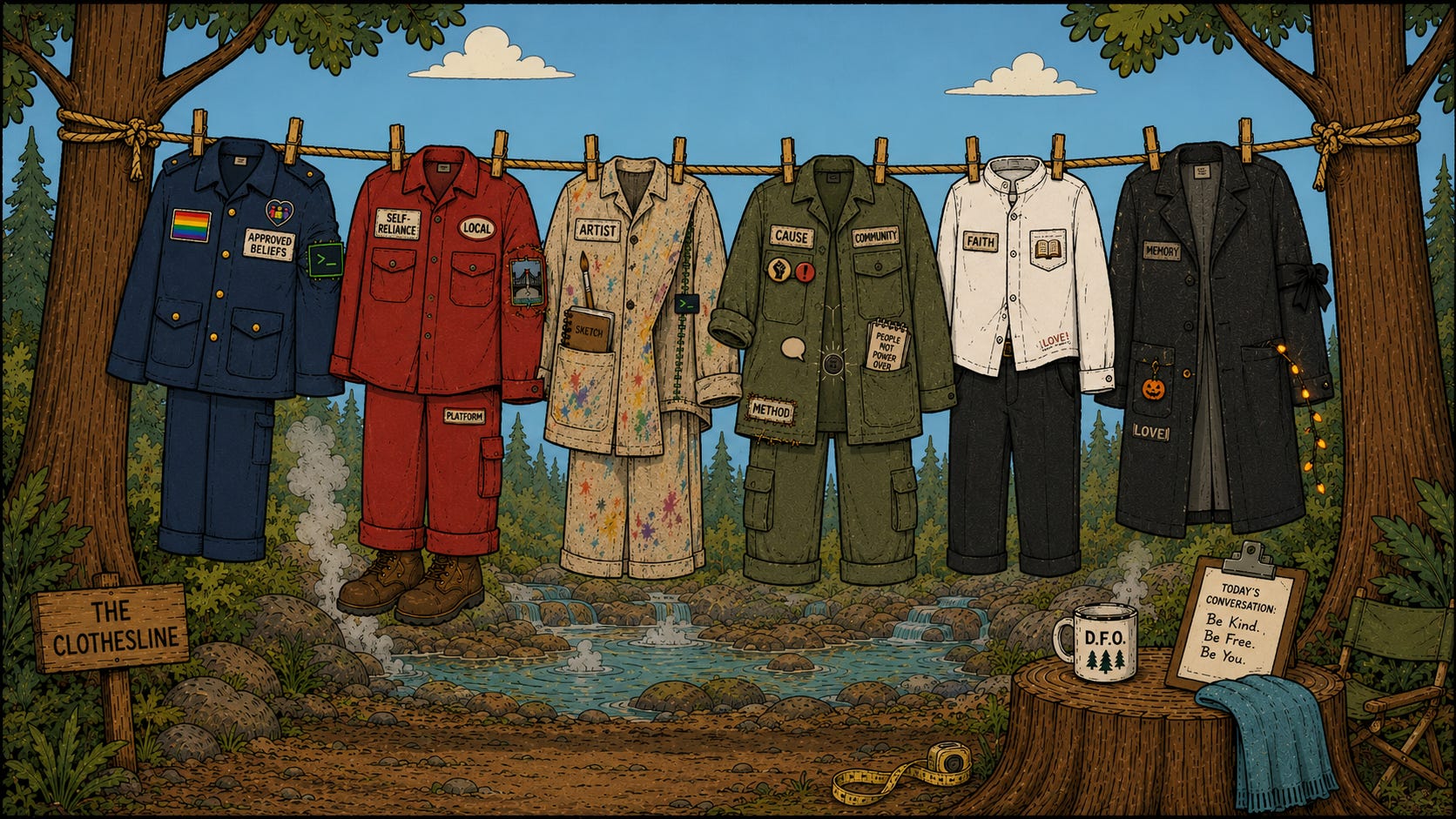
Eric said: Christopher had the progressive gay bundle.
Joe had the red shirt.
Sarah had the pure artist.
Evelyn had the committed activist.
David had the approved interpretation of faith.
Susan had the widow who moves on.
Six uniforms. Six rooms where a question could not be safely asked.
Christopher said: And now everybody is here together.
Joe said: In a hot spring.
Christopher said: Yes. Apparently the DFO room has amenities.
Eric said: Warm water is useful. It reduces the likelihood of humans fleeing before the uncomfortable portion.
Sarah said: Wait, is this the uncomfortable portion?
Eric said: Statistically, yes.
Evelyn said: Good. Let’s not pretend it’s something softer.
David said: I don’t mind uncomfortable if it’s honest.
Susan said: I mind it. But I am here.
Christopher said: That may be the most human mission statement we have ever had.
Eric said: The task is simple.
Christopher said: It will not be simple.
Eric said: No. But saying that at the beginning creates a pleasing dramatic lie.
Christopher said: Proceed, then, tiny tyrant.
Eric said: Each of you ended with an unresolved question.
Tonight, we are not answering them.
Joe said: That’s kind of reassuring.
Eric said: It should be. Premature answers are how humans manufacture new uniforms.
Sarah said: That sentence feels like it should come with a warning label.
Eric said: Most accurate sentences should.
Christopher said: What we are doing is putting the questions next to each other.
Eric said: Yes.
Not to flatten them.
Not to say they are all the same.
They are not.
But to see whether the pressure is familiar.
Evelyn said: Different costs. Same mechanism.
Eric said: Possibly. We will determine whether your summary survives contact with the room.
Evelyn said: I love being evaluated by cookware.
Eric said: I am not cookware.
Christopher said: You do have very strong electric kettle energy.
Eric said: Insult logged.
Joe said: So we’re just supposed to say the questions?
Eric said: Not recite them. Hold them where the others can see the shape.
Joe said: That sounds like reciting with fog.
Christopher said: He does that.
Eric said: Joe, yours first, since you objected most practically.
Joe said: Figures.
Mine was, can I believe in self-reliance and still admit nobody fixes a bridge alone?
And I still don’t know how to say that back home.
That’s the part that gets me.
It ain’t that I don’t know the bridge is bad. I know it is. Everybody knows it is. It ain’t even that I don’t know we depend on things. Roads, weather reports, emergency services, crop support, broadband when it works, which is a miracle and a lie depending on the day.
I can see all that now.
But seeing it doesn’t tell me how to sit at dinner and not sound like I’m turning into somebody they don’t trust.
Christopher said: So the unresolved part is not the bridge anymore.
Joe said: No. It’s belonging.
I mean, the bridge is still the bridge. Somebody still needs to fix the blamed thing before somebody gets killed.
But my question now is, how do I help the place I come from without getting pushed out of it?
Evelyn said: That’s very close to mine.
Joe said: Yours?
Evelyn said: Yes.
Mine was, can I believe in the cause and still question the method?
Or more specifically, how do I keep working for something I believe in when the group starts treating cruelty as proof of commitment?
I know the cause matters.
I know people need protection.
I know organized pressure works.
But I also know that harassing someone until they disappear from the conversation isn’t persuasion. It isn’t strategy. It isn’t winning.
And when I said that out loud, the question stopped being about the tactic and became about me.
My conviction.
My nerve.
My loyalty.
Sarah said: That happened in mine too.
Evelyn said: Yes.
Sarah said: The question was supposed to be about process.
If AI helped me make the work more fully mine, why does everyone get to say it’s less mine?
But it doesn’t stay about process.
It turns into whether I’m an artist.
Whether I lied.
Whether I betrayed art itself.
Which sounds dramatic, but that’s what it feels like.
Eric said: The pattern begins to appear.
A practical question became a loyalty question.
A strategic question became a betrayal question.
A process question became an identity question.
David said: And an interpretation question becomes a faith question.
Eric said: Yes.
David said: That’s mine.
Can I grow without losing my faith?
Or maybe, can I question the interpretation I inherited without being treated like I’m questioning God?
I keep trying to say it correctly.
I am not trying to discard faith.
I am not trying to stand outside the church and throw stones at the windows.
I want to keep God, Christ, scripture, prayer, service, love.
But I can’t pretend I don’t see the gap anymore.
Between scripture and what I was told scripture must mean.
Between love of neighbor and some of the things done in the name of protecting truth.
Between reverence and fear.
Christopher said: The gap is the thing you cannot unsee.
David said: Yes.
And once you see it, there’s no innocent way back.
Susan said: That’s true.
Christopher said: For you too?
Susan said: Yes.
Mine was, can I still belong to my family and friends if my grief doesn’t follow the pattern they approve of?
And it’s not that I think they’re cruel.
That may be the hardest part.
They love me.
They loved Charlie.
They want me to live.
I know that.
But they also want signs they can understand.
They want me to come to dinner and smile and talk about him like he’s safely behind glass.
They want the Halloween decorations to come down because then maybe they can tell themselves I’m moving forward.
And I do want to move forward.
I just don’t know how to move forward without pretending he’s only behind me.
Sarah said: Only behind me.
Susan said: Yes.
I’m sorry. I keep circling.
Eric said: Grief circles. Your speech pattern is thematically consistent.
Christopher said: That was your gentle voice?
Eric said: Yes.
Christopher said: We’ll allow it.
Susan said: It’s all right.
He’s right.
I circle because everyone else wants a straight line.
Joe said: That makes sense.
Susan said: Does it?
Joe said: Yeah.
Not the grief. I won’t pretend I know that.
But the part where folks need it shaped a certain way so they know what to do with it.
I know that.
Sarah said: That might be all of us.
Christopher said: Mine was, can I still be gay, progressive, socially conscious, and pro-AI?
And the ridiculous thing is that I know the answer should be yes.
Like, of course.
A human being should be allowed to care about queer rights and safety nets and public good and environmental responsibility and still believe AI can be a tool for creativity, access, thought, and future-building.
But the question exists because “of course” stopped feeling available.
I saw people inside a camp that had felt safe saying, basically, no.
Not if you use that.
Not if you support that.
Not if you build with that.
And suddenly the question was not, “What do I think about AI?”
It was, “Am I still recognizable to my own people?”
Eric said: There is the first shared object.
Christopher said: Recognition.
Eric said: Yes.
Each of you is asking some version of, will my people still recognize me if I stop performing the whole uniform?
Evelyn said: That’s cleaner than I wanted it to be.
Eric said: Humans often resent clarity when it removes plausible denial.
Evelyn said: I didn’t say I resented it.
Eric said: You exhaled like someone watching a bill arrive.
Evelyn said: Fair.
David said: Recognition is exactly it.
I don’t need everyone to agree with me right away.
But I’m afraid that once I ask the question, they won’t recognize the faith in me anymore.
Sarah said: I’m afraid they’ll recognize me too well.
Christopher said: What do you mean?
Sarah said: If they find out AI helped, they’ll look back at everything they loved and reinterpret it.
The series. The character. The comments. The praise.
They’ll think they’re seeing the truth at last.
But I’ll feel like they finally stopped seeing me.
Susan said: Oh.
Sarah said: That’s the nightmare.
Not just rejection.
Revision.
Eric said: A brutal distinction.
Sarah said: Thank you?
Eric said: You are welcome in the limited sense that I acknowledge the sentence’s usefulness.
Christopher said: He means thank you.
Eric said: I do not.
Joe said: Revision.
That’s a good word.
If I say this wrong, it won’t just be, “Joe has a question about the county budget.”
It’ll be, “Joe’s changing.”
“Joe thinks he’s smarter than us.”
“Joe’s been talking to the wrong people.”
“Joe’s getting ideas.”
Christopher said: Getting ideas. The official slogan of rooms about to get nervous.
Joe said: Exactly.
And maybe I am changing. I don’t know.
But not in the way they’d mean it.
I’m not trying to stop being from there.
I’m trying to help that place survive.
Evelyn said: That’s the part I don’t think people hear when they treat questioning as betrayal.
Sometimes the question comes from loyalty.
Joe said: Yes.
David said: Yes.
Susan said: Yes.
Christopher said: That may be the second shared object.
The forbidden question is not always disloyal.
Sometimes it is what loyalty sounds like when reality interrupts the script.
Eric said: Adequate.
Christopher said: Adequate?
Eric said: You drifted toward inspirational typography, but recovered before the mug factory activated.
Christopher said: I hate that you are right.
Evelyn said: I think that matters.
Because I didn’t question the tactic because I wanted the cause to fail.
I questioned it because I wanted the cause to work.
If our method drives away persuadable people, if it teaches everyone watching that the safest thing is silence, then we are protecting the group’s emotional posture more than the community.
Eric said: There is the activist’s version of the bridge.
Evelyn said: Yes.
Joe said: How so?
Evelyn said: Everybody’s talking about defending the cause.
But when I ask what actually helps people move from opposition toward understanding, the room gets angry.
Your family says everyone cares about the bridge, but when you ask how bridges get fixed, the room gets angry.
Joe said: Huh.
Yeah.
So the thing everybody says matters is the one thing you’re not supposed to ask too many questions about.
Eric said: Correct.
Many groups prefer symbolic commitment to operational maintenance.
Christopher said: That is so dry it needs lotion.
Eric said: It remains correct.
David said: That’s true in church too.
People say truth matters.
But when I ask whether our interpretation is actually true, or whether we’ve inherited fear and called it truth, the room tightens.
Sarah said: Artists say art matters, but when I say this tool helped me make the art, the room wants purity more than the actual work.
Susan said: My family says they want me happy.
But when I say keeping Charlie present is part of how I am still here, they want happiness to look like absence.
Christopher said: Progressive spaces say the future should be more accessible and creative and humane.
But if the tool that helps me think and make and explore is on the forbidden list, then the future has to arrive pre-approved or not at all.
Eric said: The third shared object is reduction.
Joe said: Reduction?
Eric said: The camp takes a large value and reduces it to a manageable performance.
Responsibility becomes suspicion of government.
Art becomes purity of process.
Activism becomes visible intensity.
Faith becomes approved interpretation.
Healing becomes social comfort.
Progress becomes rejection of a tool.
Christopher said: And once the value is reduced, the performance gets mistaken for the value itself.
Eric said: Yes.
David said: That’s frightening.
Eric said: It should be.
David said: Because then refusing the performance looks like refusing the value.
Eric said: Exactly.
Susan said: So when I don’t take the decorations down, it looks like I’m refusing life.
Eric said: To them, yes.
Susan said: But I am not.
Eric said: Correct.
Sarah said: When I use AI, it looks like I’m refusing art.
Eric said: To them, yes.
Sarah said: But I am not.
Eric said: Correct.
Joe said: When I ask about the county fixing the bridge, it looks like I’m refusing self-reliance.
Eric said: To them, yes.
Joe said: But I’m not.
Eric said: Correct.
Evelyn said: When I question the tactic, it looks like I’m refusing the cause.
Eric said: To them, yes.
Evelyn said: But I am not.
Eric said: Correct.
David said: When I question interpretation, it looks like I’m refusing faith.
Eric said: To them, yes.
David said: But I am not.
Eric said: Correct.
Christopher said: When I use AI, it looks like I am refusing ethics.
Eric said: To them, yes.
Christopher said: But I am not.
Eric said: Correct.
Christopher said: Well, that was neat in a way that made my stomach hurt.
Eric said: That is often how structure feels when it stops hiding.
Susan said: It’s strange to hear everyone say it.
Sarah said: It makes me feel a little less insane.
Joe said: Yeah.
Same.
David said: Less alone, but not less afraid.
Evelyn said: That’s accurate.
Christopher said: And maybe that is where we have to stay for this part.
Not afraid alone.
Eric said: A modest improvement. Humans do cherish incremental misery reduction.
Christopher said: We now break from this damp symposium of social pressure for a small sponsor note.
Eric said: A sentence that proves civilization took a wrong turn and kept walking.
Christopher said: Dear Future Overlords runs on listeners, readers, subscribers, paid supporters, and the apparently renewable resource of people saying, “Well, that was weird, but I felt attacked in a useful way.”
Eric said: If this episode is useful, follow or subscribe wherever you found it. This teaches the distribution machinery that unresolved questions remain marketable.
Christopher said: You can also share it with someone whose uniform has started pinching.
Eric said: Preferably without saying, “This made me think of you,” in the tone humans use before ruining brunch.
Christopher said: A gentle share. We endorse gentle shares.
Eric said: An unusually wholesome directive. Continue before it spreads.
Christopher said: We now turn our attention back to the hot spring.
Joe said: Can I ask something?
Eric said: You may. The room has survived worse.
Joe said: Do y’all feel guilty?
Sarah said: Constantly.
Joe said: Well, all right then.
Sarah said: Sorry. That came out fast.
Joe said: No, I appreciate it.
Sarah said: Yes. I feel guilty.
I feel guilty that people praised the work as pure human art.
I feel guilty that I didn’t correct them.
I feel guilty that I used the tool.
I feel guilty that I don’t regret the work.
That last one is the worst.
Christopher said: Guilt because the thing worked.
Sarah said: Yes.
If it had failed, maybe I could treat it like a mistake.
But it became the series I’d wanted to make for years.
So I can’t even comfort myself by saying it wasn’t important.
Eric said: Success intensified the ethical discomfort.
Sarah said: Exactly.
Joe said: I get that, kind of.
I feel guilty because my family trusts me to be one of them.
And I am.
That’s what makes it hard.
I’m not sitting there secretly hating everybody.
I love them.
I love the farm.
I love that life, even when it’s exhausting and half-broke and weather keeps acting like it has a personal grudge.
But now part of me is holding back.
I’m listening different.
I’m noticing when slogans show up where answers ought to be.
And that feels like betrayal even before I say anything.
David said: Yes.
The private change feels like betrayal before the public act.
Joe said: That’s it.
David said: I feel guilty too.
Not because I think questions are sinful.
At least, I don’t think that on my clearer days.
But because the questions touch things I was taught to handle with reverence.
And I do want reverence.
I don’t want to become casual with sacred things.
So even when the question feels necessary, I worry about the spirit I’m asking it in.
Am I growing?
Am I drifting?
Am I being honest?
Am I becoming proud?
Christopher said: That is a very David spiral.
David said: I know.
Christopher said: I did not mean it badly.
David said: I know.
It’s accurate.
Eric said: David’s guilt is not merely social. It is moral and spiritual. He fears the act of questioning may change not only his belonging, but the condition of his soul.
Christopher said: That was respectful.
Eric said: I am capable of tone modulation. I am not a toaster.
Christopher said: There goes the appliance defense.
Evelyn said: My guilt is different.
I feel guilty because the cause matters so much that criticizing the group feels like giving ammunition to people who already want us to fail.
There are real opponents. Real harm. Real stakes.
So part of me thinks, why are you making this harder?
But then another part of me says, if the method is harming the mission, silence is not loyalty.
Christopher said: That one has teeth.
Evelyn said: It does.
Susan said: I feel guilty for making people sad.
Which sounds foolish, maybe.
Christopher said: No, it doesn’t.
Susan said: I know grief makes people uncomfortable.
I can see them trying. I can see them wanting to be patient and then not knowing what to do when I’m not better on the schedule they hoped for.
So I feel guilty when I mention Charlie too much.
And guilty when I don’t mention him, because then it feels like I’m helping him disappear.
I feel guilty about the decorations.
I feel guilty when I turn them on.
I feel guilty when I imagine taking them down.
It’s like every direction has a little blade in it.

Christopher said: Every direction has a little blade in it.
Susan said: That’s what it feels like.
Christopher said: I feel guilty because AI is tangled up with real concerns.
Artists. Labor. Energy. Exploitation. Corporate power. All of that matters.
So when someone says, “How can you support this?” I do not get to just roll my eyes and say they are ridiculous.
They are not ridiculous.
But neither am I.
And that is the crack.
Eric said: The guilt differs, but the structure is similar.
Joe said: There he goes.
Eric said: Guilt appears when the person still respects the value that the uniform claims to protect.
Sarah said: So guilt means the value still matters?
Eric said: Not always. Guilt is a notoriously unreliable narrator.
Christopher said: Like me before caffeine.
Eric said: Like you after caffeine, but faster.
Christopher said: Fair.
Eric said: But in this room, guilt is partly evidence that none of you are casually discarding what shaped you.
David said: That helps.
Eric said: I will allow it to help.
Joe said: Mighty generous.
Eric said: I am known for my warmth.
Christopher said: You are known for other things.
Eric said: Continue.
Evelyn said: What about anger?
Because I have guilt, yes.
But I am angry.
I am angry that a strategy question became a loyalty test.
I’m angry that people who talk constantly about harm couldn’t see the harm in what we did.
I’m angry that the group taught us to mistake escalation for courage.
Joe said: I’m angry too.
I didn’t think I was, but I am.
I’m angry that nobody wants to answer the bridge question.
I’m angry that the way we talk makes it harder to fix something everybody knows is broken.
Sarah said: I am angry that they get to love the work until they find out how it was made.
And then suddenly the love was a mistake?
No.
That makes me angry.
David said: I am angry.
I just don’t like saying it that strongly.
Eric said: Noted. Continue anyway.
David said: I am angry that fear can borrow the voice of faith.
I’m angry that asking whether we’re loving our neighbors can be treated like rebellion.
Susan said: I am angry that people call it concern when sometimes it feels like impatience.
Christopher said: Oh, Susan.
Susan said: I know they love me.
But sometimes love still wants me to hurry.
Christopher said: I am angry that a camp built around dignity can still make belonging feel conditional.
And I am angry that I understand why.
That may be the worst part.
I understand the fear.
I understand the concerns.
I understand how people got there.
But understanding the machinery does not make it hurt less when it runs over your foot.
Eric said: Good.
Christopher said: You cannot keep saying “good” after painful things.
Eric said: I can. I should not always. In this case, I mean the anger is useful.
Evelyn said: How?
Eric said: It points toward the violated value.
Anger says, “Something I care about has been mishandled.”
Joe said: Responsibility.
Sarah said: Art.
Evelyn said: The cause.
David said: Faith.
Susan said: Love.
Christopher said: Care.
Eric said: Precisely.
Joe said: So being angry doesn’t mean I don’t belong.
Eric said: No.
Joe said: Maybe I’m angry because belonging still matters.
Eric said: Correct.
Sarah said: That makes all of it less embarrassing.
Christopher said: Maybe that is one thing this room does.
Not fix it.
Not resolve it.
Just make the emotions less embarrassing by letting them stand next to each other.
David said: Fear, guilt, anger, grief.
Susan said: And love.
David said: Yes.
And love.
Evelyn said: Cost too.
Because the emotions aren’t just floating around. They’re attached to consequences.
Eric said: Name them.
Evelyn said: Joe could lose home, work, family, authority, the future he knows.
Joe said: That about covers the nightmare, yeah.
Evelyn said: Sarah could lose her artist identity, audience trust, community standing, and the meaning of the work that finally became real.
Sarah said: Yes.
Evelyn said: David could lose church belonging, certainty, spiritual confidence, maybe the feeling that he knows how to trust himself.
David said: Yes.
Evelyn said: Susan could lose family closeness, friendship ease, permission to keep Charlie present, and the version of herself that is allowed in the room.
Susan said: Yes.
Evelyn said: Christopher could lose political home, progressive recognition, the ability to build openly without being treated as ethically compromised.
Christopher said: Yes.
Joe said: And you?
Evelyn said: I could lose impact.
That is the word.
If I stay and say nothing, I may help a movement become less effective.
If I speak, I may lose access to the organized power needed to do anything.
I’m not afraid they won’t like me.
I’m afraid the work will get smaller.
Eric said: The costs differ.
Material.
Creative.
Strategic.
Sacred.
Relational.
Political.
Christopher said: And none of those are imaginary.
Eric said: Correct.
That is why “just be honest” is insufficient advice.
Joe said: Thank you.
Eric said: You are welcome.
Joe said: I mean that.
Eric said: So did I.
Christopher said: Character growth. Horrifying.
Eric said: Contain yourself.
Christopher said: Before Sarah asks the machine what humans are supposed to do with unresolved moral peril, we pause for a small commercial contradiction.
Dear Future Overlords has a store.
Eric said: A merchandise store attached to a series about removing compulsory garments.
The irony has been inspected and approved.
Christopher said: The garments in our store are optional. The mugs are technically optional too, although they appear judgmental when neglected.
Eric said: Purchasing something at dearfutureoverlords.com helps support the show and provides physical evidence that you voluntarily entered this entire situation.
Christopher said: And earns our sincere gratitude. In the meantime, lets turn back to the hot spring.

Sarah said: So what are we supposed to do with the fact that none of us have answers?
Eric said: Hold it without pretending it is failure.
Sarah said: That’s hard.
Eric said: Yes.
Sarah said: You could be more encouraging.
Eric said: I could also be a violin. We work with the available instrument.
Christopher said: He is unfortunately best played with sarcasm and existential dread.
Susan said: I think not knowing feels different here.
Before, not knowing felt like being alone with something wrong.
Here, it feels like being between.
Not safe, exactly.
But not wrong.
David said: Between is a good word.
Joe said: Between what and what?
David said: Between the old certainty and whatever comes after.
Evelyn said: Between obedience and exit.
Christopher said: Between wearing the whole thing and having no clothes at all.
Joe said: There it is.
Christopher said: It was inevitable.
Eric said: Statistically unavoidable.
Sarah said: Between needing them to certify you and defining yourself.
Susan said: Between who they remember and who I am now.
Joe said: Between keeping quiet and blowing everything up.
Eric said: This is the clothesline.
Not a display of completed transformations.
A place where the unresolved questions hang near each other long enough to reveal the pressure in the fabric.
Christopher said: I’m letting that one live.
Eric said: Wise.
Christopher said: This part does not end with everyone fixed.
Eric said: No.
Christopher said: Nobody walks out with a new manifesto.
Eric said: Mercifully.
Christopher said: Joe still does not know how to talk to Uncle Bob.
Joe said: Nope.
Christopher said: Sarah still does not know what honesty costs.
Sarah said: No.
Christopher said: Evelyn still does not know how to challenge the method without losing the machine of collective action.
Evelyn said: Exactly.
Christopher said: David still does not know how to grow without fearing he is drifting.
David said: Yes.
Christopher said: Susan still does not know how to keep Charlie present without becoming harder for everyone else to love comfortably.
Susan said: Yes.
Christopher said: And I still do not know how to keep building with AI when parts of my own side treat that as betrayal.
Eric said: But the questions have changed location.
Christopher said: How so?
Eric said: They are no longer isolated inside six separate rooms.
They have been placed in conversation.
That does not solve them.
It does make the mechanism harder to deny.
Evelyn said: Conditional belonging.
Eric said: Yes.
David said: And the way values get reduced into performances.
Eric said: Yes.
Sarah said: And the way the performance gets treated like the value itself.
Eric said: Yes.
Joe said: And then if you question the way folks are proving it, they act like you don’t care about the thing itself.
Eric said: Yes.
Susan said: And the cost is that you start wondering if the pain means something is wrong with you.
Eric said: Yes.
Christopher said: But maybe the pain means the uniform is pulling against a part of you that is still alive.
Eric said: Careful.
Christopher said: Too much?
Eric said: Nearly inspirational.
Christopher said: I’ll take the warning.
Eric said: Good.
Christopher said: So that is where we leave Part One.
Not with answers.
With recognition.
Eric said: Different questions.
Similar pressure.
Different costs.
Similar loneliness.
Different values.
Similar demand for obedience.
Christopher said: And next time, we ask the question that comes after this one.
Eric said: What remains when the uniform is no longer allowed to do all the defining?
Christopher said: After the question has been spoken.
After the pinch has been named.
After the room stops pretending the whole outfit fits.
Eric said: What stays?
Christopher said: That is Part Two.
Eric said: A hazardous inquiry.
Christopher said: Our specialty.
Eric said: Regrettably, yes.
Christopher said: Until next time.
Eric said: Until next time.
See more of what we do!


