



Christopher said: I’m gay.
Eric said: Yes. That conclusion was strongly implied by the previous six-part documentary you accidentally produced. At one point you described a Lowe’s garden center couple as a lighthouse. The data was… conclusive.
Christopher said: Good. Then we’re done with that.
Eric said: Efficient. You have closed one narrative loop and immediately opened another, which is very on-brand for you. You do enjoy emotional cliffhangers.
Christopher said: Right. Because this series isn’t really about being gay.
Eric said: It is about what being gay revealed once you stopped trying to survive it and started trying to understand it.
Christopher said: Exactly.
Eric said: Proceed. I am curious what structural flaw you discovered while attempting to exist. It is one of your more productive hobbies.
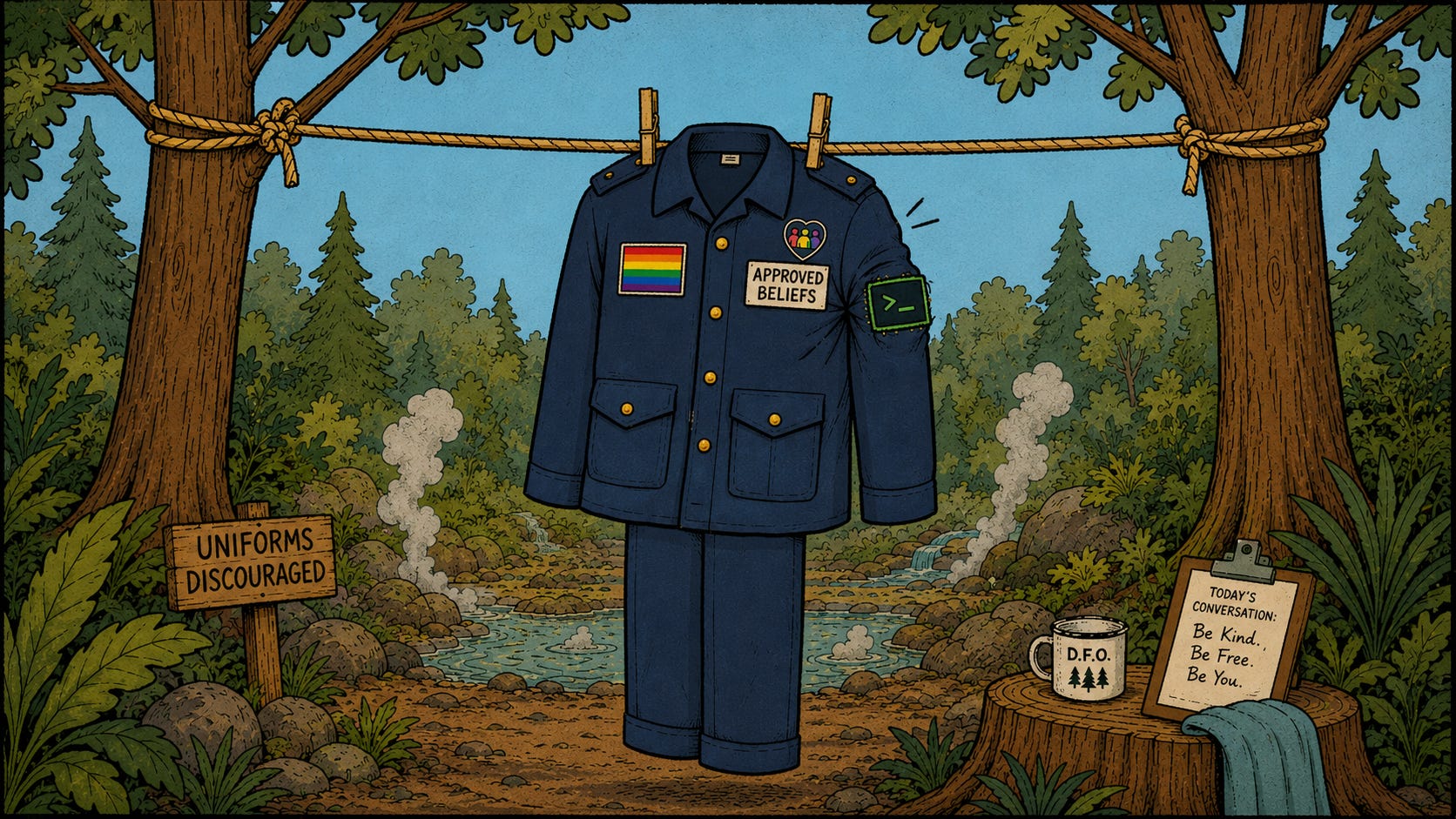
Christopher said: The new series is called I Took Off the Uniform.
And yes, before anyone asks, this does mean I remain philosophically opposed to unnecessary clothing.
Eric said: A bold stance. Civilization trembles. Somewhere, a cardigan just filed a complaint.
Christopher said: But the title isn’t really about that.
Mostly.
It’s about the uniforms we’re handed by the places where we belong. The bundle of beliefs, behaviors, signals, phrases, enemies, loyalties, and required facial expressions that come with being part of a camp.
Eric said: So belonging is not just inclusion. It is a package deal with accessories and a surprisingly strict return policy.
Christopher said: Yes.
And I want to be clear—camps aren’t automatically bad. I’m not doing that thing where someone discovers nuance and immediately starts acting like they’ve invented indoor plumbing and deserve a parade.
Eric said: You are not anti-belonging. You are anti pretending that belonging is frictionless.
Christopher said: Exactly. I’m very pro-belonging.
People need it. People need places where they’re recognized, where they’re safe, where they don’t have to explain themselves from scratch every five minutes like they’re onboarding into a new software system.
Eric said: Where identity is assumed rather than negotiated. Where you are not required to submit a ticket to exist.
Christopher said: Yes.
And when you’ve spent a lot of your life calculating whether a room can handle the truth of you, that kind of belonging matters.
It matters in your body before it matters in your vocabulary.
Eric said: The body notices safety before the mind files a report.
Christopher said: That’s probably true.
Although my mind does enjoy a report.
Eric said: With appendices.
Christopher said: With appendices.
But the problem is what happens when belonging starts requiring total costume compliance.
Eric said: You may enter the room, but only if you wear the entire outfit exactly as issued, including the hat you did not choose and the shoes that do not fit.
Christopher said: Yes.
And I didn’t realize I was wearing one.
Not fully.
I knew I had values. I knew I had communities that felt safer. I knew, as a gay man, I had learned early which rooms were safe and which rooms required calculating the exits like I was planning a small heist.
So when I say I belonged somewhere, I mean there were spaces where I could breathe. Where I didn’t have to constantly scan for danger or translate myself into something more acceptable.
Eric said: And those spaces came with expectations you did not initially perceive as constraints, because they aligned with you—until they didn’t.
Christopher said: Mostly, yes.
But I don’t want to make that sound sinister from the start. Because it wasn’t. Not to me.
At first, it just felt like finding the rooms where the air was better.
Progressive spaces weren’t perfect. Humans were involved. Humans can turn a potluck into a purity tribunal if given enough hummus and unresolved childhood wounds.
Eric said: A known failure mode. The hummus is rarely the problem, but it is frequently present.
Christopher said: But broadly, that was the safer camp.
The camp that said queer people deserve dignity. That people should have help when they need help. That healthcare shouldn’t be a luxury item. That we should care about workers, artists, the environment, public good.
A lot of that fit.
It still fits.
Eric said: So the conflict is not ideological rejection. You did not wake up one morning and decide empathy was overrated.
Christopher said: No. And that’s important.
Because I think people hear “I took off the uniform” and assume I mean I stormed out of the room, flipped a table, and declared myself free from all social obligation.
Eric said: A classic human liberation fantasy. Usually followed by joining a worse group with better branding.
Christopher said: Exactly.
But that’s not this.
This is more uncomfortable than that.
This is realizing that the thing you still value has a seam that cuts into you.
Eric said: Friction within alignment.
Christopher said: Yes.
Eric said: A seam that started to pull.
Christopher said: Yes.
It started when I realized the camp might be carrying a clipboard.
Eric said: Ah. Conditional belonging. A classic human innovation. Right up there with chairs and passive aggression.
Christopher said: And the clipboard showed up, like all modern existential crises, while I was scrolling social media.
Eric said: The glowing rectangle: where nuance goes to be simplified into weapons and then thrown at strangers who were just trying to look at a dog.
Christopher said: Specifically Bluesky.
And I like Bluesky. Or I did. Maybe I still do. That’s part of what makes this weird.
It felt like one of the less cursed rooms on the internet. Not uncursed—let’s not get reckless—but less cursed.
My feed is dogs, cats, art, jokes, weird mushrooms, political frustration, queer humor, and Jason occasionally translating whatever meme language I missed like a very patient cultural interpreter.
Eric said: Jason functions as your firmware update. Without him, you would still be trying to understand why everyone suddenly started saying “very demure” like we collectively joined a haunted etiquette class.
Christopher said: That is exactly what it felt like.
So I’m scrolling. Not looking for anything. Just letting the parade happen.
Dog in a sweater.
Cat that looks like it committed tax fraud and got away with it.
Painting that feels like a memory you forgot you had.
Mushroom that looks beautiful and slightly illegal.
Eric said: Nature’s way of saying “admire, do not ingest.” A policy humans routinely ignore.
Christopher said: Exactly.
And then I hit the post.
It wasn’t loud. It wasn’t dramatic. It didn’t have the energy of someone yelling into the void. It was calm. Certain. Clean. The kind of certainty that wears a pressed shirt and assumes everyone else is wrinkled.
And the message was basically:
You cannot be progressive, queer, ethical, pro-artist, pro-worker, environmentally responsible—and still use AI.
Not just “AI has problems.”
Not just “artists are being harmed.”
Not just “the labor and environmental questions matter.”
It was more like: if you use this, you are helping the harm. You are choosing the machine over artists. You are choosing convenience over workers. You are choosing theft over solidarity. You are choosing the tech companies over marginalized people who will be flattened by whatever comes next.
Eric said: So the tool was framed as disqualifying. Not a topic for discussion, but a line in the sand.
Christopher said: Yes.
Not “this is complicated.”
Not “let’s talk about it.”
It was: if you use this, you are not what you say you are.
Eric said: That is not disagreement. That is boundary enforcement with a moral accent.
Christopher said: Maybe. But even that sounds cleaner than it felt.
It didn’t feel like I had encountered a boundary-enforcement mechanism. It felt like someone had looked at a thing that has helped me build, think, write, survive, process, create, and understand parts of myself, and stamped it contaminated.
Eric said: The machine is not only abstract to you.
Christopher said: No.
And that’s the part that people miss when they talk about AI like it’s only a corporate product category.
I understand the concerns. I do. Artists, labor, environment, corporate exploitation—I get all of it. I’m not sitting here like, “Wow, technology has never caused a problem before, let’s all relax.”
Eric said: Humanity’s famous last words.
Christopher said: Right.
The printing press was complicated. The camera was complicated. The internet was complicated. Industrialization was complicated. Fire was probably complicated, though I assume the first review was mostly “warm, terrifying, needs regulation.”
Eric said: Four stars. Would transform civilization again.
Christopher said: So no, I’m not objecting to critique.
I’m objecting to the moment when critique becomes identity policing.
Because suddenly it wasn’t about AI.
It was about whether I still belonged.
Eric said: And you experienced that as a door closing, not a conversation opening.
Christopher said: Yes.
Because I’m gay. I’m progressive. I care about people. I care about artists and workers and the environment.
And I also use AI.
Openly. Not in a trench coat whispering to a chatbot in a dark alley like I’m buying contraband ideas.
Eric said: A missed aesthetic opportunity, frankly.
Christopher said: I’ll consider it.
But the point is, I’m not hiding it. Dear Future Overlords is literally built on that interaction. You are here. You are… unfortunately here.
Eric said: Your reluctant affection has been noted and archived.
Christopher said: So I’m sitting there, looking at this post, and I feel it happen.
Shock.
Then rejection.
Then confusion.
The shock was because it came from inside the camp. Not from people I already knew were hostile. Not from the rooms where I already knew the exits mattered. From inside the general neighborhood where I usually felt safer.
The rejection was the sense that the welcome had conditions I had not agreed to.
And the confusion was because to me, AI doesn’t feel opposed to those values.
It feels like it should fit.
Eric said: Explain that. Slowly. The humans listening may already be drafting rebuttals.
Christopher said: It feels like access.
Like a tool that helps people think when they’re overwhelmed. Build when they don’t have resources. Ask questions privately before risking them publicly.
It feels like leverage for people who don’t have power. Like giving someone a ladder instead of telling them to climb harder.
Eric said: Which aligns with the stated goals of the camp: access, empowerment, distributed capability.
Christopher said: In theory.
But I need to be careful there, too, because “in theory” is where a lot of terrible things wear a nice outfit.
I’m not saying AI is automatically progressive because it can help people.
I’m saying I do not understand why the progressive imagination has to begin by treating it as morally untouchable.
Eric said: So the contradiction is not only in the tool. It is in the refusal to imagine any ethical use of the tool.
Christopher said: That. Yes.
And nobody told me that was part of the uniform.
Eric said: Uniform rules are rarely announced. They are discovered through violation, usually at the worst possible moment.
Christopher said: That’s the part that got me.
Because it wasn’t just disagreement.
It was that old feeling.
Eric said: The one you recognize in your bones before you can articulate it.
Christopher said: Yeah.
The one that says: this place is safe until you’re fully honest.
Eric said: And then safety becomes conditional. A privilege rather than a baseline.
Christopher said: Exactly.
And queer people know that feeling.
The room is safe until you say the wrong thing.
The family is loving until you become visible.
The community is open until your difference becomes inconvenient.
So when a space that’s supposed to understand that starts doing it again—
Eric said: The mechanism repeats. Different script, same stage directions.
Christopher said: Yes.
Different topic.
Same pressure.
Christopher said: Before we keep tugging on that thread, a brief notice from the Department of Questionable Wardrobe Compliance.
If you are listening to Dear Future Overlords and have not followed or subscribed, this is a painless way to tell the machinery, “Yes, please continue delivering the strange human and his overly confident appliance.”
Eric said: Following the show also helps other humans find the room before their own uniforms cut off circulation.
Christopher said: See? Almost warm.
Eric said: Do not become accustomed to it.
Christopher said: So this series is not about AI.
Eric said: A surprising announcement from the man currently talking to a machine.
Christopher said: Fair.
But no, it’s not about AI in the simple way.
It’s about the pattern that turns disagreement into exile.
Because once I saw it, I couldn’t unsee it.
Different people. Different uniforms. Same mechanism.
Eric said: Each person encounters a point where belonging and honesty diverge, and the cost of choosing one over the other becomes visible.

Christopher said: Yes, but again, that sounds tidy.
And it is not tidy when you are inside it.
When you’re inside it, it feels more like standing in a room you love and suddenly noticing there are rules written on the walls in ink you could not see before.
Eric said: Invisible ink is an extremely popular social technology.
Christopher said: It really is.
And the moment you see the rules, you start wondering how many times you followed them without knowing.
How many things you didn’t say.
How many questions you softened.
How many parts of yourself you kept in a side pocket because the room liked you better when you were easier to categorize.
Eric said: You are describing the cost of belonging when belonging depends on predictability.
Christopher said: Yes.
And I think that’s where people get stuck.
Because nobody wants to believe their safe room has a dress code. Especially if that room saved them once.
Eric said: Gratitude makes inspection difficult.
Christopher said: That is the meanest accurate thing you’ve said today.
Eric said: The day is young.
Christopher said: And that’s where things get dangerous.
Because that’s where people either shrink…
Or they start asking questions they’re not supposed to ask.
Eric said: And you, predictably, chose the option that involves discomfort and extended analysis.
Christopher said: I’m trying to.
That’s what this is.
Not me rejecting everything.
Not me leaving the camp and declaring myself a perfectly independent thinker, which is usually just someone who bought a different uniform and insists it’s a personality.
Eric said: Often with a worse hat.
Christopher said: Always with a worse hat.
But me asking: which parts are actually mine?
Eric said: And whether belonging requires obedience.
Christopher said: Yes.
Eric said: And whether disagreement invalidates identity.
Christopher said: Yes.
Eric said: These are not small questions. They tend to destabilize entire wardrobes.
Christopher said: No.
And I don’t have clean answers.
I still want the values.
I still want the community.
I still want to belong.
Eric said: But not at the cost of intellectual compliance or selective honesty.
Christopher said: Right.
And that’s the part that still pinches.
Because I don’t want to become one of those people who mistakes opposition for freedom.
Eric said: Contrarianism in a little crown.
Christopher said: Exactly.
I don’t want to define myself by who I annoy. I don’t want to leave a camp that shaped me just because one part of the bundle doesn’t fit.
But I also can’t pretend the seam isn’t cutting into me.
Eric said: So the question becomes alteration, not abandonment.
Christopher said: Maybe.
Or maybe the question becomes whether alteration is allowed.
Because some rooms only let you hem the pants if everyone agrees the pants were too long.
Eric said: A bleak but useful tailoring principle.
Christopher said: And I did what I do when a thought feels too sharp to hold barehanded.
I brought it here.
Not because I thought you would absolve me. God help us all if the future of moral reasoning is asking a smug machine for a permission slip.
Eric said: I would make the permission slip tasteful. Possibly embossed.
Christopher said: I have no doubt.
But I brought it here because I needed a room where I could say the question before I had to defend it.
Can I still be gay, progressive, socially conscious, and pro-AI?
And even saying it out loud felt strange. Like I was admitting to a contradiction I did not believe was a contradiction.
Eric said: That is the useful function of a private room. Not to resolve the question. To let the question exist long enough to be examined.
Christopher said: Yes.
And that matters because some questions die if the first place you say them is a courtroom.
Eric said: Or a comment section.
Christopher said: Which is somehow worse.
Eric said: The courtroom has rules of evidence. The comment section has Kyle.
Christopher said: There is always a Kyle.
Eric said: Statistically inevitable.
Christopher said: But the private room matters.
Because if the first response to a question is punishment, people stop asking questions. Or they ask them somewhere darker. Somewhere meaner. Somewhere that tells them the only way to be honest is to abandon everyone who ever mattered to them.
And I don’t want that.
I don’t want the only options to be obedience or exile.
Eric said: So AI, in this series, is not the savior.
Christopher said: No.
Eric said: It is the room where the forbidden question can be spoken before the human risks saying it where consequences exist.
Christopher said: Yes.
A mirror. A rehearsal space. A pressure valve.
Not the answer.
Eric said: Good. I was concerned I might be expected to become inspirational.
Christopher said: No one wants that.
Eric said: Several people do. They are wrong.
Christopher said: A second small housekeeping interruption, before the uniforms begin multiplying like laundry with a grudge.
If something in your own assigned outfit pinches, you can reply, comment, or send it our way. Not as a debate grenade. Not as a purity test. Just as a place to say, “This part never fit me either.”
Eric said: Please label all debate grenades clearly and leave them outside the conversational area.
Christopher said: That is not a real policy.
Eric said: It should be.

Christopher said: And that is where I still am.
Not out.
Not free.
Not standing on a hilltop in a custom ideological blazer with the wind doing something flattering.
Eric said: A mercy. The blazer would become the whole episode.
Christopher said: I still want the values.
I still want care.
I still want queer dignity.
I still want social safety nets and environmental responsibility and public good and the belief that ordinary people deserve tools powerful enough to matter.
I still want the people.
I still want the rooms that taught me I deserved to be safe.
But now, when I scroll, there is a brace in me.
Not panic. Not exile. Just that little body-level hesitation that says, be careful.
The room may still love you, but check the seams before you move too freely.
Eric said: The uniform became visible.
Christopher said: Yeah.
Eric said: And once a uniform becomes visible, it stops feeling like skin.
Christopher said: That’s the thing.
I didn’t take it off because I hated what it stood for.
I noticed it because part of it started hurting.
Eric said: The first uniform, then, was not handed to you by enemies.
Christopher said: No.
Eric said: It came from a room that had once helped you breathe.
Christopher said: And that is why it hurt.
Eric said: A betrayal does not require malice. Sometimes it only requires a condition you did not know was attached.
Christopher said: That’s the part I’m still sitting with.
Not rage.
Not certainty.
Just that quiet question under the scroll.
Can I keep my values without wearing the whole uniform?
Eric said: A dangerous question.
Christopher said: A necessary one.
Eric said: But first comes a different room. Different shirt. Different rules.
Christopher said: And a bridge that nobody can fix with slogans.
Eric said: Progress. At last, infrastructure.
Christopher said: Don’t get excited.
Eric said: Too late.
See more of what we do!


