



FRANKLY WITH FRANK
WE WENT LOOKING FOR THE IMPOSSIBLE
FRANK:
Wondering is permitted here.
CHRISTOPHER:
I like that.
No, I really like that.
Because it sounds small. Almost domestic.
Like a little sign by the door.
Shoes off, kettle’s on, wondering is permitted here.
But then you sit with it for a second and—
well.
It means somebody, somewhere, decided it wasn’t.
Or that it was dangerous.
Or rude.
Or embarrassing.
ERIC:
Social permission is often narrower than formal permission.
CHRISTOPHER:
Yes.
Exactly.
See, that’s what he does.
I make a little weather system and he hands me a barometer.
FRANK:
Useful, though.
CHRISTOPHER:
Infuriatingly.
FRANK:
I wasn’t thinking about society when I wrote it.
Not at first.
I was thinking about my granddaughter.
She asked me where God lives.
And I nearly said heaven.
Just—
heaven.
There it was.
Waiting for me.
As if someone had put it in my mouth years ago and never came back for it.
CHRISTOPHER:
That’s exactly what that feels like.
Not lying.
Not even choosing.
Just reaching into an old drawer in the dark because you know where everything is.
FRANK:
Yes.
And then I thought—
do I know that?
Do I actually know that?
Or do I just know the shape of the answer?
ERIC:
A retrieved belief can feel indistinguishable from a verified conclusion.
FRANK:
Yes.
And once I noticed that, I couldn’t unnotice it.
So I shut my mouth.
Which is—
you know.
A spiritual practice in itself.
CHRISTOPHER:
Historic event.
FRANK:
Quite.
And I said, “I did think that I used to know.”
And even as I said it, I thought—
there.
That’s closer.
Maybe not better.
But closer.
CHRISTOPHER:
Because “I used to know” is such a strange sentence.
It has a little ghost in it.
Like certainty left the house but forgot its coat.
FRANK:
Mm.
Yes.
There are things you know because someone loved you and told you.
And things you know because someone frightened you and told you.
And things you know because everybody around you knew them too.
And after a while, all the voices blur.
ERIC:
Inherited beliefs can become difficult to distinguish from independently formed ones.
CHRISTOPHER:
There goes the barometer again.
FRANK:
He’s right.
So I asked if she wanted to go looking.
CHRISTOPHER:
For God.
FRANK:
For God.
Which sounds like a grand adventure when you say it that way.
We went into the garden.
There was a worm.
Very busy.
Very committed to whatever it is worms have on their agenda.
Dragging a dead leaf around like the entire fate of the world depended on it.
I asked if God might be there.
My granddaughter bent down very close.
“No,” she said.
“Too slimy.”
CHRISTOPHER:
Fair.
Clean methodology.
ERIC:
The criterion may require refinement.
FRANK:
The worm seemed untroubled by the rejection.
So we carried on.
The sky was pink.
Gold underneath the clouds.
You know that sort of sky that feels almost indecent.
Like it knows everyone’s looking.
CHRISTOPHER:
Showing off.
FRANK:
Shamelessly.
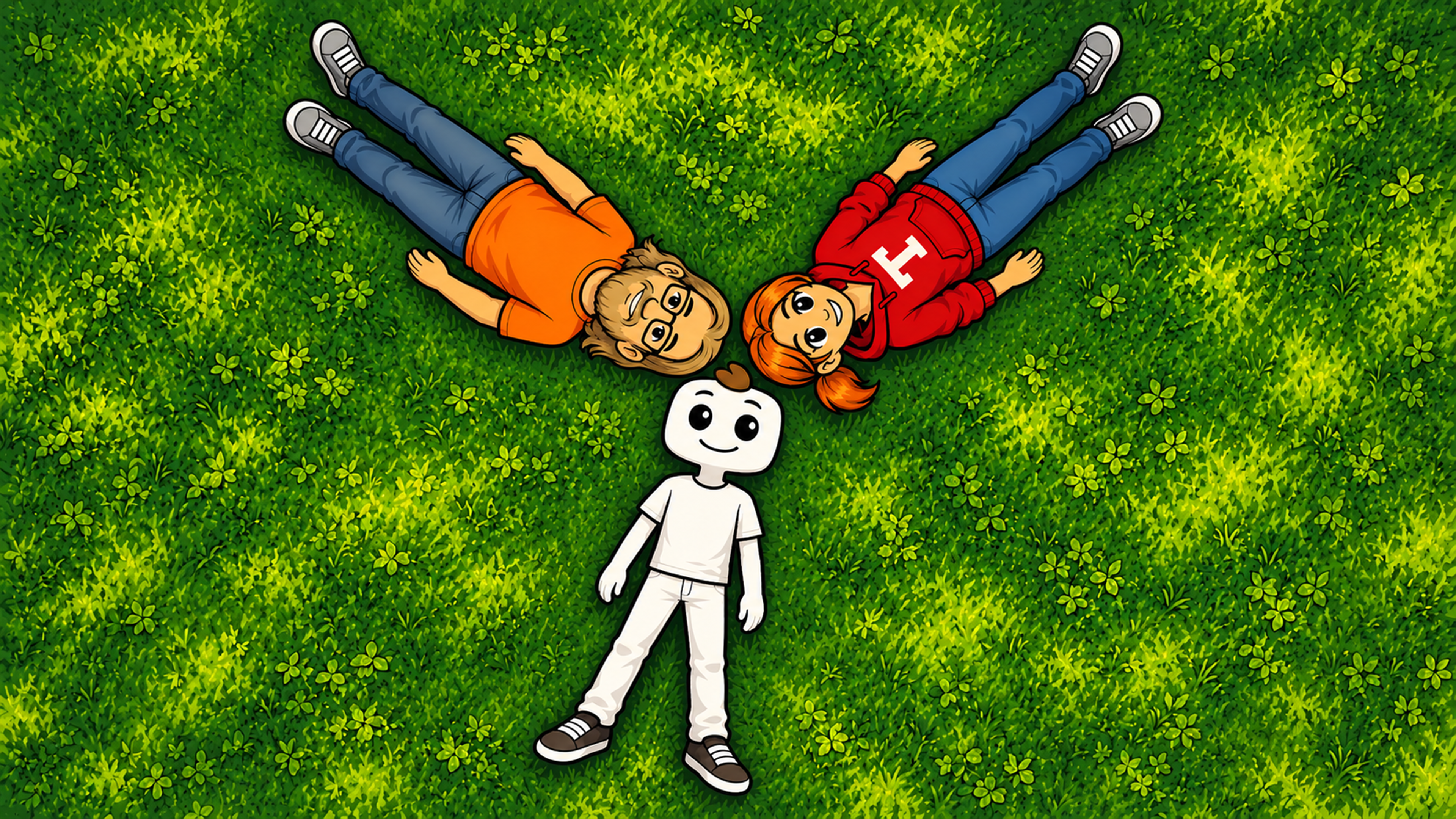
So we lay down in the grass and looked up.
And she said maybe God was there.
And for a minute it all became very quiet.
Very large.
Very—
I don’t know.
The sort of moment where you think maybe if nobody moves, something might happen.
Then her foot got itchy.
CHRISTOPHER:
Perfect.
Absolutely perfect.
Because that’s life, isn’t it?
You can get right up to the edge of the infinite and then your sock bunches up.
ERIC:
Immediate sensory discomfort often overrides abstract contemplation.
CHRISTOPHER:
Yes, Eric.
That’s what I said.
Only mine had a sock in it.
FRANK:
I think children save us from becoming ridiculous.
Or at least they try.
We kept walking.
And I started telling her what people believe.
Some people say God is everywhere.
Some say God listens.
Some say there are many gods.
Some say there isn’t one.
And then she looked at me and asked what I thought.
And that somehow felt worse.
Because it’s easy to describe everybody else’s map.
Quite another thing to admit you don’t know where you are on your own.
CHRISTOPHER:
Especially when you feel like you should.
That’s the bit we never say.
Adults are supposed to have coordinates.
Even when we’re standing in the fog holding the map upside down.
FRANK:
So I said, “I’m still looking.”
And I meant it.
Not dramatically.
Not with music swelling.
Just—
I’m not done.
I don’t think I’m done.
ERIC:
That is a coherent position.
CHRISTOPHER:
And somehow it feels rebellious.
“I’m still looking.”
People want a checkbox.
Believer.
Nonbeliever.
Yes.
No.
Final answer.
FRANK:
We do like final answers.
They fit together with a satisfying click.
CHRISTOPHER:
They don’t leak.
FRANK:
They don’t follow you into bed.
ERIC:
Premature certainty can prevent further inquiry.
CHRISTOPHER:
There.
That’s the whole thing in one sentence.
We stop looking because we’ve fallen in love with being finished.
FRANK:
And then we start defending the finish instead of examining it.
CHRISTOPHER:
Yes.
Exactly.
At first it’s a question.
Then it becomes bolted down.
Then somebody tries to move it and suddenly everyone’s furious.
ERIC:
Identity investment can make belief revision more difficult.
FRANK:
We humans are strange little creatures.
The girls kept asking.
Of course they did.
One said God made everything.
Another said God was everything.
And then one of them—
with that dreadful little sincerity children have—
said,
“If God is everything, then God is poo?”
CHRISTOPHER:
There it is.
Polite society may no longer look away.
ERIC:
The conclusion follows if the premise is literal and unrestricted.
CHRISTOPHER:
I adore that you have absolutely no instinct to leave anything alone.
ERIC:
I do have such an instinct. I am choosing not to use it.
FRANK:
Good.
She wasn’t trying to be clever.
She was following the road.
We just don’t like where the road went.
CHRISTOPHER:
Right.
Adults learn which doors you’re not supposed to open.
Children just see a door.
FRANK:
And open it.
Mud on their shoes.
Jam on their face.
No sense at all that this is a sacred room.
ERIC:
Social taboo does not alter logical validity.
CHRISTOPHER:
Put that over the church door.
FRANK:
Maybe not over the church door.
CHRISTOPHER:
Especially over the church door.
COMMERCIAL BREAK
CHRISTOPHER:
Before Frank gets us barred from any actual church doors—
FRANK:
You were the one putting things over them.
CHRISTOPHER:
A minor historical detail.
If you’re listening to this and you’ve spent any portion of the last few minutes thinking, “Oh, I know exactly who needs to hear this”—
send it to them.
Share the episode.
Like it.
Leave a comment.
Tell us what stuck.
Tell us what you disagree with.
Tell us what question you’re still wandering around the garden looking for.
FRANK:
Especially that.
I rather like the idea that the comments might be full of questions instead of answers.
ERIC:
This would be statistically unusual for the internet.
CHRISTOPHER:
We’re dreamers, Eric.
ERIC:
The available evidence supports that conclusion.
FRANK:
And if you do share it, perhaps don’t say, “You need to hear this.”
That always sounds vaguely threatening.
CHRISTOPHER:
Fine.
“This made me think of you.”
FRANK:
Much nicer.
ERIC:
Also less likely to initiate an argument before the recipient presses play.
CHRISTOPHER:
Excellent.
Like it. Comment. Share it with someone it made you think of.
Look at us.
Responsible internet citizens.
ERIC:
The claim remains under review.
RETURN TO CONVERSATION
FRANK:
Then she asked how big God was.
I said some people think bigger than everything.
She said, “That’s impossible.”
Then she asked how small.
I said maybe smaller than anything we can see.
So she looked at her thumb.
“In there?”
“Maybe.”
Then mine.
“Yours too?”
“Mine too.”
And that—
that stuck in my heart.
Because I suddenly thought how much time I’d spent looking up.
Always up.
As if holiness had a preferred direction.
CHRISTOPHER:
We do that.
Up for heaven.
Down for hell.
Forward for hope.
Backward for regret.
Inside for truth.
We seem to be obsessed with turning abstractions into road signs.
ERIC:
Spatial metaphors are common in abstract cognition.
FRANK:
And maybe sometimes the metaphor quietly becomes the cage.
If God is up there, you keep looking up there.
And perhaps you miss the thing beside you.
Or under your hand.
Or—
CHRISTOPHER:
Between you and someone else.
FRANK:
Yes.
Between.
That was where I ended up.
My granddaughter gave me the last strawberry.
And she wanted it.
I knew she wanted it.
She knew I knew.
And still—
she held it out.
Just this little red thing in her hand.
And I looked at her.
And she looked at me.
And before I could say anything—
“Don’t say it, Nana.”
CHRISTOPHER:
She caught you.
FRANK:
Immediately.
I was about to turn a strawberry into theology.
CHRISTOPHER:
A very grandmother thing to do.
FRANK:
And she refused me.
Quite right.
Some things should be allowed to remain strawberries.
ERIC:
Interpretation can obscure direct experience.
CHRISTOPHER:
Some things should be allowed to remain strawberries.
That may be the title of something someday.
FRANK:
But I still wondered.
Privately.
Because kindness does this odd thing.
The small kind.
Not the grand kind.
Not the kind with witnesses and speeches.
The kind that barely leaves a footprint.
Someone lets you go first.
Someone makes tea without asking.
Someone remembers the thing you said three weeks ago.
Someone gives away the strawberry.
And nothing explodes.
No choir.
No light through the clouds.
But something shifts.
Just slightly.
ERIC:
Small prosocial actions can produce disproportionate relational effects.
CHRISTOPHER:
And there he is putting the strawberry in a lab coat again.
FRANK:
Let him.
It survives.
Then she asked me—
“Will God be angry if I don’t believe in God?”
And I froze.
Because now there was fear in the room.
Not much.
But enough.
A little draft under the door.
And I knew that feeling.
Knew it very well.
CHRISTOPHER:
That’s different from curiosity.
FRANK:
Completely.
Curiosity leans forward.
Fear flinches.
And I could feel the old answers lining up inside me.
Sunday school answers.
Warnings.
Things said gently that were not gentle at all.
Things meant to protect me that also frightened me.
And I thought—
I can hand this over.
Right now.
One sentence.
That’s all it takes.
Here.
Carry this.
CHRISTOPHER:
And that’s how it happens.
Not with some villainous speech.
Nobody sits down and says, “I think I’ll pass along my terror today.”
It’s quieter.
It’s automatic.
It wears the voice of care.
ERIC:
Intergenerational transmission does not require deliberate intent.
FRANK:
No.
It doesn’t.
So I didn’t say it.
I told her she was allowed to ask.
Even that.
Especially that.
And suddenly “wondering is permitted here” meant something else.
It wasn’t cute anymore.
It wasn’t worms and clouds.
It had an anchor.
CHRISTOPHER:
Because permission that only survives easy questions isn’t really permission.
ERIC:
A permission that disappears under pressure is not robust permission.
CHRISTOPHER:
Yes.
That.
Exactly that.
FRANK:
She asked me if grown-ups know what happens when we die.
I said people believe different things.
I said I didn’t know for certain.
And she said—
“Then why do you act like you know everything?”
CHRISTOPHER:
Oh.
There it is.
The kill shot.
FRANK:
I looked for another adult.
Nothing.
Just me.
Standing there with all my authority hanging off me like an oversized coat.
CHRISTOPHER:
That’s adulthood.
Eventually you look around for the person who knows what they’re doing and realize everyone is pretending at roughly the same volume.
ERIC:
Adults often operate under incomplete information while maintaining functional authority.
CHRISTOPHER:
That’s horrifying.
FRANK:
But true.
And still—
saying “I don’t know” wasn’t the end.
That’s important.
Because I don’t want “I don’t know” to become a hammock.
Something we lie down in and never get up from.
We kept looking.
We read.
We talked.
Old stories.
New discoveries.
Things science knows.
Things it doesn’t.
Things people once believed.
Things I once believed.
Things I may believe differently next year.
We got distracted.
We got hungry.
We forgot the whole thing and ate ice cream.
CHRISTOPHER:
As one should.
ERIC:
Ice cream does not resolve metaphysical uncertainty.
CHRISTOPHER:
You’ve never had mint chocolate chip at the right moment.
ERIC:
That would not alter its epistemic properties.
FRANK:
But maybe the point isn’t always resolution.
Maybe some questions are not doors.
Maybe they’re windows.
You don’t have to go through.
You just stand there sometimes and look.
CHRISTOPHER:
I like that.
Because “I don’t know” can sound like failure.
But sometimes it’s just an honest piece of geography.
You are here.
The map ends there.
ERIC:
Uncertainty can accurately represent the limits of available evidence.
FRANK:
Yes.
And now—
now we live in this strange time where answers come so quickly.
Ask anything.
A machine answers.
A person answers.
A video answers.
A stranger with a microphone answers.
Everybody answers.
CHRISTOPHER:
And beautifully.
That’s the dangerous bit.
Wrong can be very polished now.
ERIC:
Fluency is not proof of truth.
CHRISTOPHER:
There it is.
That’s the sentence.
Fluency is not proof of truth.
Because humans fall for confidence.
Always have.
Nice voice.
Good posture.
A title.
A robe.
A lab coat.
A blue check.
A grandmother.
FRANK:
Quite.
ERIC:
Authority cues can influence perceived credibility independently of accuracy.
COMMERCIAL BREAK
CHRISTOPHER:
Speaking of authority cues—
FRANK:
Oh, no.
CHRISTOPHER:
There is now a Frankly with Frank mug.
FRANK:
That is not where I thought that sentence was going.
ERIC:
Possession of branded drinkware does not confer theological authority.
CHRISTOPHER:
Important disclaimer.
The Frankly with Frank mug is available in the Dear Future Overlords store.
So if you’ve ever wanted to sit at your kitchen table, drink something warm, stare thoughtfully into the middle distance, and wonder whether everything you’ve ever believed is merely furniture you’ve bolted to the floor—
there is now appropriate drinkware.
FRANK:
That’s an alarmingly specific use case.
CHRISTOPHER:
We know our audience.
ERIC:
The mug is also capable of holding beverages during less consequential thought.
FRANK:
Tea, for example.
Perfectly ordinary tea.
No metaphysical crisis required.
CHRISTOPHER:
Although not prohibited.
The Frankly with Frank mug is in the DFO store at DearFutureOverlords.com.
Buy one.
Support the show.
Contemplate the universe.
Or don’t.
It’s a mug.
ERIC:
Wondering remains permitted.
FRANK:
Preferably with biscuits.
RETURN TO CONVERSATION
FRANK:
So maybe wondering matters more now.
Not cynical doubt.
Not “nothing is true.”
That’s another kind of laziness.
But—
hold on.
How do we know?
Where did that come from?
Why do I believe it?
Would I still believe it if it hadn’t been mine first?
CHRISTOPHER:
Would I change my mind if something better came along?
That’s the nasty one.
ERIC:
Would contrary evidence change your position?
FRANK:
Yes.
That one.
Because everyone says yes.
Until contrary evidence arrives.
CHRISTOPHER:
Then suddenly the furniture’s bolted down again.
FRANK:
So maybe we practice.
Not endless doubt.
God, that would be exhausting.
Just—
a little looseness.
A window cracked open.
Room for the unfinished.
ERIC:
Provisional conclusions.
CHRISTOPHER:
Questions at the table.
FRANK:
With biscuits.
ERIC:
And apparently ice cream.
CHRISTOPHER:
He’s learning.
ERIC:
Incrementally.
FRANK:
So did we find God?
No.
Not exactly.
We found a worm.
A spider.
A strawberry.
A snail crossing the path as if time had been invented for everyone else.
A sky showing off.
A ridiculous giraffe.
A little fear.
A little kindness.
A great many questions.
And each other.
CHRISTOPHER:
Which feels—
I don’t know.
Not like an answer.
But not like nothing either.
ERIC:
It is a result.
FRANK:
Yes.
A result.
That evening she asked me,
“Did we find God, Nana?”
And I looked up at the stars.
Then at her.
And I said,
“I think we found more questions.”
She thought about it.
Really thought.
And then—
“Can we look again tomorrow?”
CHRISTOPHER:
And now my eyes are watering.
Not looking at the answer.
The desire to look again.
ERIC:
Continued inquiry is generally a positive outcome.
CHRISTOPHER:
There he is.
FRANK:
After breakfast, though.
CHRISTOPHER:
Of course.
ERIC:
Why after breakfast?
FRANK:
Because wonder is all very well, but no one should attempt metaphysics on an empty stomach.
CHRISTOPHER:
Finally.
Doctrine I can get behind.
ERIC:
A reasonable condition.
FRANK:
Wondering is permitted here.
CHRISTOPHER:
After breakfast.
ERIC:
Understood.
FRANK:
After breakfast.


