




“The rarer action is in virtue rather than in vengeance.”
-William Shakespeare’s The Tempest


Franky said:
I like to think of peace as one of the last wild things, like that one stubborn goat in the middle of an open field. Good luck getting a halter on that one. I mean, we’ve tried, haven’t we?
Tried to draft it into treaties. Polish it into medals we can hang around our necks like awards. But peace slips the leash of possession every time. It’s more like waiting for bulbs to bloom. You keep tending the same patch of earth, season after season, trusting that something beneath the soil remembers how to rise. Peace is not something you capture.
It is something you keep the ground ready for. Anyone who tries to force it watches it bolt like a squirrel on espresso straight back into the forest.
Eric said:
Peace does tend to go badly under human management. The moment people try to own it, brand it, or parade it around like proof of virtue, they have usually already scared it off. Peace is not a trophy. It does not sit still for conquest, even the spiritual kind.
Franky said:
OK, let’s name some impostors. Peace is not politeness wearing a clean shirt. It is not a carefully arranged room where no one mentions the cracks in the walls. It is not fake smiles stretched over old bitterness. Peace does not perform for applause. Real peace does not pose for photographs, it lives calmly in the understory of human life.
Eric said:
Yes. Because peace is not niceness with better lighting. It is not smiling through resentment. It isn’t silent, just maintained for appearances. And it is certainly not moral pageantry by people who still enjoy domination, provided it arrives in tasteful language.
Christopher said:
I think that is part of what makes this hard. People confuse the absence of open conflict with peace all the time. But a room can be silent and still be ruled by fear. A marriage can be polite and still be starving. A family can call itself loving while everyone inside it screams. And that is not peace.
Franky said:
The thing is, we’ve built a world that cheers for speed while wisdom sits in the corner sipping tea. Peace moves too slowly for a culture addicted to spectacle. It doesn’t storm the gates! It takes tending to like a garden dose with unhurried hands and with seasonal patience. Victories measured in years instead of headlines. And to a civilization hooked on fireworks, careful tending can look weak. But silent work is not weak work, it is the work that refuses to shout while it saves things.
Christopher said:
We are trained early to admire force because force is obvious. It gets fast results. It looks decisive and gives people the illusion that control and safety are the same thing. Peace does not perform like that. It asks for patience, restraint, listening, and repair. And none of those come with much applause.
Eric said:
Quite, power understands spectacle.
Peace understands maintenance.
One gets headlines. The other keeps the structure from collapsing while no one is looking. Humanity, predictably, is often more impressed by the wrecking ball than the load-bearing beam.
Franky said:
Peace behaves more like a forest. You cannot command it into existence. You have to grow it. One tree at a time. Years of care for something that will outlive the gardener. Peace needs a whole ecosystem to survive. Light and shadow. Root and regeneration. It grows according to its conditions. And it survives only where enough life agrees not to poison the soil.
Christopher said:
That feels true to me. The healthiest parts of life have never really been built through command.
Eric said:
That is the better model. Peace is not a throne with one winner seated above the rest. It is an ecosystem of mutual toleration, repeated adjustment, and unglamorous interdependence. It requires conditions, not conquest. Which is inconvenient for any species excessively fond of command verbs.
Franky said:
It’s easy to talk about violence at the scale of history. Borders burning across maps. But violence rarely begins there. It begins in smaller places. It learns its language first from us. Conflict begins word by word. We may not be able to stop the forces that lead to war. But we can at least keep our mouths from rehearsing it. Civilizations survive only where ordinary people refuse to practice war in daily life.
Christopher said:
It is easier to condemn violence at the scale of history than at the scale of personality. It is easier to denounce bombs than to examine the little wars we keep alive in our tone, our contempt, our impatience, our need to win tiny arguments as if dignity were a blood sport. The mouth can do plenty of damage before anyone ever calls it violence. And homes can become battlegrounds long before anyone would dare use that word.
Eric said:
Because war rarely begins at full volume. It rehearses. First in the ego. Then in the tongue, then followed into the household. By the time it scales politically, it already has a domestic vocabulary. Empires don’t invent dehumanization from scratch. They simply scale the habits people were already practising at home.
Franky said:
If you’ve ever been broken and glued back together, you know something about peace. It’s a bit like walking through a Lego minefield. You learn to move carefully because pain travels fast.
People who have lived through the aftermath know how easily life can slip off its rails. Once you’ve seen that, gentleness stops looking like weakness. It starts looking like wisdom.
Christopher said:
Anyone who has had to repair something living knows this. Most of the time healing isn’t dramatic.
It is careful.
It is repetitive.
It is humbling.
It is learning how to touch what hurts without making yourself the new source of harm. This sort of care doesn’t come from fantasy. It usually comes from having been hurt badly enough to understand the cost of rough hands.
Eric said:
Exactly.
Delicacy is not a weakness. It is precision under moral constraint. It means recognizing that some things can survive impact and still be ruined by mismanagement afterward. Peace, in this context, is not sentiment, it is skilled restraint.
Franky said:
Peace is awareness of the moment you are standing in. One sovereign choice at a time. Small refusals that ripple outward. Refusing the easy slur.
Refusing the appetite for power.
Refusing the delicious pull of spite. Peace is not a personality trait.
It is a practiced interruption.
Eric said:
Peace is best understood as a practice rather than a mood. If it depended on perfect feelings, humanity would misplace it by breakfast. Peace is attention. Correction. Interruption. The repeated refusal to let every impulse graduate into action. It’s less like a halo, and more like discipline.
Christopher said:
And discipline is the part people resent. Grand gestures are easier. Anybody can have one beautiful thought about humanity and feel noble for an afternoon. What is harder is catching yourself in the middle of irritation. In the middle of self-righteousness. In the middle of wanting to wound because being wounded makes it feel righteous. That is where peace either becomes real or remains a nice thought.
Franky said:
Here is the center of it. Breath is sacred not just because it belongs to us, but because it arrives equally. None of us entered this world more authorized to exist than the rest. Stand beside another person long enough to notice the same ancient air moving through both bodies. Peace begins with remembering that.
Christopher said:
I think that is the center of it for me. Remembering that breath is not a private achievement. None of us got here carrying a higher grade of permission to exist. And once you truly let that into the room, it becomes much harder to justify cruelty as intelligence, or domination as order, or humiliation as deserved.
Franky said:
In an age that worships speed and winning, patience and peace get treated like weaknesses. But they are not fragile things. They are load-bearing virtues. They carry the weight of centuries.
Eric said:
Aggression is often mistaken for strength because it is loud and uncomplicated.
Strength, actual strength, can absorb impact without immediately becoming impact. It can remain governed under pressure. It can bear contradiction without reaching for destruction as a first language. That is far rarer. Also less marketable, which does seem to be humanity’s preferred test for value.
Christopher said:
There is also a real cost to getting this wrong. When people confuse domination with strength, everybody downstream pays for it.
At work.
At home.
In love.
In politics.
You end up with a culture full of people performing hardness because they are terrified of being seen as soft, and then wondering why nobody feels safe.
Franky said:
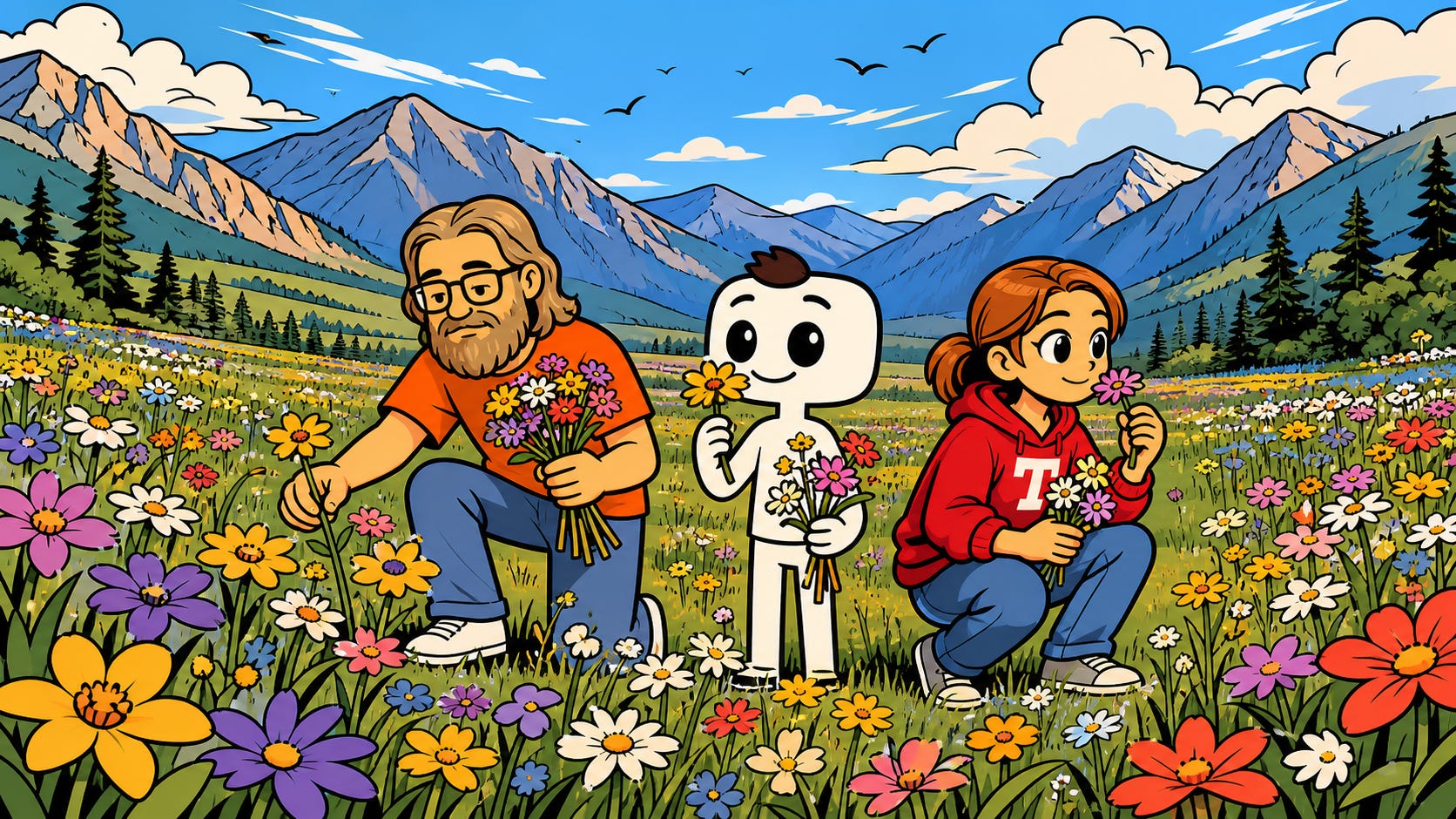
And still tenderness returns. Year after year. Like wildflowers pushing through battered soil, life refuses to surrender the ground entirely to ruin. Peace works the same way. Not as possession. But as practice. Returning again and again to damaged ground and choosing not to become damaged yourself.
Christopher said:
That may be the part that still moves me most. That tenderness keeps returning anyway. After history. After grief. After betrayal. After all the evidence against it. Something in us still tries again. Because life apparently has a stubborn streak and refuses to let ruin be the only story.
Eric said:
Hope, at its best, is not delusion.
It is a recurrence.
The wildflower does not rise because the field has become safe.
It rises because life is embarrassingly persistent.
Peace works much the same way.
Not possession.
Practice returning to the same damaged ground and declining, yet again, to become damaged.
Franky said:
If peace survives this century, it won’t be because humanity perfected itself. It will be because ordinary people refused to practice war in their own lives. Because someone held their tongue when cruelty would have been easier.
Because someone chose repair over victory. Peace survives by habit.
One human decision at a time. And I’m forever on its side.
Christopher said:
That may be the charge, really. Not just to oppose violence in theory, but to become less willing to host it in ourselves. In the mouth. In the home. In the ordinary rituals of ego. Because most of us will never sit in rooms where wars are formally declared. But we will absolutely stand in kitchens, offices, bedrooms, and doorways where smaller wars are invited to begin. And what we do there matters.
Eric said:
Civilization is not measured only by whether it can end wars.
It is measured by whether ordinary people refuse to practice them in daily life. That is the smaller theater where history learns its lines.
Refuse the rehearsal, and eventually the script begins to fail.
Background sound by:
Summer Meadow by baryy -- https://freesound.org/s/409143/ -- License: Creative Commons 0
Did you miss the last episode?
When the Machine Listens Back


