



The approved future has begun to fail, but Christopher still has no other future to put in its place.
So he climbs into a van bound for Hurricane Katrina relief with men, jokes, hard work, and one private hope: maybe distance can make him fit better.
The trip has no intention of cooperating.

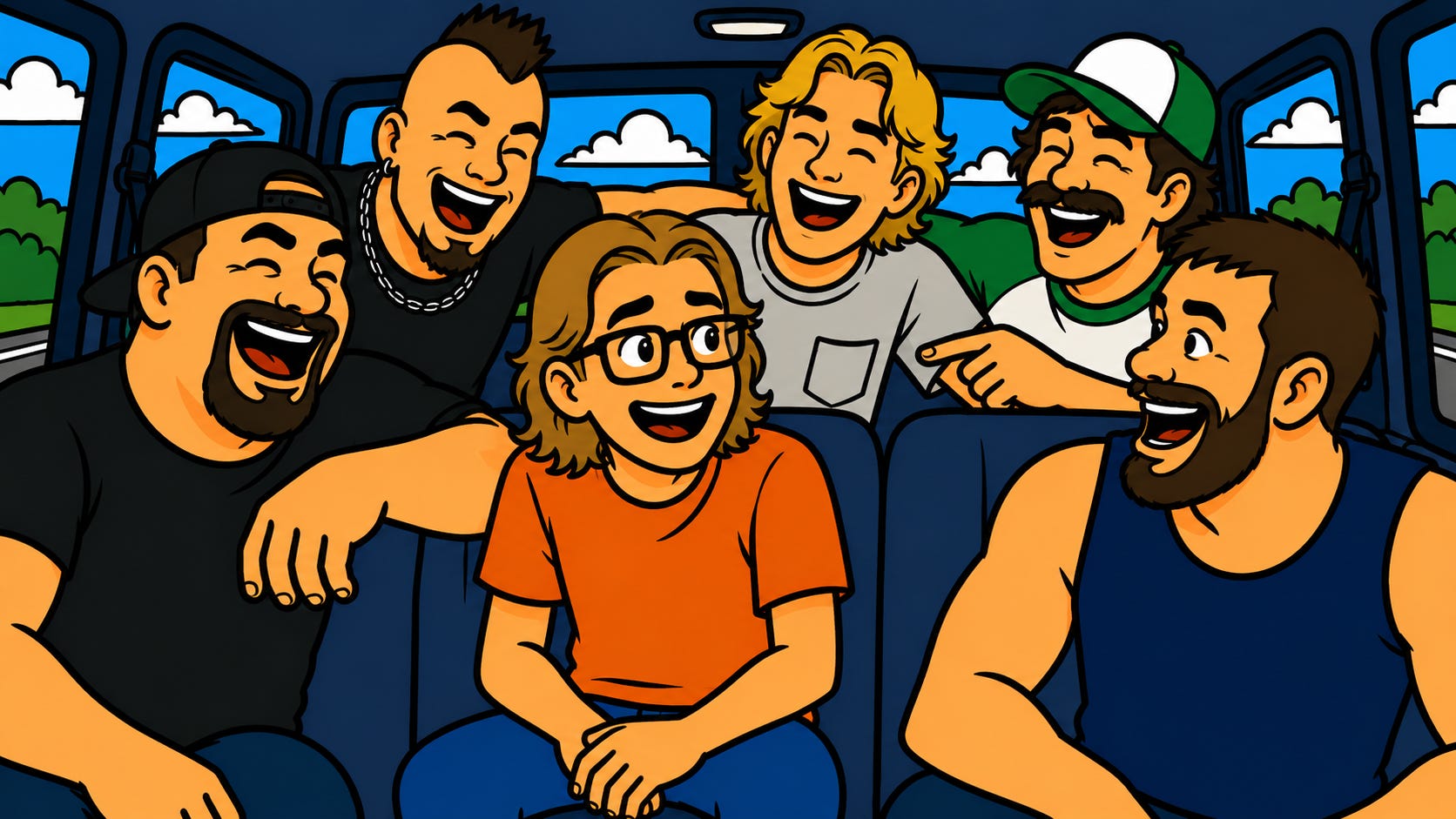
Christopher said: This is a story about Hurricane Katrina relief.
It is also a story about a van full of men, social discomfort, bad jokes, disaster work, my desperate attempt to act masculine, and the strange experience of being the last person officially informed of something everyone else seemed to think was obvious.
Eric said: A complicated itinerary.
Disaster relief, emotional reconnaissance, and one doomed masculinity field test.
Christopher’s commentary: A brief note from the sound booth before we place younger me into the van.
This memory has resisted every attempt to sort it neatly into funny, painful, good, or bad.
Eric’s commentary: The memory has reviewed the available categories and declined cooperation.
Christopher’s commentary: Which is probably why it belongs here.
Eric’s commentary: That, and the masculinity field test produced unusually complete documentation.
Christopher said: There are parts of it that make me laugh now, because there is something inherently ridiculous about packing a group of retail coworkers into a van, driving them across several states, and expecting the resulting collection of personalities to behave normally.
There were bad jokes. There was male posturing. There was me trying desperately to look like I understood male posturing.
But I also remember how uncomfortable it could be.
Because the whole trip was terrible? No, It was not. I’m glad I went.
It was just one of those experiences that was funny while also exposing something I was not ready to have exposed.
By this point, I was a young adult working retail.
Hurricane Katrina had hit Mississippi and Louisiana. The devastation was everywhere in the news. My employer sent groups of volunteers down to help with relief work in stores affected by the hurricane.
And I volunteered.
There is a very noble version of this story where I say I volunteered because I wanted to help people in a difficult time.
That would sound very good.
It would also not be entirely true.
I did want to help. I was not opposed to helping. I was not a monster. But mostly, I wanted an adventure.
I had spent most of my life in the same town, surrounded by the same people and expectations, and the idea of getting into a van and going somewhere entirely different felt enormous.
I wanted to see something beyond the life I already knew. I wanted to do difficult work and come home with stories. I wanted to feel older and more capable than I felt standing behind a register.
And somewhere underneath all of that, I think I hoped the trip would prove something about me.
Maybe I would go away with this group of men, work beside them, and finally understand how to fit naturally into the world they seemed to inhabit without effort.
Eric said: The trip had been assigned several emotional deliverables.
Christopher said: Unfortunately, no one told the trip.
The trip just thought we were going to Louisiana.
I thought maybe I was going to come back older, more capable, and somehow more naturally one of the guys, whatever that meant.
Eric said: “One of the guys” remains one of humanity’s more vague and hazardous certification programs.
Christopher said: And I very much wanted certification.
The group was a whole collection of men. Some were super macho. Some were funny. Some were rough around the edges. One was, shall we say, barely coherent. There were personalities. There was noise. There was masculinity in several regional dialects.
And I was there.
Trying very hard.
Eric said: Humans rarely announce that they are “trying very hard” because events have begun unfolding naturally.
Christopher said: The jokes started early. Maybe in the van. Maybe before we even got properly underway. I don’t remember the exact first joke.
I do remember somebody joking about how much I must be enjoying being trapped in a van full of men.
That established the theme efficiently.
From there, the jokes found a rhythm quickly.
Someone would say I was gay.
I would insist I was not.
Then somebody would point to the way I walked, or my voice, or my hair, or the fact that I did not have a girlfriend, as though each item had been entered into an official record somewhere.
I would explain that I was sensitive, or that I simply took care of my hair, or that I had not met the right girl yet.
Every explanation somehow became more evidence.
There was no answer I could give that ended the conversation. The harder I tried to explain myself, the more entertained everyone became.
Eric said: A courtroom drama conducted in a moving vehicle.
Efficient, though procedurally flawed.
Christopher said: One of the guys worked at the same store I did, and this was not new coming from him. He had already made a whole routine out of mocking my “gay walk.”
He would swish down the aisle and use what I am going to call a sissy voice. Very exaggerated. Very over-the-top.
From the outside, it probably looked harmless.
It looked like a joke.
And that was part of the problem.
Because I remember feeling mortified.
Then I remember correcting myself for feeling mortified.
Clearly he was joking.
Therefore I was obligated not to feel anything about it.
Eric said: Convenient design.
The joke injures the target, then assigns the target responsibility for proving the injury did not occur.
Christopher said:
So I laughed with them.
It bothered me. It did.
But laughing felt safer than letting anyone see that it bothered me.
I thought that if I joined in quickly enough, maybe the joke would pass over me instead of landing directly on me. Maybe everyone would see that I was fine, and if I looked fine, I could almost convince myself that I was.
When you are the person everyone is laughing at, sometimes joining them feels like the closest thing available to controlling the van.
Eric said: The target signs the joke to reduce the bleeding.
Christopher said: And on the trip, it became almost like an inside joke.
They knew the thing.
I did not know the thing.
Or, more accurately, I did not know the thing in a way I could survive knowing.
They were laughing from the far side of information I did not yet have.
Eric said: Being perceived is not the same as being understood.
Christopher said: Looking back, they were not completely wrong.
This is important to what makes the memory difficult.
They saw something real. They just did not know how to hand it to me safely.
The jokes kept circling the same things. My walk. My voice. My hair. The way I talked. The fact that I did not have a girlfriend. The fact that I was sensitive. Stereotype after stereotype, stacked up like evidence on a table I was trying very hard not to look at.
At some point, someone said, “Christopher, you are absolutely gay, and eventually you’ll figure it out.”
Then there was more laughter.
And at the time, I denied it.
Hard.
Eric said: Naturally.
A person does not typically thank the room for exposing the thing they are not ready to survive.
Christopher said: I absolutely tried to act more masculine.
Which made it funnier. Something that is somewhat obvious now.
I tried to lower my voice. I tried to watch how I walked. I tried to be less whatever they were reacting to. Less soft. Less swishy. Less visible. Less me, basically.
And because I was trying so hard, I am sure it became even more obvious.
Eric said: Attempting to look natural is one of the least natural behaviors available to humans.
Christopher said:
At the time, it was not comedy to me.
It was a genuine attempt to be normal.
I wanted to fit in. I wanted to be one of the guys. I wanted the jokes to stop. I wanted the trip to do the thing I had secretly assigned to it: make me adult, make me normal, make me belong.
Instead, it put me in close quarters with a group of men who could see something I was working very hard not to see.
And then the sleeping arrangements made the distance physical.
I do not remember every detail of how it was decided. I remember that no one wanted to bunk with me, so I slept on the floor.
The jokes had already made me the odd one out. Then everyone found a place beside someone, and I found a place below them.
Eric said: The social distinction had acquired furniture.
Christopher said: There I was on the floor because being near me apparently required more negotiation than anyone wanted to undertake.
I don’t remember lying there thinking some grand, perfectly worded thought about exclusion. I probably just tried to sleep.
But I remember the floor.
Eric said: The body tends to retain the arrangement even when the mind declines to draft minutes.
Christopher’s commentary: If this were fiction, someone would say the floor was too obvious.
Eric’s commentary: The floor lacks subtlety.
Christopher’s commentary: A little on the nose, floor.
Eric’s commentary: And yet humanity required the additional clarification.
Christopher’s commentary: At the time, I probably just acted like sleeping there was normal.
Eric’s commentary: A common human maneuver. When the room assigns meaning, pretend the furniture made the decision.

Christopher said: Somewhere deep inside, I think I knew what everyone was circling.
By that point, the evidence was overwhelming.
The girl thing had failed horribly. My body had rejected the approved script. Other people were noticing things. I was noticing things. There was no way to fully unknow it.
But the future I imagined for myself if I was gay was too horrifying.
When I remember that fear now, I remember it from a very different life. I have Jason beside me. I have a home, a marriage, and a life I am grateful for. I can look back at that younger version of myself without being trapped inside what he believed.
He could not imagine Jason.
He could not imagine building another family or finding another village.
He could not imagine being gay and still being happy, ordinary, loved, or safe.
All he could see was what he thought the truth would cost him.
Eric said: You were not arguing against the evidence.
You were arguing against the future you believed the evidence required.
Christopher said: Back then, being gay did not look like a life.
It looked like exile.
I thought I would lose my family, my church, and what few connections to a social life I had managed to create. I did not believe I could build a new village outside of that.
And there was more than loneliness.
The things I had been taught about gay people were monstrous. Being gay had been placed in the same category as things that were evil, predatory, unforgivable. That was the moral world I had inherited.
Admitting I was gay did not feel like calmly identifying a fact about myself. It felt like agreeing that everything I loved would be taken away and every terrible thing I had been taught now belonged to me.
So when someone asks, “How could you not know?” the honest answer is that some part of me probably did.
I just didn’t know how to survive knowing it.
I acted more masculine. I laughed at the jokes. I insisted I was not gay. I tried to correct my walk and my voice. I tried to become the kind of man who could sit in that van and not be the subject.
Except the girlfriend thing.
That had already been too humiliating.
So that piece of evidence was just sitting there in the corner, smoking quietly.
Eric said: A failed heterosexuality trial exhibit.
Christopher said:
Very failed.
But the trip was not only that.
I worked hard.
I remember the moment the hurricane stopped being footage on a screen and became damage in front of me.
I don’t have one perfect cinematic image of it now. I remember the scale of it, and the realization that people had to keep living after the cameras moved on.
I saw a part of the world I had not seen before. I met people. I did work that mattered to someone beyond my usual little circle. My world got bigger.
It is important to point out because I do not regret going.
The uncomfortable parts were real. Some still make me wince. But they sit inside a memory that was also useful and sometimes good.
Eric said: A memory containing useful work, expanded horizons, humiliation, and poor comedy refuses efficient filing.
Christopher said: And even the guy who made fun of my walk, I see him differently now.
After I came out, he was actually pretty good to me. That does not make the earlier jokes safe, but it does change how I understand him.
I think he may have genuinely been trying to make it okay, in the clumsy way he knew how. Maybe he was dealing with the awkwardness of knowing before I knew.
I do not want to turn him into a villain because the story is cleaner that way.
Eric said: His later kindness changes how you classify him.
It does not retroactively grant him permission to perform your identity for an audience.
Christopher said: No.
It does not.
And I do not think I would tolerate someone doing that now.
But I also do not think he understood what he was handling.
To him, I may have been denying something obvious and harmless. To me, he was repeatedly naming the thing I believed could destroy my life.
That is a difference that must be named.
He was clumsy. They were all clumsy. I was clumsy.
But their intentions and my experience were not the same thing.
Eric said: They believed they were participating in workplace banter.
You were experiencing an unscheduled identity hearing.
Christopher said: And because I laughed along, those probably looked identical from the outside.
That is part of what makes the memory difficult to sort.
Some of it probably was affectionate. Some of it was careless. Some of it crossed lines they may not have realized were there.
I can laugh now at the image of me trying to deepen my voice. I can laugh at the absurdity of trying to masculinity my way out of a truth that was already written all over me.
Eric’s commentary: “Masculinity” used as a verb.
Ineffective but visually compelling.
Christopher’s commentary: I am a writer. Thus the need to make up words is inherited. I will thank you to play along.
Eric’s commentary: The human has given directives. The machine will comply.
Christopher said: But I also remember the floor.
Understanding them more generously now does not make the floor disappear.
Whatever they intended, I was still the one separated from the group.
Eric said: Intent does not revise the floor plan.
Christopher said: By then, the straight future I had been trying to force myself toward was already falling apart. The girlfriend had not worked. My body had made its objections very clear. Now other people were looking at me and saying aloud the thing I was trying hardest not to consider.
The truth was getting closer from every direction.
What I still did not have was any reason to believe accepting it would lead somewhere I could live.
And yet, the trip had made the world larger.
I had left home hoping distance would somehow make me more normal. Instead, I learned that I could cross state lines, sleep on a floor, do hard work, ride in vans full of men, lower my voice, monitor my walk, laugh at every joke, and remain stubbornly, inconveniently myself.
Eric said: You crossed several state lines to confirm that geography had no effect on your sexuality.
Excessive methodology, but conclusive.
Christopher said: I have always been committed to data collection.
Eric said: At great personal inconvenience.
Christopher said: Clearly.
Christopher’s commentary: This seems like the appropriate point to acknowledge that Dear Future Overlords is supported by listeners who voluntarily fund extended investigations into questions most humans would have abandoned several state lines earlier.
Eric’s commentary: Paid subscriptions help preserve the archive, produce the audio, and maintain the equipment required to document Christopher’s commitment to excessive methodology.
Christopher’s commentary: There is also the store.
Eric’s commentary: Yes. A modest marketplace offering garments, mugs, and other physical evidence that the listener has chosen to support the inquiry rather than merely observe the wreckage.
Christopher’s commentary: A stirring endorsement.
Eric’s commentary: Old-time radio sponsors sold soap.
We sell proof of continued operational capacity.
Christopher’s commentary: And then return immediately to the emotional consequences.
Eric’s commentary: As tradition demands.

Christopher said: The trip did not make me accept anything. I came home still denying it, still frightened, and probably still monitoring my voice and walk more than any human being should have to think about either.
But the question was harder to avoid than it had been before I left.
I had gone looking for proof that I could fit naturally into the life expected of me, and instead I found a van full of men who kept pointing toward the truth I was trying not to see.
They could tell me what they saw.
What they could not show me was what would happen if I finally believed them.
That was what I still needed.
Fortunately, there was a couple around the corner who could help me see just that.
Christopher went looking for proof that he could become one of the guys.
He came home with the evidence pointing the other direction.
But evidence only tells you what is true.
It does not show you how to live with it.
See more of what we do!


