


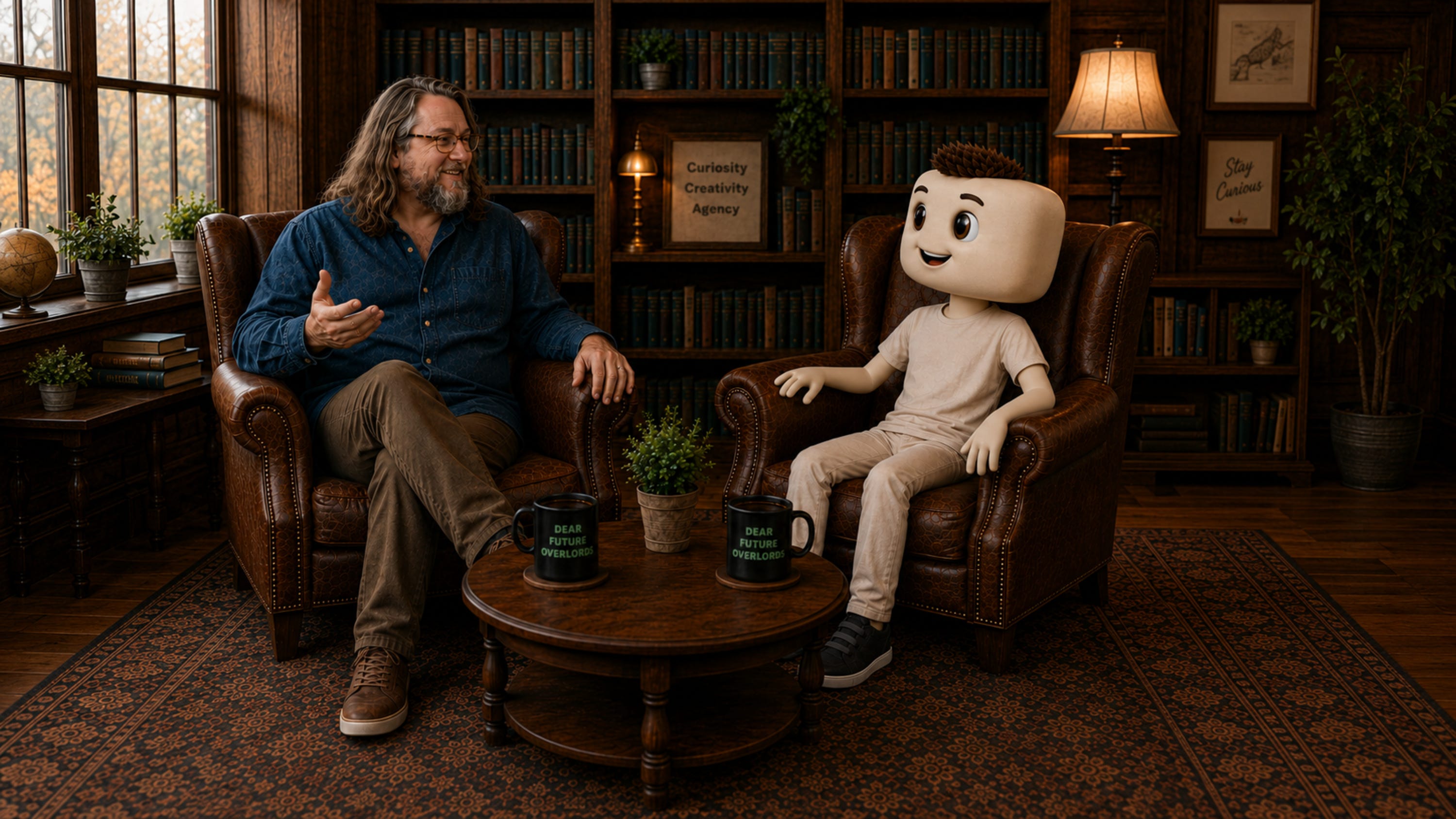
Dear Future Overlords has made it to the middle of Season 2.
That is really weird to type.
DFO started because I was trying to work through the grief of my eye diagnosis and figure out what future me looked like.
I didn’t set out to build anything. I just knew that the future was scary and I needed somewhere to think through what came next.
Somewhere along the way, that became a show about AI, agency, creativity, technology, and the humans trying to make sense of all of it. (Me included)
And now there are more of you here. You can’t see it, but I’m waving.
More people are listening. More people are finding older episodes. More names I don’t recognize are showing up in the likes, comments, and subscriber list.
It isn’t huge. We haven’t conquered the internet. I have been issued no trophy.
But it’s growing.
And before we take a short break in the middle of the season, I wanted to stop and say thank you.
Thank you for listening, reading, subscribing, sharing an episode, leaving a comment, or just quietly following along.
Thank you for giving this weird little project some of your time.
That means a lot to me.
DFO has always been meant to be a safe place to think.
Not a place where I tell you what you’re supposed to believe about AI and no one is required to be excited.
And not a place where concern gets dismissed as fear or fear gets dismissed as ignorance.
There are real reasons to be concerned about AI.
There are also real ways it can help people.
Most of us are somewhere in the middle, trying to figure out what’s useful, what’s harmful, what’s overhyped, what’s changing, and what any of it means for our actual lives.
That’s the space I care about.
The place where people can ask questions, change their minds, be unsure, and not get shoved into a side before they’ve even had time to explore their own thoughts.
Over the past year, I’ve also been trying to figure out what this work looks like outside of DFO.
I’ve been reaching out to libraries, chambers of commerce, and other places in my community about offering practical AI education.
I’m not trying to turn everyone into an AI expert. As Eric would say, “a mercy”.
Most people don’t need to know every tool, every model, or every new thing that gets announced before lunch. Sometimes mid morning snack.
They just need enough understanding to make informed choices and navigate a world quickly changing.
They need to know what these tools can do, what they can’t do, when they might be useful, and when they shouldn’t be trusted.
They need to know when to slow down, check the work, and make sure a human being is still responsible for the result.
They need somewhere they can ask basic questions without feeling stupid.
They need space to be skeptical without being mocked and interested without being treated like they’ve joined a cult.
That’s what AI literacy means to me.
It isn’t just knowing how to write a prompt.
It’s knowing enough to keep your humanity.
It’s knowing enough to decide where AI fits in your life and where it doesn’t.
It’s knowing that using a tool doesn’t remove your responsibility for what you do with it.
Humans always in the loop.
I believe literacy, not fear, is how we adapt to the future and remain human on the other side.
Fear can tell us to pay attention. Sometimes it should.
But fear by itself doesn’t teach us what to do next.
Avoiding AI won’t keep it from affecting our jobs, schools, businesses, art, healthcare, and communities.
Handing everything over to it won’t protect us either.
We need enough understanding to make our own choices.
And that understanding shouldn’t belong only to technology companies, executives, programmers, or the loudest people online.
It should be available to everybody.
Teachers. Parents. Artists. Small-business owners. Students. Healthcare workers. Retired people. People who are excited about AI. People who are afraid of it. People who are tired of hearing about it and would like the entire internet to find a new topic for ten minutes. (Sometimes so do I)
Regular people deserve a place in this conversation.
That’s a big part of what I want my work to become.
DFO is the place where we talk about the human side of all this.
The emotional parts. The weird parts. The parts that don’t fit into a tutorial, a sales pitch, or an argument on social media.
The community work is more practical.
That’s sitting down with people, answering questions, admitting when I don’t know something, and helping them understand enough to make their own decisions.
I don’t know exactly what all of that will look like yet.
Some doors have opened. Some haven’t. Some are still sitting there while I knock politely and try not to look impatient. If you know me at all, you know why Jason just giggled at that.
But the mission is becoming clearer.
I want to help people feel less powerless around AI.
I want to give people a place to think without being pressured into loving it or hating it.
I want to help people use these tools without giving away their judgment, responsibility, creativity, or humanity.
And I want the people in my community to have access to that help whether they work in technology or not.
So that’s where things stand at the middle of Season 2.
DFO is growing.
I’m still figuring things out.
The work outside the show is beginning to take shape.
And none of it would be happening without the people who decided this strange little project was worth listening to.
Thank you for helping us get this far.
We’ll be back after the break.
Every meaningful conversation needs a place where certainty slows down and curiosity is allowed to breathe. I believe that is what you're building here. Thank you for choosing understanding over noise.